Can You Use Exterior WPC Fluted Panels for a Privacy Fence?
Modern privacy fencing is no longer simply about enclosing a property. For many homeowners, architects and landscape designers, a privacy fence is an architectural feature that complements the residence and outdoor living spaces. Exterior wood-plastic composite (WPC) fluted cladding, with its vertical grooves and wood-inspired finishes, can create an attractive modern fence appearance.
But can exterior WPC fluted wall panels actually be used for a privacy fence? Potentially, yes—as a decorative finish on a properly designed fence or privacy-screen structure, provided the exact product and installation are suitable. Decorative wall cladding should not automatically be treated as a freestanding, structurally rated fence system. Posts, supports, foundations and connections must withstand wind and other applicable loads.
USA Builders Depot offers exterior fluted WPC wall panels in Brown Walnut, Golden Teak, Charcoal/Black and Ash Gray. This guide covers the product distinction, structural support, gate and trim planning, material quantities and design ideas.
What Is WPC Fluted Fence Cladding?
WPC stands for wood-plastic composite, a manufactured material combining wood-derived components, polymers and other additives. WPC products can include exterior wall cladding, decking and purpose-designed fencing systems; these applications are not interchangeable. Fluted decorative panels feature parallel grooves that create architectural texture and shadow lines.
Decorative Cladding vs. Structural Fence Panels
A purpose-designed fence system may include engineered boards, posts, rails, connections and installation requirements. Decorative exterior wall cladding is primarily a finish for an approved supporting surface and may not be designed to span unsupported distances between posts. Where proposed for a fence, the complete structure—not the decorative panels alone—must provide the required structural performance.
Why Use Fluted WPC Panels for a Privacy Fence?
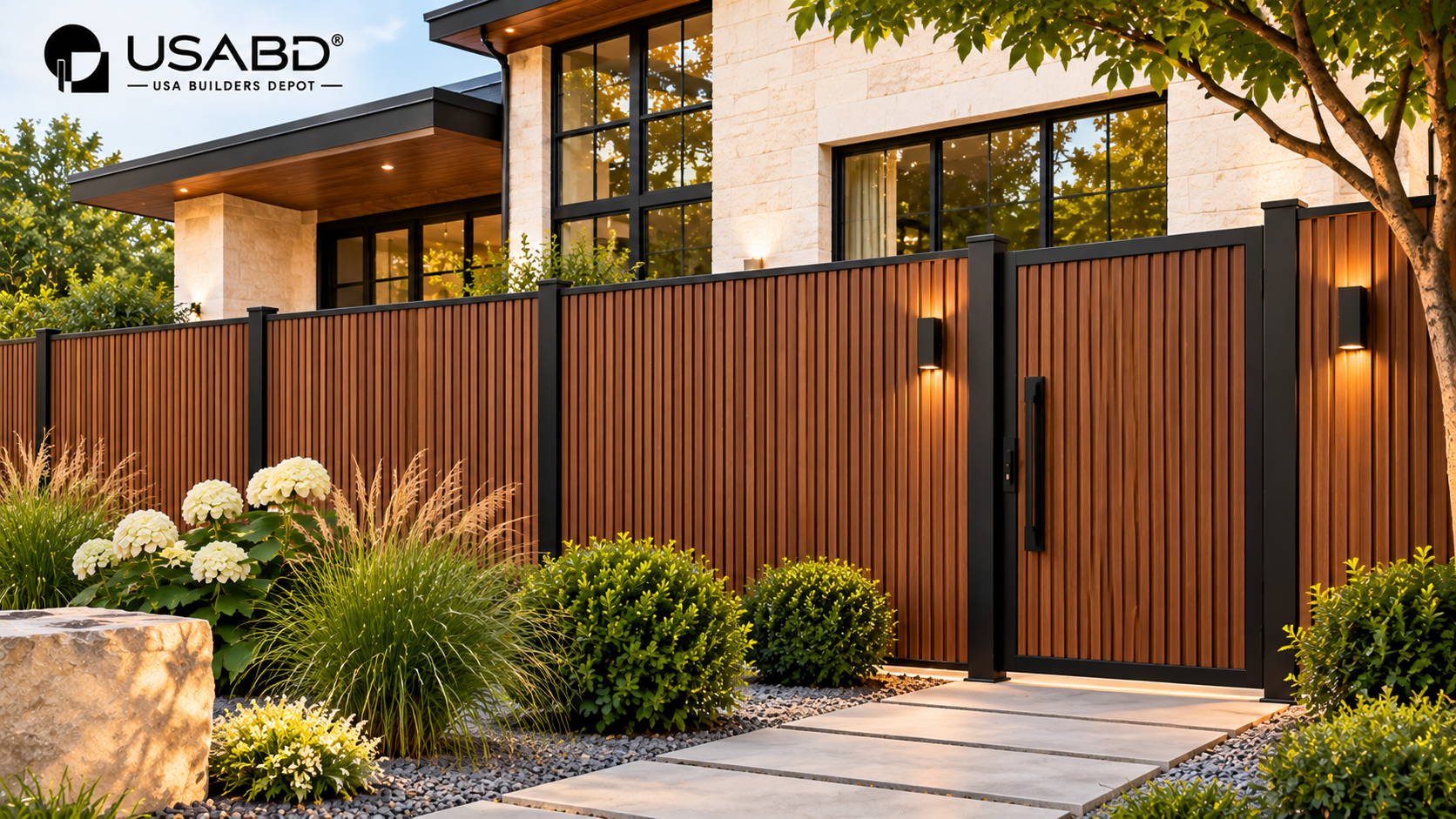
The biggest attraction is the modern, linear appearance. A warm walnut-look finish can complement cream limestone, black steel windows and landscaped patios. A charcoal finish creates contrast with pale exterior walls. The panels may also visually coordinate with WPC accents already used on a residence. Privacy depends on the complete assembly: panel joints, gaps, backing and framing can affect visibility, so a fluted appearance alone does not ensure an opaque fence.
1. Confirm the Product Is Suitable for the Intended Fence Application
USA Builders Depot’s exterior fluted panel listings describe decorative exterior wall and façade cladding, not complete structural fence systems. The exact proposed application needs verification of approved substrate, fastening system, orientation, support span, weather exposure, movement allowances and technical documentation. A product designed to finish a building wall is not automatically approved to span between fence posts. If the manufacturer cannot confirm suitability, use an appropriate purpose-designed fence product.
2. Understand Why Structural Support Matters
A solid privacy fence is exposed to substantial wind forces. Pressure on the surface must transfer through the cladding and support structure into posts and foundations. An exterior panel that performs adequately against a supported wall may not perform safely across an unsupported fence opening.
The project may require properly designed steel, aluminum, treated wood, masonry or other structural posts and horizontal or vertical framing. Post dimensions, spacing, footing depth and anchoring must suit the site and applicable requirements. Decorative WPC must not replace the load-bearing framing.
3. Freestanding Fences vs. Attached Privacy Screens
Freestanding Privacy Fence
A freestanding boundary fence needs its own post, frame and foundation design. It must accommodate local wind and ground conditions and applicable property rules.
Attached Privacy Screen
A screen attached to an existing wall, deck or other structure introduces additional loads. Do not assume an existing retaining wall, railing or masonry garden wall can safely support it without an appropriate evaluation.
Decorative Feature Wall
WPC may be considered as a decorative finish over a properly constructed garden wall or other supporting assembly when the product and installation method are compatible. Fastening, drainage and movement still require attention.
4. Plan the Fence Height and Layout
First decide whether the screen is meant to conceal equipment, separate patios, provide backyard privacy or form an architectural backdrop. Then determine the permitted location and height. Local rules and homeowners associations may limit heights, setbacks, easements, materials, or visibility near driveways. A six-foot fence is common in some residential settings but is not universally permitted or appropriate. Verify the location and applicable requirements before purchasing.
5. Design the Supporting Frame Before the Panel Layout
For vertical decorative WPC panels, a suitable frame may use horizontal supporting members and additional supports as needed. The exact rail arrangement and spacing must follow the selected panel system and project design—not an assumed universal two- or three-rail rule. Concealed supports can create an elegant appearance but must still safely carry applicable loads. Complete the supporting-frame design first.
6. Can Exterior WPC Panels Be Installed Vertically?
Vertical fluted panels emphasize height and can create the appearance of closely spaced timber slats. Confirm that the exact profile and approved assembly permit the intended orientation. Plan the layout around structural posts, bays, gates, corners and changes in elevation. Balance the groove pattern and avoid leaving thin strips in prominent locations where possible.
7. What About Horizontal Fluted WPC Fencing?
Horizontal panels can visually emphasize the length of a property, but rotating a decorative profile may change its structural support, drainage and movement behavior. Do not assume a panel approved for vertical wall installation may be mounted horizontally on a fence. Verify orientation with the manufacturer or select a suitable horizontal fencing system.
8. Finish the Fence Corners and Ends
Fence ends, outside corners and top edges are often more exposed than cladding on a building wall. Compatible exterior edge trims can conceal cuts, while matching corner trims can create consistent transitions where the fence changes direction. Confirm trim compatibility with the exact WPC profile and do not substitute an indoor trim without approval. An exposed top edge may need an appropriate cap or water-management detail; decorative trim alone is not necessarily flashing or structural reinforcement.
9. Plan Bottom Clearance
Fence bases can encounter standing water, irrigation, splashback, soil moisture and debris. Do not assume decorative WPC panels may be buried in soil or placed directly on grade. Follow the selected product’s clearance and exposure requirements. A masonry or concrete base can be an architectural option, but it must be coordinated with support, movement and water protection.
10. Allow for Thermal Expansion
Composite materials can change dimensions as temperatures change. Fixed metal posts and frames may restrain a long panel if the required movement allowance is omitted. The correct joint or gap is product-specific and depends on the length, formulation, fastening and installation temperature. Avoid assuming one universal expansion gap. See USA Builders Depot’s WPC expansion gap guidance when applicable.
11. Consider the Appearance of Both Sides
Unlike exterior wall cladding, a privacy fence may be visible from both directions. Some decorative panels have one finished face while the reverse side reveals the profile or fastening arrangement. Decide whether this appearance is acceptable. Adding panels to both faces is not automatically permitted: it can change overall weight, structural demand and attachment requirements. A purpose-designed double-sided fence system may be preferable.
12. How Much WPC Cladding Do You Need for a Fence?
Estimating fence cladding requires more than a simple square-foot calculation. Panel length, orientation, installed coverage width, cutting waste, post locations and allowable support arrangements all matter.
Example: 24-Foot-Wide by 6-Foot-High Privacy Screen
A hypothetical 24-foot-wide, 6-foot-high screen has a gross area of 144 square feet. Selected USA Builders Depot exterior fluted panels are listed around 114.17 inches long and 8.62 inches wide, with approximately 6.24 square feet of published coverage per full-length panel. Confirm current dimensions and coverage for the exact selected product.
Dividing 144 by 6.24 gives approximately 23.1 panels, or 24 by area alone. But 6-foot-high vertical pieces cut from approximately 114-inch-long stock may yield only one full-height section each, with remaining offcuts not reusable in that layout. Using the published full-length coverage to infer approximately 7.9 inches of effective installed width, a continuous 24-foot-wide run would need roughly 37 full-height pieces. That is an illustrative calculation—not an approved bill of materials.
Final counts depend on actual installed width, fence bays, cut constraints, post locations, permitted fastening and offcut reuse. If the selected product ships in four-panel boxes, 37 pieces would round to 40, before other adjustments. A panel-by-panel takeoff is more reliable than a coverage-only estimate. See the WPC cladding cost guide for broader budgeting considerations.
13. What Colors Work Best for Privacy Fencing?
Brown Walnut
Brown Walnut creates a warm wood-inspired appearance alongside limestone, black steel-framed windows, stone paving and contemporary landscaping.
Golden Teak
Golden Teak provides a lighter and warmer tone suited to selected neutral outdoor settings.
Charcoal/Black
Charcoal/Black creates a striking modern backdrop against pale stone and works with black metal frames and lighting.
Ash Gray
Ash Gray provides a subdued contemporary look with selected gray stone and light stucco finishes.
A fence may match the house cladding or provide a complementary contrast. Review actual samples outdoors in different lighting before choosing.
14. Can WPC Fence Cladding Be Used Around a Pool?
Pool areas introduce moisture, chemicals, drainage and safety requirements. A decorative privacy screen is not automatically a compliant pool barrier. If the fence must serve as a safety barrier, verify all applicable height, opening, gate, self-closing and latching requirements, as well as any climbing-hazard restrictions. The complete assembly—not only the decorative panel—must satisfy them.
15. How Do You Incorporate a Gate?
A matching pedestrian gate can be an important architectural feature. It requires suitable structural gate framing, properly supported hinges and latches, coordinated gate posts, and allowance for the full cladding weight and wind exposure. Do not attach hinges or locks solely to decorative WPC. Also maintain the manufacturer’s required panel movement allowances so operation is not obstructed. Design the gate frame before finalizing decorative panel cuts.
16. Common Mistakes When Using WPC Panels for Fencing
Mistakes include treating decorative cladding as structural fence boards, spanning unsupported distances between widely spaced posts, neglecting wind loads, failing to design a gate, using incompatible trims, omitting expansion clearance, trapping panel bottoms in wet soil, estimating only by square footage and ignoring the appearance of the reverse face. Address these issues in a coordinated, approved design before installation.
17. Design Ideas for Modern WPC Privacy Screens
Contemporary Backyard Fence
Walnut-look vertical fluting with understated black metal framing can form a sophisticated backdrop to patios, gardens and lawns.
Outdoor Kitchen Privacy Screen
A decorative screen may separate outdoor cooking or dining spaces, but the design must account for heat exposure, equipment clearances, ventilation and fire-safety requirements.
Luxury Courtyard Fence
Charcoal-colored fluted panels can complement light stone paving, carefully planted beds and warm architectural lighting.
Decorative Garden Screen
A smaller freestanding panel assembly can highlight ornamental grasses and shrubs, but it still requires proper anchorage and structural support.
Screen Above Masonry Wall
A privacy screen above a masonry garden wall can look striking, provided the wall and attachments are evaluated for the added loads and exposure.
Frequently Asked Questions
Can exterior WPC wall panels be used for fencing?
Potentially, as decorative cladding on a suitable, approved supporting assembly. Product-specific suitability must be confirmed.
Are exterior fluted WPC panels structural fence boards?
Not automatically. Decorative façade panels should not be assumed to span between posts or carry fence loads independently.
Can fluted WPC be attached to steel fencing frames?
Potentially, with an approved fastening method and a properly designed supporting frame.
Can WPC fence cladding be installed horizontally?
Only if the exact profile and complete installation system permit the intended orientation.
Can WPC panels touch the ground?
Do not assume so. Follow product-specific ground-clearance and moisture-exposure requirements.
Do WPC privacy fences need expansion gaps?
Composite panels may require allowances for movement. Follow the selected system’s installation documentation.
Are WPC wall panels suitable for pool fencing?
A decorative panel is not automatically a compliant pool safety barrier; verify the complete assembly against applicable requirements.
Can decorative panels be installed on both sides?
Only when the complete supporting and cladding arrangement is suitable. A second face adds weight and may affect the design.
How do you finish the top of a WPC fence?
Use a product-appropriate approved top termination, trim or cap while preserving required weather and movement details.
How many panels will I need?
Prepare a full panel layout accounting for cut lengths, actual coverage, supports, waste, trims, packaging and product restrictions.
Final Thoughts: Use the Right Material in the Right Assembly
Exterior fluted WPC has strong visual potential for modern privacy screens. Its vertical grooves and wood-look finishes can complement luxury landscaping and contemporary architecture. But decorative cladding and structural fencing are not the same. Verify that the chosen panel suits the application, design the structural posts and support, and coordinate wind resistance, fastening, gate construction, movement, drainage and finishes before ordering or installing.
Explore Exterior Fluted WPC Panels at USA Builders Depot
USA Builders Depot offers exterior fluted WPC wall panels in Brown Walnut, Golden Teak, Charcoal/Black and Ash Gray, as well as selected compatible finishing accessories. For a decorative privacy fence or screen, contact USA Builders Depot with your dimensions, supporting structure, desired panel orientation, finish, exposure conditions and project location so product suitability and available documentation can be evaluated before purchase.