Exterior WPC Cladding for Outdoor Kitchens: Heat Safety, Design & Installation Guide
A luxury outdoor kitchen should feel like a natural extension of the home.
Whether located beside a swimming pool, beneath a covered patio, or within a landscaped backyard, the materials used around the cooking area can have a significant impact on its appearance.
Modern outdoor kitchens increasingly combine stone countertops, stainless steel appliances, black-framed glass doors, architectural lighting, and decorative exterior wall finishes.
One material homeowners and designers may consider is exterior wood-plastic composite (WPC) cladding.
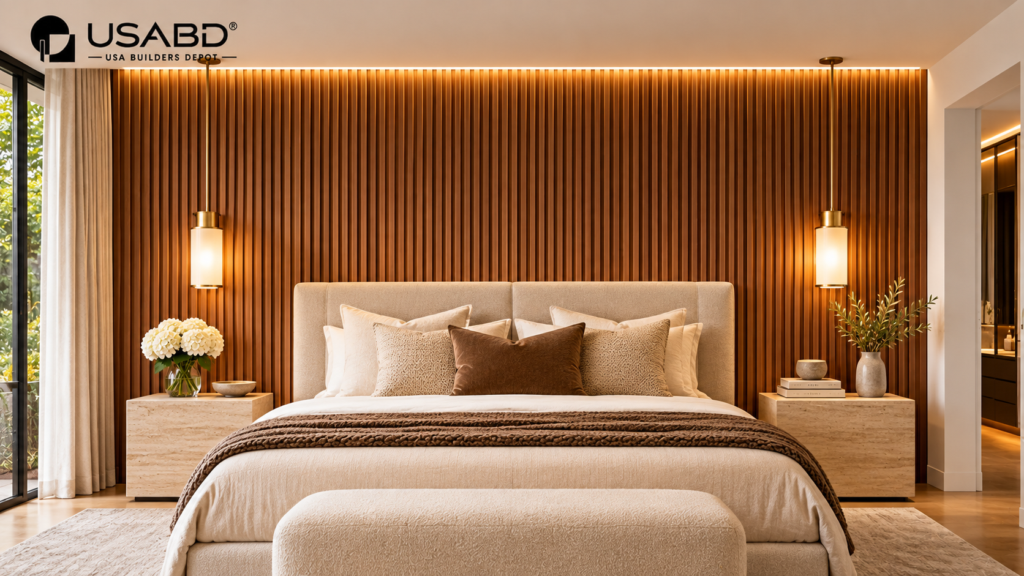
Fluted WPC wall panels offer repeating vertical lines, rich wood-inspired colors, and contemporary architectural texture.
However, outdoor kitchens create conditions that ordinary exterior accent walls do not.
Grills, pizza ovens, side burners, exhaust systems, hot cooking surfaces, grease, moisture, and cleaning chemicals introduce additional design requirements.
The most important consideration is that decorative exterior WPC cladding must not automatically be installed behind or immediately beside a grill.
This guide explains where exterior WPC may be suitable in an outdoor kitchen, how to evaluate heat exposure, which areas may need alternative materials, and how to plan an attractive, properly coordinated wall installation.
Quick Answer: Can WPC Cladding Be Used in an Outdoor Kitchen?
Exterior WPC cladding can be considered for selected decorative walls in an outdoor kitchen when the exact product is approved for the intended exterior application and is located outside the heat and clearance restrictions of nearby cooking equipment.
However, ordinary decorative WPC panels should not be assumed suitable as a backsplash immediately behind a grill, inside a grill enclosure, or near other high-temperature equipment.
Grills and related appliances have model-specific installation requirements.
Before specifying WPC, confirm the appliance’s clearances to combustible and heat-sensitive materials, the cladding manufacturer’s limitations, and applicable building and fire codes.
If product compatibility or required clearances cannot be established, use an appropriately documented alternative material.
1. Why Use Exterior Fluted WPC in Outdoor Kitchen Design?
An outdoor kitchen is more than a place to cook.
In luxury residential projects, it may be part of a complete outdoor entertainment area containing seating, dining, a fireplace, landscaping, and a swimming pool.
Exterior fluted WPC can introduce architectural texture to appropriately located decorative walls.
Modern visual appearance: Vertical grooves create a repeating pattern that can complement streamlined outdoor cabinetry and contemporary rooflines.
Wood-inspired finishes: Brown Walnut and Golden Teak offer warm colors that can complement natural stone and black metal finishes.
Coordinated architecture: The same exterior cladding finish can potentially be used on selected walls of the main residence, pool house, or outdoor entertaining structure.
Feature-wall opportunities: WPC can create a decorative background behind seating, an outdoor television, or a lounge area where exposure and installation conditions permit.
Selective use: You do not need to clad every exterior wall. A smaller feature-wall application can create visual interest while allowing cooking zones to use more appropriate materials.
2. Why Grill Heat Changes the Cladding Decision
Outdoor cooking appliances generate substantial heat.
Depending on the equipment, heat may be directed upward, backward, or sideways.
Wind, appliance placement, and surrounding construction can influence how heat accumulates.
A material designed for ordinary exterior weather exposure is not necessarily suitable for the temperature conditions near a cooking appliance.
Radiant heat: Hot surfaces emit radiant energy that can warm nearby materials.
Convection: Hot air rising from a grill can expose adjacent walls, cabinetry, ceilings, or overhead structures to elevated temperatures.
Grease and cooking residue: Grease and smoke can deposit residue on nearby surfaces.
Wind: Wind may redirect heat and exhaust toward a wall or other construction.
Enclosed or covered kitchens: Covered patios and outdoor cooking enclosures can create additional ventilation and heat-management concerns.
These conditions make it essential to evaluate the actual appliance and complete installation.
3. Can You Install WPC Directly Behind a Grill?
Do not assume so.
A wall immediately behind an outdoor grill may be exposed to significant heat, grease, and cooking residue.
Decorative WPC cladding should not be treated as a noncombustible grill backsplash unless the exact material and assembly have valid documentation supporting the intended use.
Check the appliance installation manual: The grill manufacturer identifies the required clearances, installation conditions, and restrictions.
Evaluate combustible construction: The material behind a decorative finish matters. A noncombustible-looking surface over combustible construction does not automatically make the entire wall suitable for a grill.
Consider a separate cooking-zone finish: Appropriately specified masonry, tile, metal, or another suitable system may be preferable in areas exposed to heat.
Do not rely on decorative trim to provide heat protection: WPC edge trims, corner trims, and ordinary wall accessories should not be used as improvised heat barriers.
The safest design approach is to establish the grill’s required clearance and wall-construction conditions before deciding where decorative WPC panels will begin.
4. How Far Should WPC Be From an Outdoor Grill?
There is no universal safe clearance that applies to every grill and WPC cladding system.
The correct dimension depends on the exact cooking appliance, its installation orientation, surrounding materials, and applicable requirements.
For example, Wolf identifies specific limitations involving combustible materials near certain outdoor grills.
Other manufacturers specify different setbacks and conditions. These instructions are not interchangeable.
What to verify: Confirm the grill’s model number, manufacturer’s installation manual, required side and rear clearances, overhead restrictions, required ventilation, and any conditions for approved liners or protective assemblies.
Then evaluate the proposed WPC finish against those requirements.
Why generic online dimensions can be misleading: A clearance shown in one manufacturer’s manual may not apply to another brand or appliance.
Similarly, a distance that satisfies an appliance requirement may not establish that a particular WPC product is suitable for the resulting temperature exposure. Both must be evaluated.
5. Outdoor Kitchen Wall Zones: Where WPC May Work Best
A practical design approach is to divide the outdoor kitchen into separate wall zones.
Cooking zone: This includes areas directly surrounding grills, pizza ovens, side burners, and other heat-producing equipment. Use materials and assemblies documented as suitable for the appliances and applicable clearances.
Preparation zone: This includes counters and surfaces used for food preparation. Evaluate water, cleaning chemicals, grease, and the proximity of cooking equipment before selecting wall finishes.
Dining and lounge zone: Walls farther from cooking appliances may offer opportunities for decorative exterior WPC cladding. The exact product must still be suitable for the exposure and wall assembly.
Exterior accent zone: A wall adjacent to the outdoor kitchen, but outside the equipment’s restricted areas, can potentially provide an architectural feature. This can be an effective way to introduce fluted WPC without placing it directly behind the grill.
Equipment and service zone: Preserve the required access to gas valves, electrical equipment, refrigeration systems, and other components. Decorative panels must not obstruct required ventilation or service access.
6. Six Outdoor Kitchen Design Ideas Using WPC Cladding
Design A: Brown Walnut and limestone. Use Brown Walnut fluted WPC on an appropriately located lounge wall. Pair it with limestone around the cooking area, black-framed doors, and warm outdoor lighting.
Design B: Golden Teak and stainless steel. Golden Teak can complement stainless steel appliances and light porcelain paving. Keep decorative cladding outside appliance-restricted areas.
Design C: Charcoal/Black and light stone. A dark feature wall creates a dramatic contrast against pale stone countertops and light outdoor flooring.
Design D: WPC feature wall behind outdoor seating. An appropriately located wall behind a dining or seating area can introduce architectural texture without making the grill itself the focal point.
Design E: Outdoor kitchen connected to a pool house. Repeat an approved WPC finish on selected exterior walls to visually connect the pool house and outdoor entertaining area.
Design F: Mixed-material entertaining pavilion. Use an appropriate heat-resistant assembly in the cooking area and decorative WPC on a separate wall or architectural feature. This creates contrast while allowing different materials to serve different purposes.
7. What About Outdoor Pizza Ovens?
Pizza ovens can produce high temperatures and may have different installation requirements from gas grills.
Some ovens also have flues or exhaust paths requiring particular clearances.
Do not assume that a wall suitable behind a conventional grill is also suitable beside a pizza oven.
Verify the oven’s installation instructions, required clearances, ventilation, and surrounding materials.
If a masonry oven is built into the outdoor kitchen, the wall assembly and decorative finishes must be coordinated with the oven’s approved construction.
Avoid extending ordinary WPC panels into areas where the oven manufacturer requires noncombustible construction.
8. Can WPC Be Installed Around Outdoor Kitchen Cabinets?
The answer depends on whether the proposed WPC is being used as stationary wall cladding or as part of the cabinetry itself.
These are different applications.
Behind cabinets: Decorative cladding may be considered on appropriately located stationary walls. Its installation must preserve drainage, moisture protection, and appliance access.
On cabinet faces: A product approved for exterior wall cladding is not automatically suitable as a cabinet door or drawer front.
Inside grill islands: Do not assume that decorative wall cladding is permitted inside an appliance enclosure.
On access doors: Moving cabinet components have different fastening, movement, and durability requirements.
For cabinet applications, use a product specifically documented for the intended construction.
9. Moisture Protection Behind Exterior WPC Panels
Outdoor kitchens can be exposed to rain, humidity, irrigation water, and repeated cleaning.
A decorative cladding panel should not replace the required water-management system of the wall.
Depending on the building, the wall assembly may include sheathing, a water-resistive barrier, flashing, drainage components, approved supports, and the exterior WPC finish.
Drainage: Water reaching behind the cladding should have an appropriate means of draining or drying.
Wall penetrations: Electrical outlets, sconces, plumbing, and other penetrations must integrate with the wall’s water-control system.
Lower terminations: The bottom of the cladding should be detailed according to the selected product’s clearance and drainage requirements.
Adjacent paving: Establish finished patio and paving heights before setting the lower panel elevation.
Cleaning exposure: Outdoor kitchen walls may experience cleaning products that differ from ordinary residential exterior washing. Verify product-specific chemical compatibility before using them.
Review the USABD Exterior WPC Installation Guide for general assembly-planning information.
10. Planning for Grease, Smoke, and Cleaning
Outdoor kitchens can produce cooking residue that accumulates on nearby finishes.
Fluted panels have grooves and recessed surfaces.
That texture creates architectural interest, but it also means cleaning should be considered during material selection.
Keep decorative finishes away from heavy grease exposure: Where possible, place the WPC feature wall away from areas likely to receive frequent direct cooking residue.
Follow approved cleaning methods: Do not assume that degreasers, solvents, bleach, or abrasive products intended for stainless steel can be used on WPC.
Avoid uncontrolled pressure washing: High-pressure water can affect joints and other components when the system is not approved for that cleaning method.
Plan access: Make sure the homeowner can inspect and maintain the cladding without dismantling appliances or other permanent fixtures.
Read the USABD Exterior WPC Cleaning Guide for additional maintenance guidance.
11. WPC Cladding Around Outdoor Lighting and Electrical Outlets
Outdoor kitchen walls often contain lighting, receptacles, switches, speakers, and other equipment.
These features should be located before installing cladding.
Wall sconces: Fixtures must be secured to an appropriate supporting system. Do not rely on decorative WPC panels as structural backing.
Electrical outlets: Outdoor electrical components must be suitable for their location and installed according to applicable electrical requirements.
Lighting cables: Concealed electrical wiring must use approved methods.
Mounting details: Wall penetrations must preserve the intended moisture-management system.
Heat proximity: Do not position decorative lighting or electrical equipment where cooking-appliance heat could create an unsafe condition.
For more information, see Mounting Outdoor Wall Lights on Exterior WPC Cladding.
12. Expansion and Movement Around Outdoor Kitchens
Exterior WPC can change dimensions with temperature.
Outdoor kitchens may expose selected walls to strong sunlight, shade, and temperature changes.
Additional heat from cooking appliances creates a separate concern and should not be addressed merely by increasing expansion gaps.
Normal exterior temperature movement: Follow the selected WPC product’s approved installation requirements.
Rigid boundaries: Plan transitions at stone walls, door frames, corners, metal trims, and other fixed materials.
Fasteners: Use the approved attachment method.
Cooking-appliance heat: A movement allowance does not make a heat-sensitive product safe beside an appliance. If the temperature exposure is outside the product’s documented limits, select a different material or revise the layout.
13. How Much Exterior WPC Cladding Does an Outdoor Kitchen Need?
The material takeoff should cover only the areas where the selected decorative WPC has been confirmed suitable.
Do not assume that every wall around the cooking equipment will receive WPC.
Example: Outdoor lounge feature wall. Suppose a feature wall next to an outdoor kitchen measures 12 feet wide by 9 feet tall, for a gross area of 108 square feet.
The selected USABD Brown Walnut Exterior Fluted WPC panel has published coverage of approximately 6.24 square feet per panel, with four panels per box.
Calculate the wall area: 12 × 9 = 108 square feet.
Divide by published coverage: 108 ÷ 6.24 = approximately 17.31 panels. Round upward to 18 panels before a cut-and-waste allowance.
For illustration, a 10% allowance gives 108 × 1.10 = 118.8 square feet. Dividing by 6.24 yields approximately 19.04 panels. Round upward to 20 panels.
At four panels per box, this equals five boxes.
This is a preliminary area-based estimate only. The final order must be developed from the actual wall elevation, permitted panel orientation, effective coverage, cut sizes, trim locations, and packaging requirements.
The selected Brown Walnut exterior fluted panel has a listed length of approximately 114.17 inches, longer than a nine-foot wall. Actual usable length depends on cutting, support, termination, and movement requirements.
View Brown Walnut Exterior WPC Panels for the current specifications.
14. Outdoor Kitchen Cladding Cost Planning
The cost of decorative WPC is more than the price of visible panels.
An accurate estimate should account for panel quantities, trim, approved fasteners, supporting substructure, water-management materials, delivery, access, labor, and project-specific conditions.
Outdoor kitchens may also require a separate noncombustible or other suitably documented finish in cooking zones.
Do not include WPC in those areas unless its suitability has been verified.
Separate the budget by location: Estimate the cooking-zone finish, decorative WPC wall areas, structural backing, electrical penetrations, and finishing accessories independently.
Avoid comparing only panel prices: The appropriate cooking-zone system and decorative feature wall may have different material and installation costs.
Confirm the final layout: A complete elevation can identify expensive cuts, narrow panels, and additional trims before ordering.
For broader cost information, review the USABD WPC Cladding Cost Guide.
15. Common Mistakes to Avoid
The most important mistake is assuming that an exterior-rated decorative panel is automatically safe behind a grill.
Other common errors include using a generic clearance rather than the appliance’s actual instructions, covering combustible wall construction with a thin finish and assuming the wall is protected, ignoring grease accumulation, and obstructing appliance ventilation.
Poorly planned walls may also trap moisture, lack appropriate flashing, use incompatible fasteners, or restrain composite movement.
Do not purchase cladding before the appliance locations and required clearances have been established.
16. Outdoor Kitchen WPC Installation Checklist
Before placing an order, verify the exact WPC product and intended application; grill, oven, and burner model numbers; current appliance installation manuals; required side, rear, and overhead clearances; combustible-material and heat restrictions; suitable cooking-zone wall construction; ventilation and exhaust requirements; approved WPC placement zones; wall substrate and approved support system; water-resistive barrier and flashing; bottom clearances and drainage paths; electrical and plumbing penetrations; panel expansion allowances; compatible trims and accessories; material quantities and cut layout; cleaning and maintenance requirements; applicable building and fire codes; and final installation and product documentation.
Frequently Asked Questions
Can WPC cladding be used in an outdoor kitchen? Potentially, on appropriately located decorative exterior walls where the exact product and installation are suitable.
Can I install WPC directly behind a BBQ grill? Do not assume so. Confirm the grill manufacturer’s required clearances and the cladding’s documented heat and fire limitations.
Is WPC cladding heat-resistant? Heat performance varies by product. Ordinary exterior suitability does not establish approval for high-temperature cooking zones.
Can I use fluted WPC behind outdoor seating? Potentially, where the wall is outside restricted appliance areas and the selected product is suitable for environmental exposure.
Can WPC cladding be used around a pizza oven? Only where the exact product, placement, and assembly satisfy the oven’s installation conditions and applicable requirements.
Can I use exterior WPC on outdoor kitchen cabinet doors? A stationary wall-cladding product should not automatically be substituted for a cabinet door or other moving component.
Does exterior WPC cladding need flashing? The complete exterior wall assembly requires suitable water-management details. Decorative panels do not replace necessary flashing.
Can WPC withstand outdoor kitchen grease? Cleaning and chemical compatibility must be verified for the exact product. Avoid placing ordinary decorative panels in heavy grease-exposure areas.
Is Golden Teak or Brown Walnut better for an outdoor kitchen? Both can provide attractive wood-inspired finishes. Choose based on the overall design and approved product application.
Can I combine WPC with stone or porcelain? Yes, where the respective materials and transitions are appropriately designed and installed.
How many WPC panels do I need for a feature wall? Use actual wall dimensions, published installed coverage, cut layout, and packaging for the selected panel.
Where can I buy exterior fluted WPC panels? USA Builders Depot offers exterior fluted WPC cladding in Brown Walnut, Golden Teak, Ash Gray, and Charcoal/Black.
Final Thoughts: Design the Outdoor Kitchen Around Both Appearance and Safety
A beautiful outdoor kitchen should combine thoughtful architecture with practical, safe material selection.
Exterior fluted WPC can create a warm, contemporary appearance on suitable decorative walls.
However, grill heat, grease, ventilation, moisture, and combustible-material clearances require careful evaluation.
The best design does not necessarily use the same material everywhere.
A properly specified cooking-zone finish can work alongside WPC feature walls, natural stone, black-framed openings, and architectural lighting.
Establish the appliance requirements first, then develop the exterior cladding design around those conditions.
The result is an outdoor kitchen that looks intentional while respecting the practical requirements of a cooking environment.
Shop Exterior Fluted WPC Cladding at USA Builders Depot
USA Builders Depot offers exterior fluted WPC wall panels in Brown Walnut, Golden Teak, Ash Gray, and Charcoal/Black, along with selected matching trims and accessories.
Explore the Exterior Fluted WPC Collection to compare available finishes and product specifications.
For outdoor kitchen projects, provide your wall elevations, preferred finish, expected quantities, project location, and the location of grills or other heat-producing appliances.
Our team can help identify available cladding products and technical documentation for the proposed application.
USA BUILDERS DEPOT — Build a Better Tomorrow.