Acoustic Wood Slat Panels for Home Theaters: Placement, Design & Sound Quality
A luxury home theater should deliver clear dialogue, convincing surround effects and a comfortable architectural setting. Even expensive speakers can sound disappointing in a room with strong reflections, poorly controlled bass or unhelpful seating positions. Acoustic wood slat wall panels can introduce texture while forming part of a planned acoustic treatment strategy—but they are not a complete soundproofing solution.
Are Acoustic Wood Slat Panels Good for Home Theaters?
Yes, when the selected panel and installed assembly provide appropriate sound absorption for the room’s objectives. Actual performance depends on backing material, cavity, mounting, frequency and other factors. Decorative slats do not automatically control deep bass or prevent sound traveling to adjacent rooms.
1. Why Room Acoustics Matter
Sound reaches the audience directly from speakers and after reflections from walls, floors and ceilings. Strong early reflections may affect dialogue clarity and sound localization. Reverberation can make sounds linger. Room dimensions, speaker and seat positions influence low-frequency peaks and cancellations. Treatment should balance the experience rather than indiscriminately cover every surface.
2. Absorption, Diffusion and Sound Isolation
Absorption reduces some reflected sound energy. Diffusion redistributes reflections. Sound isolation limits transfer between rooms through the complete construction of walls, ceiling, floors, doors and openings. An attractive acoustic panel is not automatically an engineered diffuser or a soundproof wall. Choose treatments for the specific goal.
3. Where Should Home Theater Acoustic Panels Go?
Side Walls
First-reflection zones from the front speakers are useful areas to evaluate, particularly around the main listening position. Multiple seats and surround speakers complicate the arrangement; treatment should reflect the actual system.
Front Wall
The screen wall may benefit from treatment depending on speaker placement, screen type and room dimensions. A projection system with speakers behind an acoustically transparent screen differs from a visible TV-and-speaker setup.
Rear Wall
Depending on room depth and seating, rear-wall absorption, diffusion or a combination may be useful. There is no universal rule to cover the entire rear wall with thin slat panels.
Ceiling
Ceiling reflections may matter, but decorative wall panels cannot be installed overhead without verifying the product’s approval and appropriate mechanical support.
4. Can Panels Go Behind a TV?
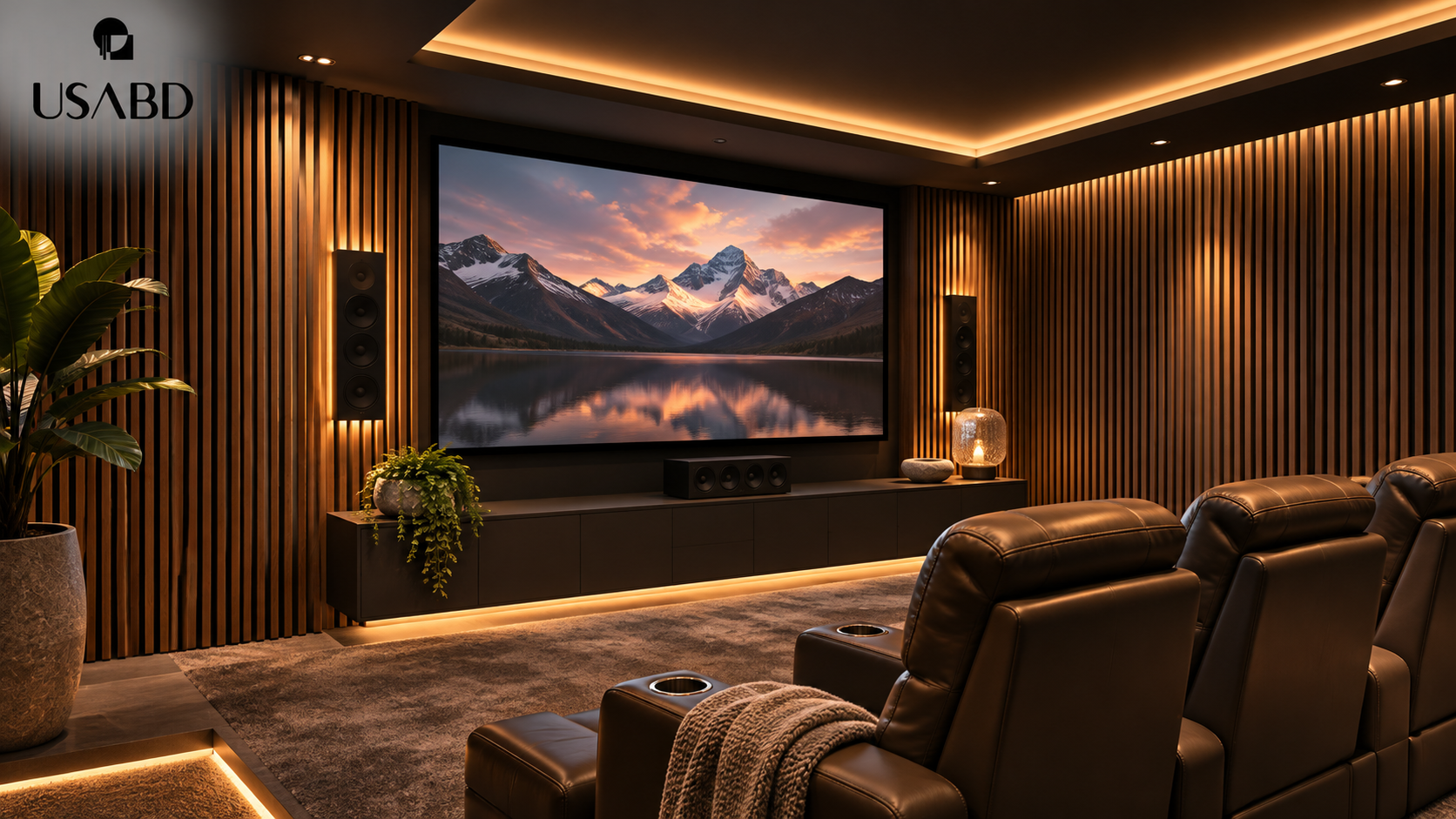
Acoustic panels can provide an attractive wall around a screen, especially in dark wood finishes. But the TV must mount to suitable structural support, not decorative slats or felt. Maintain ventilation, service access and electrical compliance. Do not obstruct speakers or their acoustic outputs without a designed covering.
5. Selecting the Right Finish
Dark Ebony can suit dedicated low-light cinemas; Smoked Oak offers a warm rich look; Classic Oak works in transitional settings; Light Brown Oak and Raw White Oak suit multipurpose media lounges. White Oak with Grey Felt provides another contemporary palette. Evaluate samples under actual theater lighting, especially near a projection screen where light-colored finishes may reflect light. Explore Dark Ebony and Smoked Oak.
6. Will Wood Slat Panels Fix Bass Problems?
Not necessarily. Deep bass interacts strongly with the dimensions of the room and may need bass traps, carefully placed subwoofers, acoustic measurement and other specialized treatment. Thin decorative slat assemblies should not be treated as substitutes for low-frequency designs. It is possible to combine slat panels with separate low-frequency treatment where the design permits.
7. Planning Dolby Atmos and Surround Systems
Select the screen, speaker positions and seats before designing the finish. Overhead and surround speaker positions must stay clear, and the panel layout should preserve speaker output and access. Multiple seating rows require a broader assessment than a single-seat optimization. Dolby’s home-theater setup guidance is a useful starting point for room and speaker planning.
8. Acoustic Slat Panels vs. Decorative WPC
Purpose-designed acoustic panels may incorporate absorptive backing and verified test information. Decorative interior WPC fluting is primarily an architectural finish and should not be assigned acoustic ratings without testing. Either may look attractive, but selection for acoustic treatment should be based on documented assembly performance.
9. How Many Panels Will You Need?
Material quantity and acoustic treatment requirements are separate questions. For a 12-foot-wide by 8-foot-high wall, the area is 96 square feet. Selected USABD medium acoustic slat panels are approximately 114 inches long by 12.8 inches wide. A simple width calculation gives 144 ÷ 12.8 = 11.25, or 12 preliminary vertical positions. If sold in boxes of four, that is three boxes before adjusting for effective coverage, cutouts, waste or layout. It does not establish the amount of treatment the room acoustically requires.
10. Direct Mounting, Cavities and NRC
A panel’s mounting method can change its performance. Direct wall mounting may be suitable when permitted; a designed cavity or backing material may change absorption. NRC summarizes absorption across a defined frequency range, not complete bass behavior. Never transfer an NRC rating from a different product or installation assembly. Review the NRC ratings guide and air-gap guide.
11. Lighting and Wiring
Indirect wall lighting, perimeter strips and dimmable fixtures can complement slat panels, but should not create screen glare or cover acoustic surfaces in unapproved ways. Plan speaker cables, power, data and lighting before closing the wall. Required electrical junction access and ventilation must remain available. Heavy equipment and cabinets need structural support independent of decorative panels.
12. Common Mistakes
Avoid treating every wall identically without considering speakers and seats; confusing absorption with sound isolation; ignoring bass; covering speakers; using unverified test ratings; failing to plan cabling; and using wall-panel installation details for ceiling applications. A high-performance home theater benefits from coordinated AV and acoustic design.
Frequently Asked Questions
Do acoustic slat panels improve movie dialogue?
They can help manage certain reflections, but speakers, placement and electronics also matter.
Should every wall be covered?
Not necessarily. Too much absorption or poorly positioned treatment can be undesirable.
Will slat panels soundproof the room?
No. Isolation requires appropriate whole-building assemblies.
Can panels be used around speakers?
Only if the arrangement maintains speaker output and meets installation requirements.
Does an air gap guarantee better performance?
No. Its effect depends on the exact tested assembly and frequency.
Final Thoughts
An attractive theater benefits from integrating its acoustics with the screen, speakers, seating, lighting and materials. Acoustic wood slat panels may provide decorative appeal and suitable absorption as part of a complete design, but specialist bass and sound-isolation measures may still be necessary.
Explore Acoustic Wood Slat Panels at USA Builders Depot
Compare USA Builders Depot acoustic wood slat wall panels in Dark Ebony, Smoked Oak, oak and other finishes. For project quotations, provide your room dimensions, wall coverage, finish and acoustic documentation requirements via our contact page.