Can You Mount a TV on Acoustic Wood Slat Panels? A Safe Installation & Design Guide
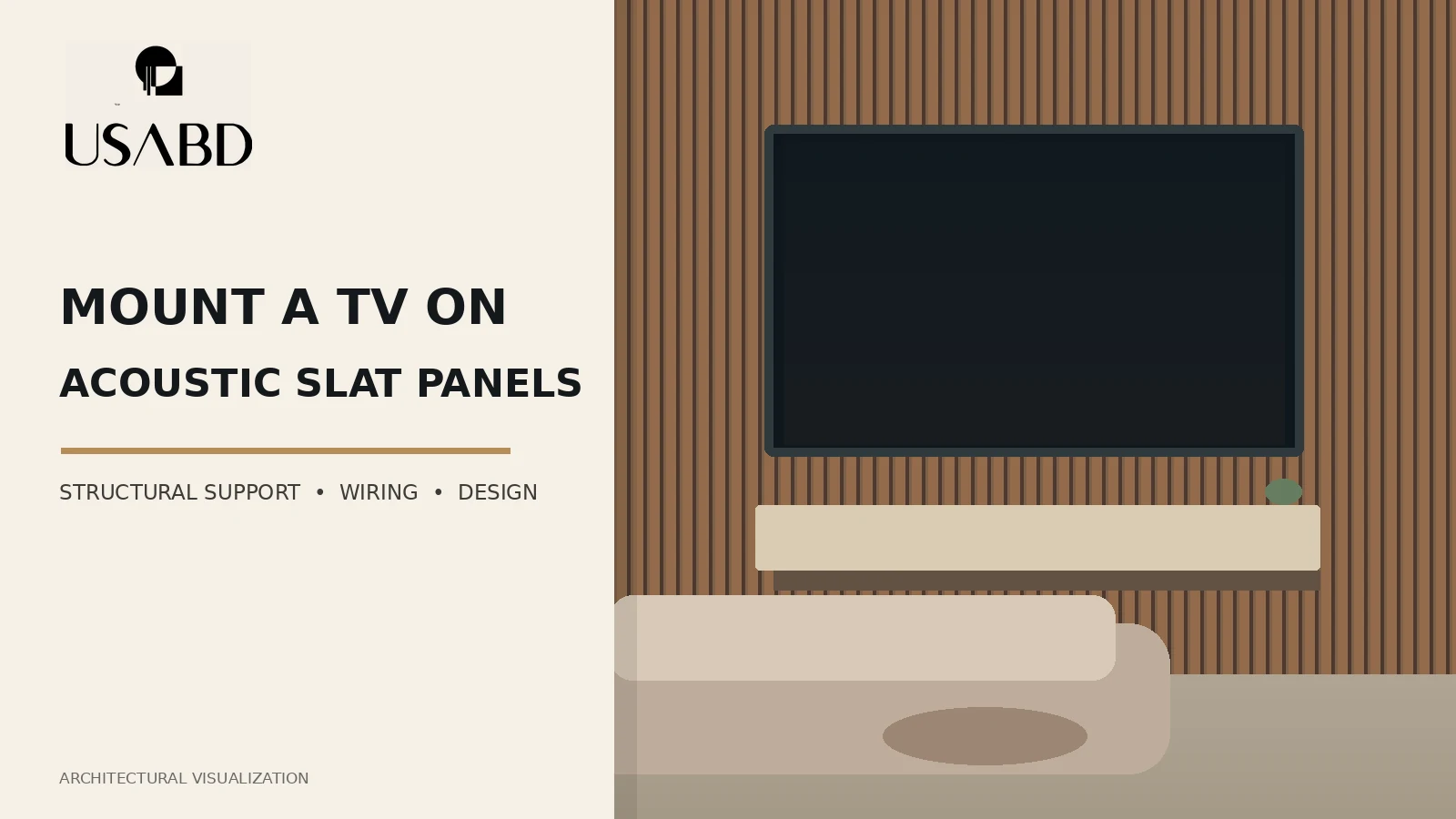
A television set against a wood slat feature wall can give a living room or media room an architectural focal point. Acoustic wood slat panels introduce texture and, where documented, may contribute sound absorption. But a beautifully finished wall does not automatically provide a safe mounting surface for a heavy television.
The central rule is simple: the decorative slat panel is a finish, not a substitute for structural mounting support. The television, bracket, wall construction, wiring and future access must be planned together. This guide describes practical options and common mistakes.
Quick answer: can a TV mount through acoustic panels?
Yes, potentially, if the television mounting system is attached to a manufacturer-approved structural substrate and the entire installation meets its requirements. Do not attach brackets only to slats or compressible felt backing unless the exact system is explicitly rated for the load. Fastening longer screws through a decorative panel does not automatically create an approved mounting assembly.
1. Identify the real supporting wall
Before installing panels, determine whether the wall contains wood studs, metal studs, solid concrete, hollow masonry or another substrate. A bracket approved for wood studs may not be appropriate for metal framing or masonry. Brick veneer should not be assumed to be a structural anchorage surface. Locate and verify suitable backing rather than guessing based on a stud finder alone.
2. Select the TV and bracket first
Record the actual television model, weight, VESA mounting pattern, overall dimensions and ventilation clearances. Compare fixed, tilting and full-motion brackets. A full-motion arm can place additional forces on wall attachments as the screen moves outward. The bracket manual governs approved wall types, fasteners and spacings. Design the feature wall around those conditions, not the other way around.
3. Three mounting approaches
Dedicated mounting recess: Terminate acoustic panels around a planned recess that exposes structurally supported backing for the TV bracket. The screen may conceal the recess once installed.
Structural backing before cladding: During new construction, coordinate adequate blocking or other engineered support while the wall remains open.
Engineered spacer or standoff arrangement: A suitable rigid standoff can sometimes bridge the decorative finish, but the complete assembly must be approved for the actual bracket, load and supporting substrate.
None of these methods establishes a universal screw length or fastener count. A qualified installer should validate the final method.
4. Prevent compression of acoustic felt
Many wood slat acoustic panels have decorative slats mounted over felt or another acoustic backing. Those materials may compress when a bracket is tightened. A structural bracket should not rely on a compressible layer to maintain stability. Never assume that adding washers or using longer anchors resolves this issue without manufacturer support.
5. Electrical outlets, HDMI and cable management
Plan the television power location and low-voltage wiring before installing the panels. Electrical outlets need suitable boxes and code-compliant wiring. Do not run a normal television power cord through the wall cavity as an improvised concealed wiring solution. Keep junction boxes and other required connections accessible. Coordinate HDMI, Ethernet, speaker cables and power locations with the final bracket position.
6. Acoustic panels behind the entire TV
A full slat wall creates a continuous architectural backdrop, while a recessed central mounting area can simplify the structural and wiring details. A smaller feature-wall section or asymmetric design may provide a similar visual effect with fewer panels. The television physically obscures some acoustic surface, so sound absorption depends on the remaining exposed panel area, tested properties and room arrangement.
7. Soundbars, cabinets and lighting
Wall-mounted soundbars and floating cabinets need their own approved support; decorative acoustic panels do not replace structural backing. LED strips or wall sconces should use compatible fixtures, wiring and service access. Maintain ventilation around TVs and electronic components. Plan lighting to avoid direct glare on the screen.
8. Choose a USABD finish
Raw White Oak and Light Brown Oak can create a bright contemporary media wall. Smoked Oak and Dark Ebony provide a darker cinema-inspired look, while White Oak with Grey Felt creates a distinct backing contrast. Request samples for accurate tone and texture. Wood color does not by itself establish an NRC rating or soundproofing capability.
9. Estimate panels for a 10-foot-wide media wall
Assume a 10-foot-wide by 9-foot-high wall using nominal 114-inch-long by 12.8-inch-wide vertical panels. Width is 120 inches; 120 ÷ 12.8 = 9.375, or 10 panels rounded up. The 114-inch length allows trimming to the 108-inch wall height if permitted. At four pieces per box, three full boxes would provide 12 panels. This is preliminary; actual installed width, cuts, edge details and packaging must be confirmed. Do not subtract screen area unless panels are deliberately omitted from a defined recess.
10. Safety and building requirements
Follow the TV and mount installation manuals, verify wall condition, and have mounting arrangements checked by a qualified professional when necessary. Building and electrical code requirements, ventilation instructions and accessibility to the locking or release mechanism must be preserved. If concealed structural backing is unknown, investigate it before purchasing mounting hardware.
Frequently asked questions
Can I bolt a TV straight into acoustic slats? Do not assume so. The structural support must be independent of the decorative panel unless specifically approved.
Are longer bolts enough? No; length alone does not establish anchorage capacity or a safe wall assembly.
Can I use a full-motion mount? Potentially, with an approved system designed for its actual loads.
Can I conceal power cords? Use an approved in-wall electrical arrangement, not an ordinary loose power cord through the wall.
Can slat panels support a soundbar? Do not treat them as structural support.
Do acoustic panels make a television sound better? They may affect reflections, but performance depends on the tested assembly and whole room.
Final thoughts and shop USABD
An attractive TV wall begins with the technical essentials: verify the wall substrate, confirm the bracket, plan power and low-voltage cabling, and create a finished slat layout around the structural support. Explore USABD acoustic wood slat wall panels, our technical resources, and the cutting guide before installation. USA BUILDERS DEPOT — Build a Better Tomorrow.