



Article: How Many Acoustic Panels Do You Need? A Room-by-Room Placement Guide
How Many Acoustic Panels Do You Need? A Room-by-Room Placement Guide

You have chosen acoustic wall panels, picked the finish, and measured the room.
Now comes the question that usually causes the most uncertainty: How many acoustic panels do you actually need—and where should they go?
The answer is not simply “cover one wall” or “install six panels.” Acoustic treatment depends on the size and shape of the room, the amount of hard reflective surface, ceiling height, furniture, the type of panel, how the panel is mounted, where sound originates, and what you are trying to improve.
A home office with a slight echo does not need the same treatment as a podcast room, conference room, home theater, music studio, restaurant, or large open-plan living area.
The goal is not necessarily to cover every surface. The goal is to place enough sound-absorbing material in the right locations to control unwanted reflections while keeping the room comfortable, functional, and visually balanced.
This guide explains how to estimate acoustic-panel quantity, where to place panels first, and how to plan an acoustic slat-wall installation without over-treating or under-treating the room.
Quick Answer: How Many Acoustic Panels Do I Need?
There is no universal panel count that works for every room.
As a practical planning method, begin by evaluating:
- Room size and ceiling height
- How reflective the room currently is
- What the room is used for
- The acoustic performance of the exact panel
- Where the strongest sound reflections occur
- How much wall or ceiling area will actually be treated
For a typical residential space with mild to moderate echo, a useful starting strategy is to treat the largest reflective zones first rather than immediately covering the entire room.
Rooms used for recording, critical listening, meetings, or home theater may require more treatment and more precise placement.
For commercial rooms, studios, performance spaces, or projects with specific reverberation requirements, an acoustic consultant may be appropriate.
Why Panel Count Alone Can Be Misleading
Imagine two rooms that are both 12 feet by 14 feet.
The first room contains carpet, upholstered furniture, curtains, bookshelves, and a fabric sofa.
The second contains polished concrete, large windows, painted drywall, stone surfaces, and minimal furniture.
Even though the dimensions are identical, the second room will usually reflect much more sound.
That means the same number of acoustic panels may produce very different results.
This is why acoustic-panel planning should focus on room behavior, not simply square footage.
What Are Acoustic Panels Actually Doing?
Acoustic wall panels are primarily used to reduce sound reflections inside a room.
They can help control echo, reverberation, speech muddiness, excessive brightness, harsh reflections, and listening fatigue.
They do not automatically soundproof a room.
Soundproofing is intended to reduce sound traveling through walls, ceilings, floors, doors, and structural assemblies. Acoustic treatment works mainly with the sound inside the room.
If your goal is stopping your neighbor’s music from entering your room—or preventing your home theater from disturbing another room—you are dealing with sound isolation rather than simple acoustic treatment.
For a deeper explanation, read the USA Builders Depot guide on Acoustic Panels vs. Soundproofing.
Step 1: Decide What Problem You Are Solving
Mild echo
You may notice your voice sounding slightly hollow in a home office, bedroom, hallway, or living room. The solution may be relatively simple: treat one or two large reflective surfaces.
Speech clarity
Conference rooms, offices, classrooms, restaurants, and large dining areas often suffer from multiple voices reflecting off hard surfaces. The goal is typically to reduce excessive reverberation so conversations become easier to understand.
Home theater
A home theater requires more strategic treatment because sound is coming from defined speaker locations and reaching a defined listening position. Early reflection control becomes especially important.
Podcast or recording room
Microphones capture reflections that your ears may ignore. Recording environments often require more treatment than ordinary living spaces.
Critical listening or studio work
Studios require more precise treatment of reflections, low-frequency behavior, speaker placement, room modes, and decay time. Decorative acoustic slat panels can be part of the solution, but they may not replace dedicated bass trapping or engineered studio treatment.
Step 2: Identify the Most Reflective Surfaces
Sound reflects strongly from hard, smooth surfaces.
Typical reflective materials include glass, painted drywall, concrete, stone, tile, hardwood, metal, and large cabinet faces.
Soft furnishings already provide some absorption. Rooms with rugs, curtains, upholstered furniture, bedding, books, fabric furniture, and other soft finishes may require less treatment than highly minimalist spaces.
Before buying panels, look around the room and ask: Where are the largest uninterrupted hard surfaces?
Those surfaces are usually the best places to begin.
Step 3: Use a Coverage Method Instead of Guessing a Panel Count
One practical way to plan acoustic treatment is to estimate how much surface area you want to treat.
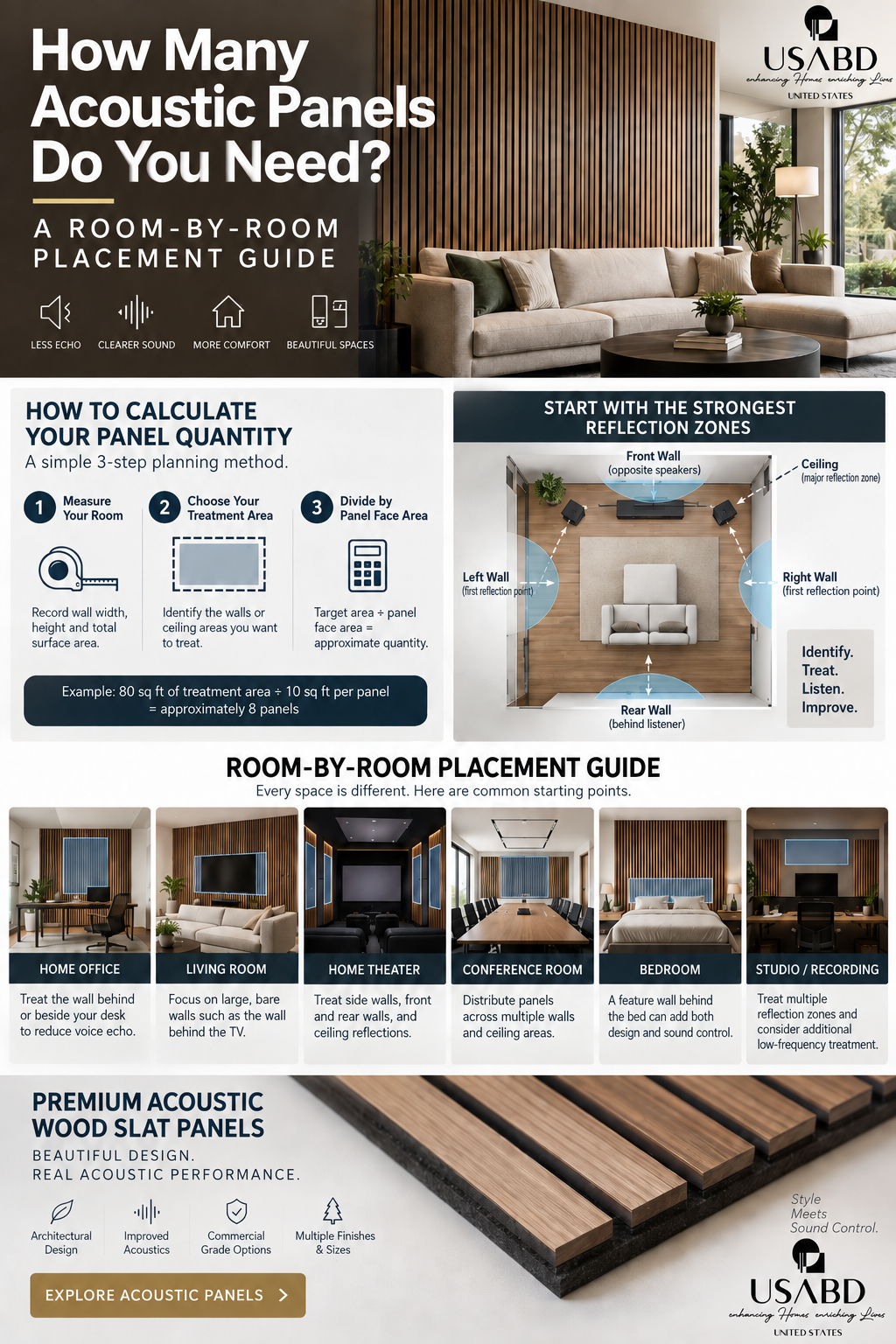
Target treatment area ÷ face area of one panel = approximate panel quantity
For example, if you decide that a wall needs approximately 80 square feet of acoustic treatment and one selected panel covers approximately 10 square feet of wall face:
80 ÷ 10 = approximately 8 panels
This is a planning calculation—not a guaranteed acoustic-performance calculation.
The actual result depends on the panel construction, mounting method, room dimensions, placement, and verified acoustic testing.
For USA Builders Depot acoustic products, always confirm the dimensions and technical information for the exact selected panel before calculating quantities.
How Much of the Room Should Be Covered?
There is no building-wide percentage that works for every acoustic-panel system. However, for early budgeting and layout planning, you can think in general treatment levels.
| Room condition | Planning approach |
|---|---|
| Mild residential echo | Start with the largest reflective wall or two smaller reflection zones |
| Home office / video-call room | Treat the wall behind or beside the speaking position plus major reflection surfaces |
| Conference room | Distribute treatment across several walls instead of concentrating everything in one corner |
| Home theater | Prioritize first-reflection zones, front/rear-wall behavior, and ceiling reflections |
| Podcast / recording room | Treat multiple reflection paths around the microphone and speaker position |
| Studio / critical listening | Use measured acoustic design rather than decorative coverage alone |
The best strategy is often to install treatment in stages, listen to the room, and add more only when necessary.
Where Should Acoustic Panels Be Placed First?
The best location is rarely determined by decoration alone. Start with the surfaces receiving the strongest reflections.
Side walls
In listening rooms, theaters, studios, and offices, side walls often create strong early reflections. These are among the first locations worth evaluating.
Wall behind the speaking or listening position
A large hard wall directly behind a person can create audible reflections. This is particularly noticeable during video calls, recording, or meetings.
Wall opposite speakers or television
Sound traveling toward a large opposite wall can reflect strongly back into the room. Treating part of that surface can improve clarity.
Ceiling
Ceilings are one of the largest uninterrupted reflective surfaces in many rooms. Acoustic ceiling treatment can be useful in open offices, conference rooms, restaurants, studios, and rooms with tall ceilings.
Only use panels in a ceiling installation when the selected product and attachment method are suitable for that application.
Large parallel walls
Two hard parallel surfaces can create repeated reflections or flutter echo. Treating at least one of the surfaces can significantly change how the room sounds.
What Are First Reflection Points?
A first reflection point is a surface where sound from a speaker reflects before reaching the listener.
These reflections arrive very shortly after the direct sound and can reduce clarity and stereo imaging.
In a typical listening room, common first-reflection areas include the left side wall, right side wall, ceiling, and sometimes the wall behind the listening position.
A simple way to identify a side-wall reflection point is the mirror method.
Sit in the normal listening position while another person moves a mirror along the side wall. Where you can see the speaker in the mirror is approximately where sound can reflect from that speaker toward you.
That area is a logical location to consider acoustic treatment.
How Many Acoustic Panels for a Home Office?
Home offices often need less treatment than studios.
Common problems include voice echo during video calls, a hollow sound from hard floors, and reflections from the wall behind the desk.
Start with the largest reflective wall near the speaking position. If your desk faces a wall, treatment behind the monitor can help reduce nearby reflections. If the wall behind you is large and empty, that is another useful location to evaluate.
A rug, curtains, upholstered chair, bookshelf, and acoustic wall panels can work together. You do not necessarily need to cover every wall.
How Many Acoustic Panels for a Living Room?
Living rooms already contain furniture that absorbs and scatters sound.
A sofa, area rug, curtains, cushions, shelving, and artwork all influence acoustics.
Instead of treating the entire room, focus on large bare surfaces.
A full-height acoustic slat feature wall behind a television or along a large blank wall can provide both architectural design and sound control.
If the room still feels excessively reflective after the first wall is treated, consider a second area rather than automatically covering every surface.
How Many Acoustic Panels for a Home Theater?
Home theaters benefit from more deliberate placement.
Evaluate side-wall first reflections, front-wall reflections, rear-wall reflections, ceiling reflections, floor reflections, and speaker and subwoofer placement.
Acoustic slat wall panels can help manage reflections while creating a premium theater appearance.
However, low-frequency problems from subwoofers may require dedicated bass treatment rather than decorative wall panels alone.
How Many Acoustic Panels for a Conference Room?
Conference rooms can become difficult to understand when voices reflect between drywall, glass, tables, ceilings, and hard floors.
Instead of placing all panels on one wall, distribute absorption around the room.
Good candidate areas include the rear wall, side walls, the wall opposite large glazing, and ceiling areas above the meeting table.
The goal is speech clarity, not complete acoustic deadening.
How Many Acoustic Panels for a Bedroom?
Bedrooms usually contain many soft materials already.
Beds, bedding, curtains, rugs, and upholstered furniture naturally reduce reflections.
If the room still feels echoey, a decorative acoustic wall behind the bed can often provide both visual impact and acoustic improvement.
Because bedrooms usually do not require critical listening conditions, treatment can be designed more heavily around aesthetics.
How Many Acoustic Panels for a Restaurant or Large Open Space?
Large rooms with concrete, glass, tile, metal, and high ceilings can create significant reverberation.
Restaurants are especially sensitive because the noise level increases as more people speak.
Commercial acoustic design should evaluate room volume, occupancy, ceiling height, surface finishes, background noise, desired reverberation time, fire-performance requirements, and mounting method.
For large commercial spaces, do not rely solely on a residential panel-count rule. A project-specific acoustic calculation may be more appropriate.
Should Acoustic Panels Cover the Entire Wall?
Not necessarily.
A full wall can create a strong design feature and meaningful absorption, but strategically distributed treatment can sometimes achieve better acoustic balance.
For example, instead of covering one entire wall, you may obtain better results by treating part of the left wall, part of the right wall, the rear wall, and selected ceiling area.
The correct choice depends on the room and the desired architecture.
Is One Feature Wall Enough?
Sometimes.
If the room has only mild echo and already contains soft furnishings, one acoustic feature wall may provide a noticeable improvement.
But a very reflective room may continue to sound bright because sound is still bouncing between untreated surfaces.
A feature wall should therefore be considered part of the room’s total acoustic strategy.
Should Panels Be Installed Vertically or Horizontally?
From a design standpoint, either orientation can work when the product allows it.
Vertical slats emphasize height. Horizontal slats emphasize width.
Acoustically, the exact performance depends much more on the complete panel construction, surface area, mounting method, and backing than on appearance alone.
Follow the installation instructions for the selected panel.
Does Spacing Between Panels Matter?
Yes.
Large gaps between small treatment areas can leave major reflective surfaces exposed. At the same time, covering every inch of a wall is not always necessary.
Think of the room as a series of reflection zones. Place panels where they intercept useful reflection paths rather than arranging them only where they look symmetrical.
A design can be both visually balanced and acoustically intentional.
Does Mounting Method Affect Acoustic Performance?
It can.
Acoustic performance may change depending on whether a panel is mounted directly to a wall, mounted over battens, installed with an air space, installed over another material, or mounted on a ceiling.
An air cavity behind certain absorptive products can change their frequency response.
However, do not assume a specific NRC or absorption value for a mounting condition unless that exact assembly has been tested.
USA Builders Depot’s acoustic product pages are intentionally documentation-first: the exact panel construction, mounting method, substrate, air space, and tested assembly should be confirmed before relying on an acoustic rating.
What Is NRC?
NRC stands for Noise Reduction Coefficient.
It is a laboratory-derived rating commonly used to describe how much sound a material absorbs across a set of frequencies.
A higher NRC generally indicates greater sound absorption within the tested assembly.
But NRC should not be treated as a universal product label independent of installation.
Mounting conditions can matter.
If an NRC value is important for a project, confirm that the current report applies to the exact product and assembly being installed.
What About Fire Ratings?
For commercial, multifamily, hospitality, educational, or code-regulated installations, acoustic performance is only one part of product selection.
Projects may also require documentation related to surface-burning behavior.
USA Builders Depot has a separate guide explaining ASTM E84 and Class A fire ratings for acoustic wall panels.
Always verify documentation for the exact product selected.
Acoustic Panels vs. Bass Traps
Decorative acoustic wall panels and bass traps solve different acoustic problems.
Wall panels are commonly used to manage reflections and reverberation in the mid and upper frequencies.
Low-frequency energy behaves differently.
Bass can collect in corners and create uneven peaks and dips throughout the room.
If your problem is primarily boomy bass, installing more decorative wall panels may not solve it.
Dedicated low-frequency treatment or professional room analysis may be necessary.
How to Use the Clap Test
The clap test is a simple first step.
Stand in different parts of the room and clap your hands once.
Listen for ringing, metallic flutter, long decay, repeated echo, or harsh reflections.
Then move toward different walls and repeat the test.
This is not a substitute for acoustic measurement, but it can help identify obvious reflective areas.
How to Avoid Over-Treating a Room
More absorption is not always better.
A heavily treated room can become unnaturally dry.
Speech may feel uncomfortable, music may lose liveliness, and the room may stop feeling inviting.
The goal is usually controlled sound, not zero reflection.
That is another reason staged installation works well.
Install the highest-priority treatment first. Listen. Then add additional panels only where they are still needed.
Common Acoustic Panel Placement Mistakes
Choosing locations only for symmetry
A perfectly symmetrical wall design may look beautiful but miss the major reflection zones. Balance design and acoustic function.
Installing panels behind large furniture
A panel hidden behind a large cabinet or tightly blocked by furniture cannot interact with the room in the same way as an exposed absorptive surface.
Assuming one small panel fixes a large reflective room
A large glass-and-concrete room requires meaningful treatment area. A few decorative panels may look good without substantially changing reverberation.
Treating only one corner
Acoustic reflections occur throughout the room. Treatment should respond to the geometry of the space.
Confusing acoustic treatment with soundproofing
Wall panels can improve sound inside the room. They do not automatically stop sound transmission through the building.
Assuming every acoustic panel has the same performance
Panel thickness, felt backing, slat geometry, mounting, substrate, air gap, and tested assembly can all affect performance.
How to Measure Before Ordering
Before ordering acoustic wall panels, record wall width, wall height, door and window locations, outlets and switches, baseboards, crown molding, ceiling height, desired orientation, number of feature walls, and panel size selected.
Then calculate the treatment area based on the actual panel dimensions.
USA Builders Depot acoustic wood slat panels are available in several sizes, so confirm the selected panel dimensions before calculating final quantity.
For the current product specifications, use the Acoustic Wall Panel Technical Resources page or the exact product page.
Should You Order Extra Panels?
Projects should account for cutting, layout changes, damaged pieces, pattern matching, and future repairs.
The appropriate overage depends on room geometry, cut complexity, panel orientation, number of corners, door and window openings, and material format.
A simple rectangular feature wall may require less overage than a wall with many openings and custom cuts.
Calculate the layout before ordering rather than applying one universal percentage.
Acoustic Panel Placement Checklist
- the acoustic goal
- room dimensions
- panel dimensions
- major reflective surfaces
- first-reflection zones
- wall and ceiling suitability
- mounting method
- substrate condition
- electrical locations
- panel orientation
- finish direction
- fire-documentation requirements
- acoustic documentation for the exact product
- final quantity and cuts
Frequently Asked Questions
How many acoustic panels do I need for a room?
The number depends on room size, surface finishes, acoustic goals, panel dimensions, mounting method, and the tested performance of the selected product. Start by identifying the largest reflection zones and calculating how much treatment area is needed.
Where should acoustic panels be placed first?
Prioritize major reflection surfaces such as side walls, rear walls, opposite walls, and ceiling areas depending on the room and sound source.
Do acoustic panels need to cover the whole wall?
No. Strategic treatment can work very well. A full acoustic feature wall may be appropriate for some spaces, while distributed treatment may work better in others.
Can acoustic panels stop sound from leaving a room?
Not by themselves. Acoustic treatment reduces reflections inside a room. Soundproofing requires controlling transmission through the building assembly.
Are acoustic panels good for home offices?
Yes. They can reduce echo and improve speech clarity for video calls, meetings, and recording.
Are acoustic panels good behind a television?
They can be. A slat-panel feature wall can combine visual texture with sound absorption and may help control reflections around the entertainment area.
Can acoustic panels go on the ceiling?
Some products can be used on ceilings when the product and mounting method are approved for that application. Confirm the exact installation requirements.
Will acoustic panels reduce bass?
Standard decorative acoustic wall panels are usually more effective at controlling reflections than very low-frequency bass. Severe bass problems may require dedicated low-frequency treatment.
How do I know whether I need more panels?
Install the highest-priority areas first, then listen again. If the room still has excessive echo, flutter, or speech muddiness, add treatment to the next major reflective surfaces.
Should I use the NRC number to calculate quantity?
NRC can help compare tested absorption performance, but panel count should not be based on NRC alone. Room geometry, mounting, surface area, placement, and acoustic goals also matter.
The Bottom Line
The best answer to “How many acoustic panels do I need?” is not a fixed number.
Start with the room. Identify the sound problem. Find the largest reflective surfaces. Prioritize the first reflection zones. Calculate treatment area using the actual panel dimensions. Then install strategically rather than covering surfaces randomly.
For general residential spaces, a carefully planned acoustic feature wall may be enough.
For conference rooms, theaters, recording rooms, and larger commercial spaces, treatment usually needs to be distributed more deliberately.
And when the project depends on a particular acoustic rating, always verify the current technical documentation for the exact panel and installation assembly.
Explore USA Builders Depot Acoustic Wood Slat Wall Panels to compare finishes and sizes for residential and commercial interiors.