



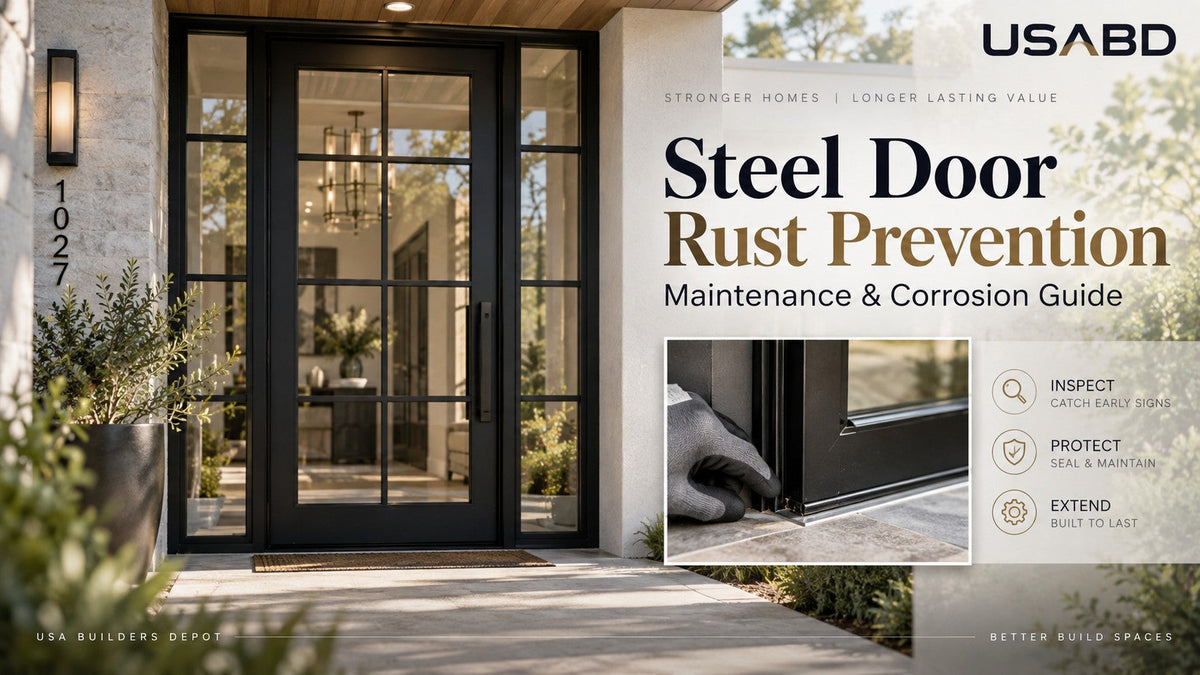
How to Prevent Rust on Exterior Steel Doors: Maintenance & Corrosion Guide

Modern steel entry doors are chosen for strength, narrow architectural profiles, large glass areas, and a clean contemporary appearance.
But steel is still a metal. If its protective finish becomes damaged and bare metal is exposed to moisture, oxygen, salt, pollutants, or repeated weather exposure, corrosion can begin.
That does not mean a steel door is inherently a high-maintenance product. A properly finished steel door can perform for years with relatively simple care. The key is understanding one principle: protect the finish before corrosion reaches the steel underneath.
A small scratch that is repaired early may remain a cosmetic maintenance item. The same scratch ignored for several seasons—especially near the coast, at the bottom of a door, or around a frequently wet threshold—can become a much more difficult repair.
This guide explains how to maintain exterior steel doors, how rust begins, where to inspect first, what to do about scratches and early corrosion, and when a problem should be evaluated professionally rather than treated as a surface issue.
Quick Answer: How Do You Prevent Rust on a Steel Door?
The most effective rust-prevention strategy is to keep the door's protective finish intact.
- Clean the door with appropriate non-abrasive products.
- Remove salt, dirt, and environmental residue.
- Inspect the finish for scratches, chips, or blistering.
- Repair damaged coatings promptly.
- Keep water from sitting against the bottom of the frame or threshold.
- Maintain weatherstripping and seals.
- Inspect hardware and fasteners for corrosion.
- Correct drainage or installation conditions that repeatedly expose the door to moisture.
- Follow the care instructions for the exact door and finish.
The exact cleaning, repair, primer, paint, or touch-up system should always match the specific door construction and finish. Do not assume every black steel door uses the same coating.
Why Steel Doors Rust
Rust is a form of corrosion that occurs when iron-containing metal reacts with oxygen and moisture.
A finished exterior steel door normally has one or more protective layers between the steel and the environment. Depending on the product, that protection might involve metallic coating, primer, paint, powder coating, a specialty finish, a clear topcoat, or another manufacturer-specific coating system.
As long as the protective surface remains intact and suitable for the exposure, moisture has much more difficulty reaching the underlying steel. Problems usually begin where that protective system has been compromised.
The Most Common Places Rust Starts
Rust does not always begin in the middle of a large flat door surface. It often begins at small, less noticeable locations.
Pay particular attention to scratches, chipped edges, welds, corners, hinge areas, handle and lock penetrations, fasteners, glazing stops, the bottom rail, frame-to-threshold connections, sill areas, places where water collects, and areas damaged during shipping or installation.

A small chip near the bottom of a door can be more important than a similar chip higher on the frame because the lower area may experience more water, cleaning residue, splashback, or exterior debris.
Scratches Are More Than a Cosmetic Issue
A scratch in a black finish may initially look like nothing more than a thin silver line. If the scratch stops within the finish layer, it may remain cosmetic. If it reaches bare steel, however, the protective barrier has been interrupted.

That is why installers and owners should inspect a steel door immediately after delivery, installation, hardware installation, nearby masonry work, landscaping, pressure washing, or moving furniture and equipment through the opening.
It is much easier to touch up a small damaged area than to repair corrosion that has spread beneath the surrounding coating.
Construction Sites Are Especially Hard on Steel Doors
A newly installed door may remain surrounded by active construction for weeks or months. Masonry crews may work beside it. Tile installers may carry materials through it. Landscaping equipment may strike the frame. Metal tools may lean against it.
Mortar, concrete slurry, grout, construction dust, adhesive, or other materials may contact the finish. Protective construction film can also create problems if it is left in place longer than intended or if moisture becomes trapped beneath it.
The door should therefore become part of the project's finish-protection plan. Do not treat it as finished simply because it has been installed.
Coastal Homes Need More Attention
Coastal environments can be more aggressive toward exposed metal because airborne salts can settle on exterior surfaces. The door does not need to be directly splashed by seawater.
Salt carried in the air can accumulate gradually on door frames, thresholds, hardware, glass edges, fasteners, decorative metal, and hinges. The combination of salt and moisture can accelerate corrosion when protective coatings are damaged.

For projects near the ocean or in other corrosive environments, the exact door finish and corrosion documentation should be reviewed before purchase. A product that is appropriate for a protected inland entry should not automatically be assumed suitable for severe marine exposure.
Humidity and Rain Are Not the Same Problem
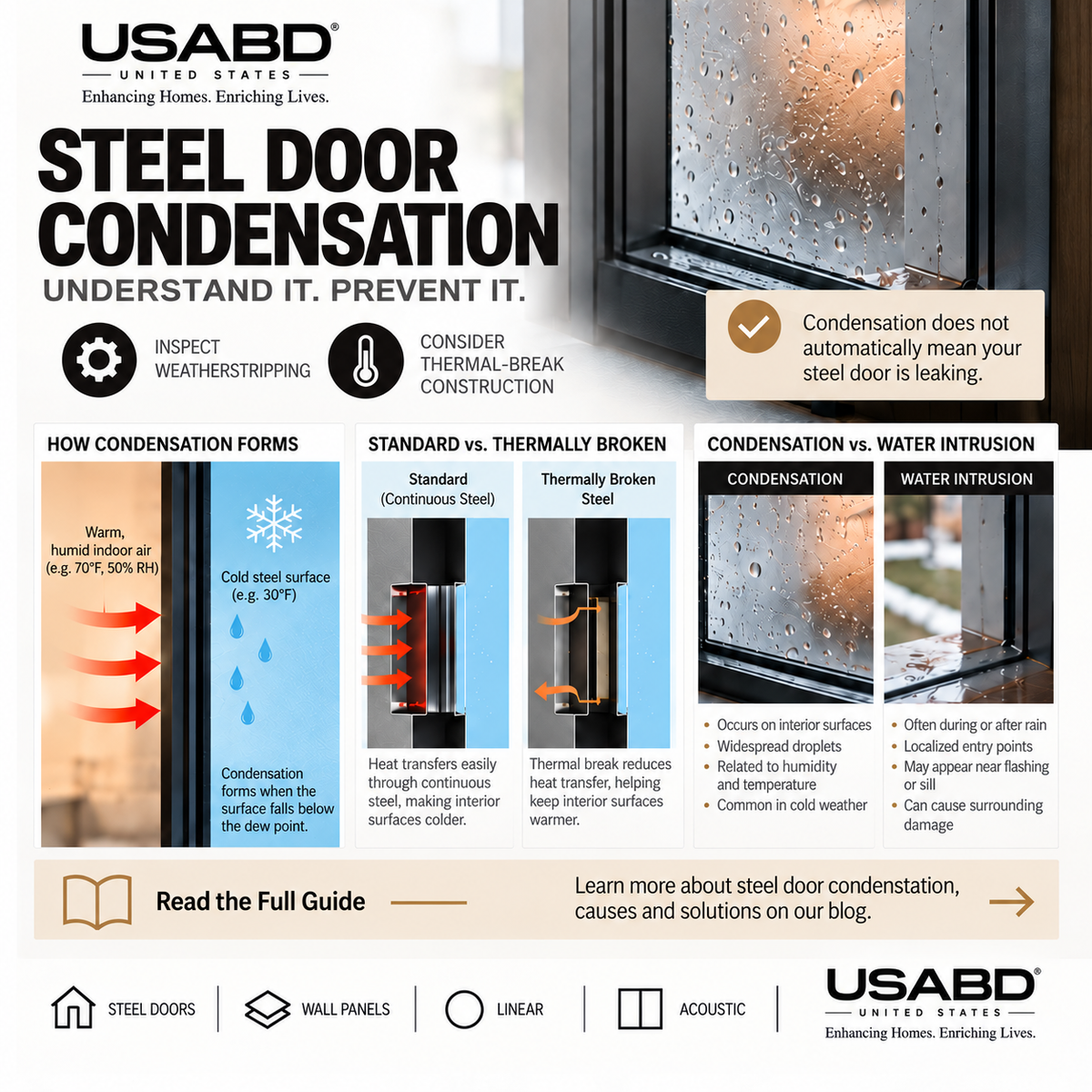
High humidity alone does not necessarily mean the door is leaking. Moisture on the interior side of a steel door during cold weather may be condensation rather than exterior water intrusion.
If water appears primarily during cold weather without rain, review our Steel Door Condensation Guide. If water appears during rain or collects around the sill, flashing, frame, or surrounding wall, investigate drainage and installation conditions.
A rust problem caused by persistent water intrusion will not be solved permanently by touching up paint alone.
Water Management Comes Before Cosmetic Repair
Imagine that rust repeatedly appears at the lower corner of a steel frame. You sand it, prime it, and paint it. Three months later, the rust returns.
The problem may not be the paint. Water may be repeatedly reaching the same location because of a blocked drainage path, incorrect exterior slope, failed sealant, improper flashing, standing water, poor sill detailing, threshold problems, frame installation, or exterior paving installed too high.
In that situation, the source of moisture should be corrected before repeatedly repairing the finish. Our Steel Door Threshold & Sill Guide explains why the bottom of the opening must be treated as an entire water-management system.
How Often Should You Inspect an Exterior Steel Door?
There is no universal inspection interval that applies to every climate and door. A protected porch in a dry inland location may require much less attention than an oceanfront entry.
A practical approach is to inspect the door periodically and after unusual exposure. Useful inspection times include after installation, after major storms, after construction work around the opening, after exterior cleaning, before winter, after winter, and whenever a new scratch or chip is noticed.
High-salt, high-humidity, industrial, or heavily exposed environments may justify more frequent checks.
What Should You Look For?
Stand several feet away first and look for discoloration, fading, bubbling, orange or brown marks, white residue, peeling, irregular gloss, or streaks.
Then inspect corners, welds, the glass perimeter, hinge plates, hardware penetrations, bottom rail, threshold, jamb bases, fasteners, and the door sweep area.
Also operate the door. Make sure it opens smoothly, closes correctly, latches properly, compresses weatherstripping evenly, does not drag, and does not allow water to collect at the sill.
How to Clean a Steel Entry Door
Always start with the care instructions for the exact finish. As a general principle, mild cleaning methods are safer than aggressive ones.
Avoid assuming that a cleaner safe for unfinished metal is also safe for painted, powder-coated, or specialty architectural finishes.
- Remove loose dust with a soft cloth.
- Use mild soap and clean water where permitted.
- Use a soft sponge or microfiber cloth.
- Rinse away cleaner residue.
- Dry the surface where appropriate.
- Inspect the finish while cleaning.
Avoid abrasive pads unless specifically approved. Abrasive cleaning can create microscopic scratches that damage the very coating you are trying to preserve.
Should You Pressure-Wash a Steel Door?
Do not assume pressure washing is appropriate. High-pressure water can force moisture into glazing seals, weatherstripping, frame joints, thresholds, hardware openings, and surrounding wall assemblies. It may also damage some finishes.
If pressure cleaning is being performed on nearby walls or paving, protect the door and follow the manufacturer's cleaning instructions.
Avoid Harsh Chemicals Without Approval
A household cleaner may be perfectly acceptable on tile or concrete and completely inappropriate for a coated metal door.
Products that may damage some finishes include strong acids, strong alkalis, bleach, aggressive solvents, abrasive powders, and harsh degreasers. Never assume compatibility. For a valuable architectural door, test and verify first.
What Should You Do About a Small Scratch?
The correct repair depends on how deep the scratch is and what finish system was originally used.
Start by determining whether the scratch affects only the top finish, exposes primer, exposes bare metal, or already shows corrosion.
For minor coating damage, the safest approach is usually to obtain the correct touch-up instructions or finish recommendation for the specific door. Do not automatically buy generic black spray paint.
Two black finishes can differ in color, gloss, texture, chemistry, UV behavior, and adhesion. A poorly matched repair may become more visually noticeable than the original scratch.
What If Bare Metal Is Exposed?
Bare steel should not remain exposed outdoors longer than necessary. Once the substrate is exposed, moisture can begin attacking it.
A proper repair may involve some combination of cleaning, removing loose corrosion, preparing the damaged area, applying a compatible corrosion-resistant primer, and applying matching finish coats.
But the exact method depends on the original finish system. If the door has a specialized factory coating, obtain the appropriate repair procedure before sanding or recoating it.
Surface Rust vs. Deeper Corrosion
Early surface corrosion
This may appear as small orange or brown marks where a coating has been scratched or chipped. Caught early, this may be a repairable finish problem.
Rust beneath the coating
Bubbling, blistering, or spreading discoloration can indicate that corrosion has begun moving beneath the surrounding finish. The repair area may be larger than the visible spot.
Pitting
If the steel surface has developed small cavities or rough depressions, the corrosion has progressed further.
Perforation or structural deterioration
If the metal has rusted through, softened, significantly thinned, or lost structural integrity, cosmetic touch-up is no longer enough. The component should be evaluated for repair or replacement.
Do Not Paint Over Active Rust
Painting directly over active corrosion usually hides the problem temporarily rather than correcting it. Loose rust and failed coating must be properly addressed before a repair coating can perform.
The new coating also needs to be compatible with the remaining finish and the substrate.
Why Rust Can Reappear After a Repair
Recurring rust often means one of four things:
- Active corrosion was not completely addressed.
- The replacement coating was incompatible.
- The coating was applied to poorly prepared metal.
- The environmental or moisture source was never corrected.
Before repeating the same repair, identify which condition is causing the failure.
Black Steel Doors Show Small Damage Clearly
Black architectural doors are popular because the narrow dark profiles create strong contrast around glass. That same visual simplicity can make scratches and finish imperfections easier to notice.
A tiny exposed metallic scratch may stand out sharply against a matte or satin black surface. For that reason, black doors should be protected carefully during delivery, installation, construction, moving, and landscaping.
Touch-up quality also matters because gloss differences are easier to see on large dark surfaces.
Hardware Can Corrode Even When the Door Does Not
A steel door assembly contains more than the door leaf and frame. Other components may include hinges, screws, lock hardware, handles, flush bolts, strike plates, closers, threshold fasteners, and decorative accessories.
These parts may be made from materials different from the primary door. A perfectly intact steel frame does not guarantee that every fastener or hardware component will behave identically outdoors. Inspect them separately.
Dissimilar Metals Require Careful Specification
Architectural doors can combine several metals, including steel, stainless steel, brass, aluminum, or other alloys.
Under certain conditions, direct contact between dissimilar metals in the presence of an electrolyte such as water can contribute to galvanic corrosion. This does not mean different metals cannot be used together. It means the complete assembly—including finishes, isolators, fasteners, and environmental exposure—should be considered when the project has demanding corrosion requirements.
Hinges Need Maintenance Too
Heavy steel doors place substantial loads on hinges. Inspect them for corrosion, loose fasteners, unusual noise, sagging, binding, and finish damage.
Use only lubricants appropriate for the exact hinge and hardware system. Excess lubricant can attract dirt or stain adjacent finishes.
Weatherstripping Protects More Than Comfort
Weatherstripping helps control air and weather around the operating perimeter. Damaged seals may contribute to drafts, water exposure, condensation, dirt infiltration, and uneven closing.
Inspect the weatherstripping for tearing, compression, missing sections, loose corners, hardening, or deformation. Replace or adjust it when required by the product system.
The Door Sweep Deserves Special Attention
The sweep sits close to exterior water, dust, insects, debris, and floor finishes. If the sweep is damaged or misaligned, the lower part of the door may experience increased exposure.
Inspect sweep contact, tears, missing sections, gaps, dragging, and trapped debris. Do not solve a sweep problem by permanently sealing drainage openings around the threshold.
Keep Exterior Landscaping Away From the Door
Plants can create unexpectedly harsh conditions for exterior metal. Avoid allowing wet soil, mulch, irrigation spray, vines, leaves, or planters to remain in contact with the door frame.
A sprinkler repeatedly hitting the lower jamb every morning can create far more exposure than occasional rainfall.
Check the Exterior Grade
Water should generally move away from the building rather than toward the doorway. Exterior paving, tile, decks, or landscape surfaces should not create a basin around the threshold.
If water repeatedly ponds against the frame, investigate the site condition. The finish should not be expected to compensate indefinitely for poor drainage.
Coastal and Pool Environments
Saltwater is not the only aggressive exposure. Pool chemicals, chlorinated environments, and certain cleaning products can also be difficult for metal finishes.
For doors installed near swimming pools, spas, oceanfront terraces, marine environments, or industrial operations, request documentation for the exact finish and application.
The words “exterior steel door” do not by themselves establish suitability for every corrosive environment.
Do Protective Coatings Make Steel Rust-Proof?
Protective coatings can significantly improve corrosion resistance. But “rust-proof” should not be interpreted as “immune to every exposure regardless of damage or maintenance.”
A coating can be compromised by scratches, impact, cutting, drilling, abrasive cleaning, harsh chemicals, installation damage, or prolonged salt exposure.
The quality of the original finish matters. So does what happens to it after the door leaves the factory.
Galvanized, Galvannealed, Powder-Coated and Painted Are Not the Same
Steel doors may use different protection systems. These can behave differently during fabrication, painting, touch-up, and weather exposure.
Do not copy a maintenance procedure from another product merely because both doors are steel. The USA Builders Depot Steel Door Technical Resources page is the appropriate starting point when a project requires finish, corrosion, coating, installation, or other model-specific documentation.
When Should You Ask for Corrosion Documentation?
Documentation becomes especially important when a door is being specified for coastal construction, beachfront homes, hospitality projects, high-humidity environments, industrial properties, pool enclosures, exposed commercial entrances, or regulated architectural specifications.
Ask for information applicable to the exact door configuration. Do not assume a coating test or finish specification from one door series automatically applies to another.
Salt-Spray Testing Does Not Equal Real-World Lifespan
Some manufacturers use laboratory corrosion testing to evaluate coatings. One common method exposes coated specimens to a controlled salt-fog environment.
That can be useful for comparing tested systems. But a laboratory test duration should not automatically be translated into a guaranteed number of years in the field.
Real buildings experience sunlight, temperature cycling, scratches, wind, rain, pollution, cleaning chemicals, installation variables, and maintenance differences. Always interpret performance documentation within its intended scope.
A Simple Steel Door Maintenance Checklist

Every inspection
- Check the finish.
- Look for scratches or rust spots.
- Inspect frame corners and glazing perimeter.
- Check hardware and hinges.
- Inspect the threshold and sweep.
- Check weatherstripping and drainage.
- Confirm exterior grade moves water away from the opening.
After construction work
- Check for impact damage and scratches.
- Remove mortar, concrete, adhesive, metal dust, or chemical residue using approved methods.
After severe weather
- Check water collection.
- Inspect seals, drainage, fasteners, and coating damage.
Coastal projects
- Increase attention to salt buildup, fasteners, hardware, lower jambs, threshold areas, and coating damage.
Frequently Asked Questions
Do steel doors rust?
Steel can corrode if its protective finish is compromised and the metal is exposed to moisture and oxygen. Proper coatings and maintenance reduce the risk substantially.
Why is my black steel door getting small orange spots?
Possible causes include scratches, coating damage, contaminated metal particles, or corrosion at exposed steel. Clean and inspect the area to determine whether the finish itself has been penetrated.
Can I paint over rust on a steel door?
Do not simply paint over active rust. The affected area should be properly prepared and repaired using a coating system compatible with the original finish.
Can I use regular black spray paint for a scratch?
Not automatically. The color, sheen, chemistry, and texture may not match the original factory finish. Obtain the correct touch-up recommendation where possible.
Does powder coating prevent all rust?
A suitable powder-coated system can provide strong protection, but damage or unsuitable environmental exposure can still compromise the coating.
Are steel doors suitable for coastal homes?
They can be, but coastal projects require careful attention to the exact steel treatment, finish system, hardware, fasteners, maintenance, and manufacturer documentation.
Why is rust forming only at the bottom of my door?
The lower part of a doorway is exposed to splashback, standing water, threshold conditions, paving, landscaping, and drainage. Investigate both the finish and the surrounding water-management detail.
Is condensation the same as rust?
No. Condensation is moisture forming on a cold surface. Persistent moisture may contribute to corrosion if it repeatedly reaches unprotected steel, but the two conditions are different.
How often should I clean a steel entry door?
Follow the care instructions for the exact product and environment. Doors exposed to salt, pollution, or heavy weather may require more frequent cleaning than protected inland installations.
When should a rusted steel door be replaced?
Replacement should be evaluated when corrosion has caused substantial pitting, perforation, deformation, structural deterioration, recurring coating failure, or other damage that cannot be corrected through a proper surface repair.
The Bottom Line
Preventing rust on a steel door is mostly about protecting the barrier between the environment and the metal underneath.
Inspect the door. Keep it clean. Repair coating damage early. Maintain seals and hardware. Keep water draining away from the opening. And if corrosion keeps returning, stop treating only the surface and identify the moisture, installation, exposure, or finish condition causing it.
A well-maintained steel door should not require constant attention. But small maintenance issues are easiest—and least expensive—to solve while they are still small.
Explore modern steel entry doors, compare residential steel doors and frames, and use the Steel Door Technical Resources page when a project requires product-specific finish, installation, or performance documentation.
Written by USA Builders Depot