
Article: NRC Ratings for Acoustic Wall Panels: What the Number Really Means
NRC Ratings for Acoustic Wall Panels: What the Number Really Means

When people shop for acoustic wall panels, one number appears again and again:
NRC.
A product may be described as NRC 0.50, NRC 0.75, NRC 0.90 or even higher.
That makes it tempting to assume the highest number automatically means the best acoustic panel.
It is not that simple.
NRC—short for Noise Reduction Coefficient—is a useful way to summarize how a tested material or assembly absorbs sound across several mid-frequency bands. But it does not tell you everything about how a panel will perform in a real room.
It does not measure sound traveling through a wall. It does not tell you whether voices will remain private between rooms. It does not describe every frequency. And an NRC value from one installation method should not automatically be applied to the same-looking panel installed a different way.
Understanding what NRC measures—and what it does not—can help homeowners, designers, builders and architects compare acoustic wall panels far more intelligently.
What Does NRC Mean?
NRC stands for Noise Reduction Coefficient.
It is a single-number rating used to summarize sound absorption performance.
Under the ASTM C423 reverberation-room method, sound absorption is measured by comparing how sound decays in a reverberant test room before and after the test specimen is introduced.
The NRC value is based on the absorption coefficients measured at four frequencies:
- 250 Hz
- 500 Hz
- 1000 Hz
- 2000 Hz
Those values are averaged and reported as a single NRC value.
In practical terms, NRC gives you a quick summary of how absorptive a tested material or assembly is across part of the audible frequency range.
What Is a Sound Absorption Coefficient?
Before understanding NRC, it helps to understand the number behind it.
A sound absorption coefficient describes the relationship between sound energy striking a surface and the amount absorbed rather than reflected back into the room.
A value near 0 indicates highly reflective behavior, while values approaching 1 indicate strong absorption.
Hard surfaces such as glass, painted masonry and concrete generally reflect much more sound than purpose-designed absorptive materials.
That reflected energy contributes to:
- echo
- reverberation
- reduced speech clarity
- harsh-sounding rooms
- listening fatigue
- poor recording conditions
- noisy open spaces
Acoustic treatment adds absorptive surface area so less energy continues bouncing around the room.
Does NRC 0.80 Mean a Panel Absorbs 80% of All Sound?
Not exactly.
This is one of the most common oversimplifications in acoustic-product marketing.
An NRC of 0.80 does not mean the material absorbs exactly 80% of every sound that reaches it.
NRC is an average derived from specific frequency bands.
A panel might absorb strongly at 1000 Hz and 2000 Hz while performing very differently at lower frequencies.
Two products can therefore have similar NRC values while having different absorption curves.
For preliminary comparison, NRC is useful. For serious acoustic design, the full frequency-by-frequency test data is more informative.
Which Frequencies Does NRC Include?
Traditional NRC calculation uses absorption data at 250, 500, 1000 and 2000 Hz.
That range contains a great deal of information relevant to normal speech and many everyday sounds.
But it leaves something important out.
NRC does not include 125 Hz
The 125 Hz octave band is lower in frequency and more difficult to absorb effectively.
This is important in spaces where the acoustic problem includes:
- subwoofer energy
- bass-heavy music
- mechanical equipment
- low-frequency HVAC noise
- drums
- home theaters
- recording rooms
A product can therefore have a respectable NRC while still providing limited low-frequency control.
If bass performance matters, ask for the complete absorption test results rather than relying on NRC alone.
NRC Is About Sound Absorption, Not Soundproofing
This distinction is critical.
Sound absorption manages sound reflections inside a room.
Sound isolation reduces sound transmission from one room or space into another.
They are different problems.
Acoustic wall panels are generally used to reduce:
- echo
- reverberation
- reflected sound
- excessive room brightness
- speech muddiness
They should not automatically be expected to prevent conversations passing through walls, television noise entering another room, music traveling upstairs, traffic noise entering a building, or mechanical equipment transmitting through partitions.
Those problems involve the complete wall, floor, ceiling, door and construction assembly.
NRC vs. STC: What Is the Difference?
NRC and STC are often confused because both appear in acoustic specifications.
But they describe different performance characteristics.
| Rating | What it describes | Primary question |
|---|---|---|
| NRC | Sound absorption within a space | How much reflected sound does this tested material or assembly absorb? |
| STC | Airborne sound transmission through an assembly | How effectively does this wall, door or assembly resist sound passing through it? |
An acoustic slat wall panel can improve the acoustic character inside a room without significantly changing the STC of the wall behind it.
Conversely, a high-STC wall may block sound effectively between rooms while still producing significant echo inside each room if its exposed surfaces are highly reflective.
A well-designed building may need both sound isolation and sound absorption.
Why Wood Slat Acoustic Panels Can Help With Reverberation
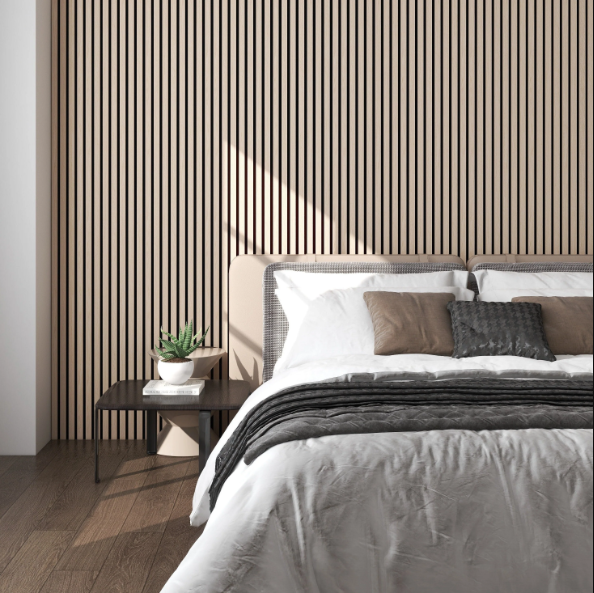
Modern wood slat acoustic panels typically combine a decorative slatted face with an absorptive backing or felt layer.
The design is different from a completely solid wood wall.
A flat, sealed wood surface tends to reflect substantial sound energy.
With a slatted acoustic assembly, sound can interact with the spaces between the slats and the absorptive backing behind them.
That creates a system designed to combine architectural appearance + absorptive treatment.
The exact performance depends on the specific construction.
Important variables include:
- slat width
- spacing between slats
- felt thickness
- backing density
- panel depth
- substrate
- air cavity
- additional insulation
- mounting method
That is why a visual match between two products does not prove identical acoustic performance.
Why Mounting Method Can Change NRC Performance
This is one of the most important points for specifiers.
A panel is not always tested directly against drywall.
Acoustic test reports can involve different mounting configurations.
For example, the test specimen might be:
- installed directly against a rigid surface
- installed over furring strips
- mounted with an air cavity
- installed over absorptive insulation
- suspended
- configured as a ceiling treatment
Adding depth or an air space behind an absorptive treatment can change its frequency response.
Therefore, when comparing two NRC values, ask: Were these products tested using the same mounting condition?
If not, the comparison may not be apples-to-apples.
Why You Should Ask for the ASTM C423 Test Report
ASTM C423 is a widely used laboratory test method for measuring sound absorption in a reverberation room.
If acoustic performance is important to the project, do not stop at a marketing statement such as “excellent acoustic performance.”
Ask for documentation.
A useful test report should help identify:
- the exact specimen tested
- product thickness
- material composition
- test surface area
- mounting condition
- frequency absorption coefficients
- reported NRC
- test laboratory
- test standard
- report date
These details tell you whether the tested product is actually the same product being specified.
For USA Builders Depot products, use the Acoustic Wall Panel Technical Resources page and the exact product documentation when a performance claim matters.
Do Not Transfer an NRC Rating From Another Product
Suppose two wood slat acoustic panels look virtually identical.
They may have the same finish, dimensions, slat pattern, color and thickness.
But underneath the veneer, one may use different felt, MDF density, spacing, adhesive, backing construction or cavity depth.
Their acoustic performance may therefore differ.
The same caution applies between product generations.
If a manufacturer changes the backing material, panel profile or construction, an older test report may no longer represent the current product.
Verify acoustic claims against the exact panel configuration and tested assembly rather than transferring a generic NRC value from another product.
Can Installation Improve Acoustic Performance?
Potentially, yes.
Installation conditions influence acoustic behavior.
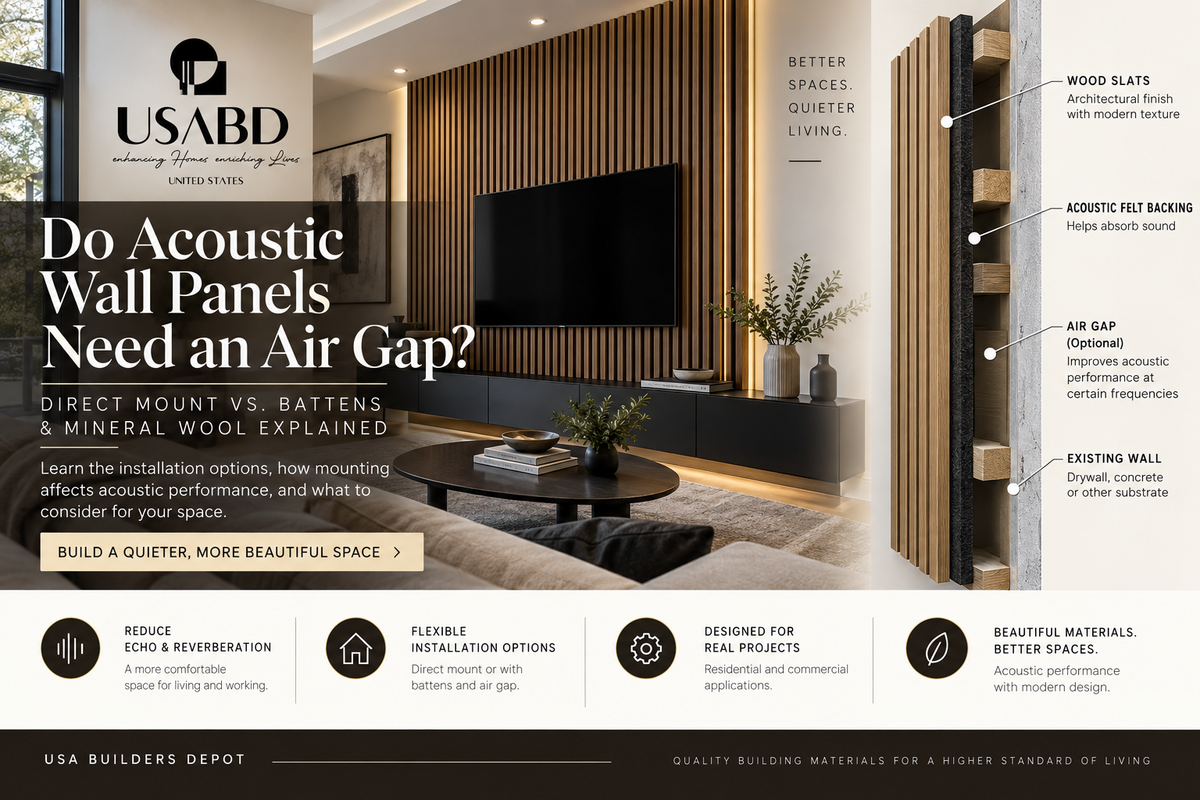
For some absorptive wall treatments, adding an air cavity behind the panel may improve absorption at certain frequencies compared with direct mounting.
In other situations, absorptive material can be added within the cavity.
But this should not become an excuse to invent a new NRC rating.
Unless the actual assembly has been tested, installers should describe the installation configuration—not assign it an unofficial performance number.
For specification-driven projects, use the tested assembly that matches the required performance.
How Much Wall Coverage Is Needed?
NRC does not tell you how many panels your room requires.
That is a separate question.
The acoustic result depends on room dimensions, ceiling height, total room volume, flooring, windows, furniture, ceiling material, wall construction, room purpose, amount of existing absorption, location of reflective surfaces and placement of the acoustic treatment.
A conference room, restaurant and home theater can have similar floor areas but very different acoustic requirements.
For quantity and placement planning, read How Many Acoustic Panels Do You Need? A Room-by-Room Placement Guide.
NRC and Reverberation Time
When a room contains many hard surfaces, sound reflections take longer to decay.
That lingering sound is described through reverberation.
In a practical sense, too much reverberation can make a room feel loud, hollow, echoey, difficult for conversation, or uncomfortable during group use.
Adding absorptive material can shorten the time sound continues bouncing around the room.
That is one reason acoustic wall panels are popular in conference rooms, offices, hospitality spaces, restaurants, media rooms, living rooms, home theaters, reception areas and educational spaces.
But the amount and location of treatment still matter.
Does a Higher NRC Always Mean a Better Panel?
No.
Higher sound absorption can be useful, but the best panel depends on the project.
Architects and designers may also need to consider:
- visual appearance
- wood species or veneer
- durability
- fire classification
- dimensions
- installation method
- cleanability
- edge treatment
- ceiling suitability
- material emissions
- code requirements
- project budget
For a decorative living-room feature wall, acoustic improvement may be one of several design goals.
For a recording or broadcast environment, the acoustic specification may drive the entire selection.
Context matters.
NRC and Fire Rating Are Not the Same Thing
A strong acoustic rating does not automatically mean a panel has the appropriate fire classification.
Acoustic performance and reaction-to-fire performance require different testing.
For projects where fire classification is required, review the documentation for the exact product rather than assuming an acoustic test also proves fire performance.
See our guide to ASTM E84 and Class A fire ratings for acoustic wall panels.
Keeping these specifications separate helps prevent one performance claim from being incorrectly used to imply another.
What About Acoustic Felt?
The felt layer behind many modern slat panels is not simply decorative.
It can contribute to acoustic absorption.
However, acoustic performance depends on the entire assembly, not merely the presence of felt.
Two felt-backed products can perform differently because of density, thickness, fiber composition, slat geometry, air space, mounting and backing construction.
So “felt-backed” should not be treated as an NRC rating.
It describes construction. The laboratory result describes performance.
Does Panel Thickness Matter?
It can.
Acoustic absorbers interact differently with different frequencies depending on material thickness and installation depth.
In broad terms, thin treatments typically address mid- and higher-frequency reflections more easily than very low-frequency energy.
But panel thickness alone cannot predict NRC.
A thicker decorative panel with a mostly reflective construction may absorb less sound than a thinner purpose-designed acoustic assembly.
Compare tested data, not thickness alone.
What Makes an Acoustic Panel Good for Speech?
For many everyday spaces, speech clarity is the primary objective.
Examples include offices, meeting rooms, restaurants, classrooms, reception areas and residential living spaces.
Because much of speech information sits within the mid-frequency range, reducing excessive reflections in that range can improve perceived clarity.
But room geometry and total reverberation also matter.
One wall of acoustic treatment may significantly improve some spaces while providing only a modest change in another.
Can NRC Values Be Greater Than 1.0?
Individual laboratory absorption coefficients can sometimes appear above 1.0 because of the characteristics of reverberation-room testing and specimen edge effects.
That does not mean a material literally absorbs more than 100% of incoming sound energy.
It is a consequence of the measurement method.
This is another reason acoustic test data should be interpreted as laboratory characterization rather than a simplistic percentage.
Questions to Ask Before Comparing Acoustic Panels
- Was this exact panel tested?
- Which ASTM or other recognized test method was used?
- What was the mounting configuration?
- Was there an air gap?
- Was insulation used behind the panel?
- What are the individual absorption coefficients?
- Is the quoted NRC from the current product configuration?
- Does the project also require a fire classification?
- Is sound absorption actually the problem—or is the real issue sound transmission between rooms?
- How much treatment is required for the room?
These questions are especially useful for commercial, hospitality, office and specification-driven projects.
Understanding USA Builders Depot Acoustic Wall Panels
USA Builders Depot offers decorative acoustic wood slat wall panels designed for interior wall and ceiling applications.
Available finishes and configurations vary by product.
For projects where an NRC or other acoustic rating is required, the correct approach is to request current documentation for the exact product and installation configuration.
Do not transfer an NRC value from another manufacturer or visually similar panel.
The same rule applies to fire performance and other technical characteristics.
Before You Specify Acoustic Wall Panels
A strong acoustic specification should answer three separate questions:
What should the space look like?
This establishes finish, profile, slat spacing, dimensions and architectural character.
What acoustic result does the project require?
This determines whether reverberation control, speech clarity, low-frequency treatment or sound isolation is the real objective.
What documentation proves the selected product meets that requirement?
This is where tested acoustic reports, mounting details and project specifications become important.
Separating these questions makes it much easier to choose materials responsibly.
Frequently Asked Questions
What is a good NRC rating for acoustic panels?
There is no universal number that defines the right panel for every room. Higher NRC values generally indicate greater average absorption across the frequencies included in the rating, but frequency response, installation and room requirements should also be considered.
Does NRC measure soundproofing?
No. NRC measures sound absorption characteristics. It is not a measure of how effectively a wall or partition prevents sound from passing into another room.
What is the difference between NRC and STC?
NRC relates to sound absorption within a space. STC relates to airborne sound transmission through an assembly.
Does NRC include bass frequencies?
Traditional NRC calculation does not include the 125 Hz octave band. If low-frequency performance is important, review the complete absorption data.
Is NRC 1.0 perfect sound absorption?
No. NRC is an averaged laboratory rating across specified frequency bands. It should not be interpreted as absorbing every sound at every frequency.
Can two panels with the same NRC sound different?
Yes. Their individual frequency absorption curves may differ even if the single-number averages are similar.
Does adding an air gap behind an acoustic panel help?
It can affect acoustic performance, but the amount of improvement depends on the panel and mounting configuration. Use tested assembly data when a specific rating is required.
Are wood slat panels the same as soundproof panels?
No. Wood slat acoustic panels are generally used to manage room reflections and reverberation. Sound isolation between rooms requires evaluation of the complete building assembly.
Should I ask for an ASTM C423 report?
If acoustic performance is important to the project or specification, requesting the current test report for the exact panel and mounting configuration is a sound practice.
Do USA Builders Depot acoustic panels all have the same NRC?
Do not assume so. Performance documentation should be matched to the exact product and configuration being ordered.