Steel Wine Cellar Doors: Insulated Glass, Seals, Condensation & Design Guide
A beautifully designed wine cellar can become one of the most distinctive architectural features in a luxury home.
Whether positioned beside a formal dining room, beneath a staircase, or within a dedicated entertainment area, a wine cellar combines functionality with interior design.
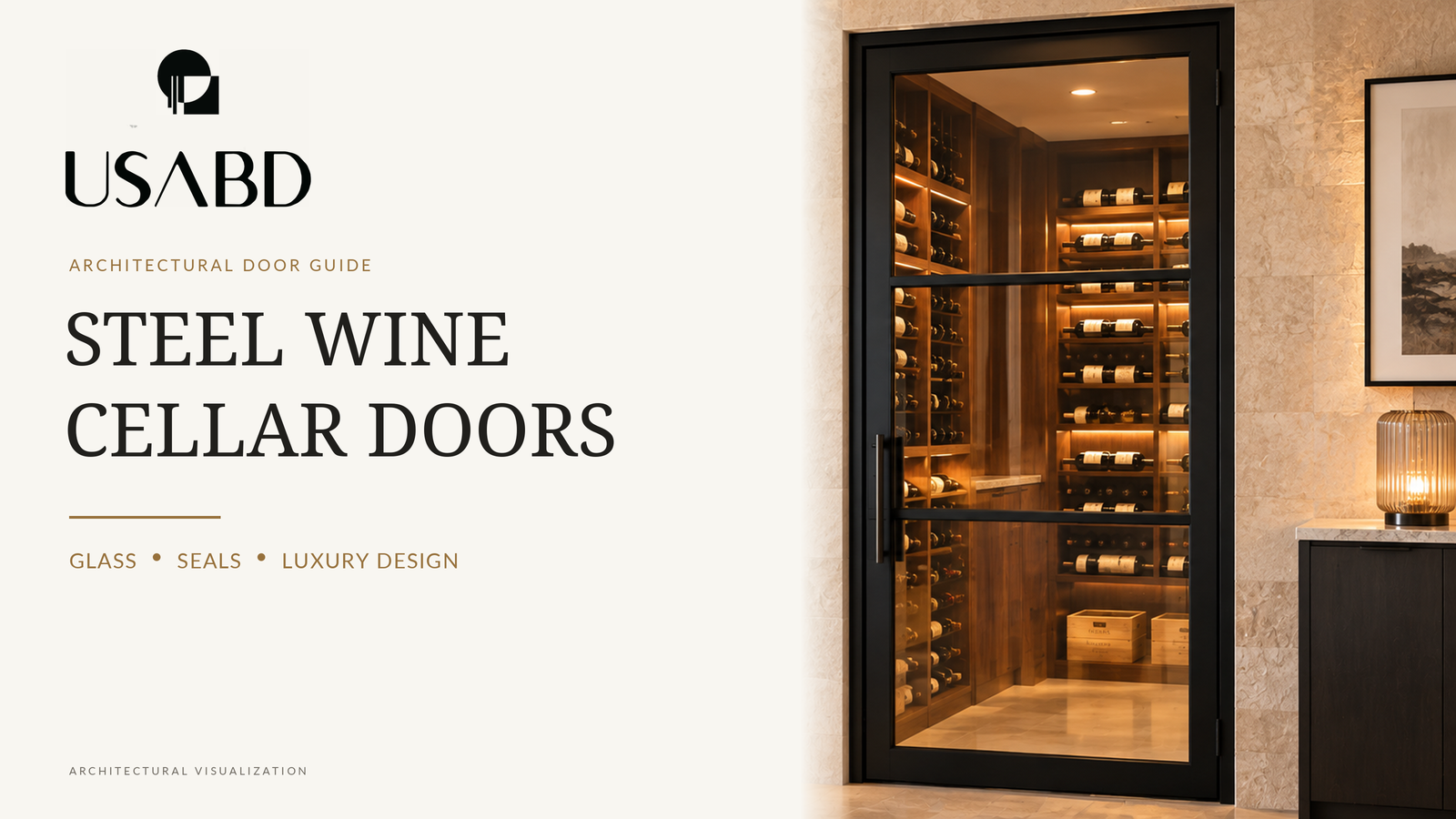
Many contemporary homes use black steel-and-glass doors to showcase wine collections.
Slim steel profiles, divided glass panels, walnut shelving, natural stone, and carefully coordinated lighting can create a sophisticated architectural entrance.
However, choosing a wine cellar door involves more than selecting an attractive design.
If the wine cellar is temperature-controlled, the door becomes part of the room’s thermal and moisture-control system.
The glass, frame, weather seals, threshold, and surrounding wall must work together to limit unwanted heat and air movement.
A decorative steel-and-glass door may look appropriate for a wine cellar but may not meet the performance requirements of a refrigerated space.
In this guide, USA Builders Depot explains how to choose a steel wine cellar door, what to consider for insulated glass and thermal performance, how to plan the opening, and which specifications should be confirmed before ordering.
Quick Answer: Are Steel Doors Suitable for Wine Cellars?
Yes. Steel-and-glass doors can be used for wine cellar entrances when the complete door assembly is suitable for the intended application.
For a decorative, non-refrigerated wine display, the primary considerations may be appearance, access, hardware, and installation.
For a temperature-controlled wine cellar, additional requirements apply.
The project team should evaluate the door’s glazing, frame construction, thermal performance, air sealing, bottom seal, and compatibility with the wine cellar’s cooling system.
A door marketed as a wine cellar door is not automatically an insulated or airtight assembly.
Before ordering, confirm whether the exact door configuration is appropriate for the temperature and humidity conditions of the planned cellar.
1. Decorative Wine Room vs. Temperature-Controlled Wine Cellar
The first step is determining how the wine room will function.
Not every wine display requires the same door construction.
Decorative wine rooms
Some homeowners create wine display rooms primarily for entertaining and architectural appearance.
These spaces may feature glass doors, illuminated shelving, stone walls, and custom wine racks.
If the space is maintained at approximately the same conditions as the adjoining living areas, its door may have requirements similar to other decorative interior doors.
However, the actual storage conditions still matter for the wines being kept.
Temperature-controlled wine cellars
A dedicated wine cellar may be designed to maintain cooler conditions than the surrounding home.
These spaces typically use a specialized cooling system.
They also require coordinated insulation, air sealing, moisture control, and appropriate construction materials.
The door becomes an important part of that system.
Why the distinction matters
A standard decorative steel door and a door designed for a refrigerated enclosure can look almost identical.
However, their frame construction, glazing, seals, and thermal characteristics may be substantially different.
Determine the wine cellar’s operating conditions before choosing the door.
2. Why Steel-and-Glass Wine Cellar Doors Are Popular
Steel-and-glass doors can create a striking architectural entrance.
Their appearance works particularly well with contemporary wine storage systems.
Slim architectural profiles
Steel frames can create narrow visual divisions between glass sections.
This allows the wine collection to remain visible.
Strong material contrast
Matte-black steel can provide a beautiful contrast against walnut shelving, natural limestone, white oak flooring, and warm interior lighting.
Divided-lite designs
Three-lite and other divided-lite configurations introduce visual structure without completely concealing the wine collection.
Custom finishes
Specialty steel doors may be available in selected black, bronze, and other architectural finishes.
The available finish should always be confirmed for the specific door model.
Custom dimensions
Architectural wine cellars often have nonstandard openings.
Custom fabrication can provide more design flexibility when the selected manufacturer offers suitable configurations.
However, the finished opening must still be coordinated with the complete door frame and installation requirements.
3. Do Wine Cellar Doors Need Insulated Glass?
For a temperature-controlled wine cellar, insulated glazing is an important consideration.
A large glass door can allow more heat transfer than a well-insulated opaque wall.
The amount depends on the glass construction, glass area, temperature difference, and other characteristics of the assembly.
Single-pane glass
Single-pane glass provides visual separation.
However, it generally offers less thermal resistance than a suitable insulated glazing unit.
For refrigerated wine-cellar applications, it should not automatically be considered an adequate specification.
Double-pane insulated glass
Double-pane insulated glass contains two glass panes separated by a sealed space.
The complete glazing unit can reduce heat transfer compared with a conventional single pane.
Actual performance depends on the glass, spacer, coatings, gas fill, and construction.
Low-E glass
Low-emissivity coatings can reduce radiative heat transfer.
However, different Low-E products have different properties.
A Low-E label alone does not establish the thermal performance of the complete wine cellar door.
Safety glazing
Glass installed in doors may be subject to safety-glazing requirements.
The exact applicable standard depends on the project and jurisdiction.
Confirm the specified safety-glazing construction and documentation.
What should you request?
Before ordering, ask for the actual insulated glazing specification, glass thickness, spacer information where relevant, safety-glazing documentation, and applicable thermal-performance data.
The complete door assembly matters—not simply the number of glass panes.
4. Why the Door Frame Matters as Much as the Glass
A wine cellar door consists of more than glass.
The surrounding frame can influence heat transfer and condensation.
Steel conducts heat
Steel is a thermally conductive material.
This means a continuous metal profile can transfer heat between environments.
For a refrigerated room, that may affect the surface temperature of the frame.
What is a thermal break?
A thermal break is a component or construction method designed to interrupt a conductive heat-transfer path.
Thermally broken steel systems can use specialized profiles that reduce heat conduction through the frame.
Is a thermal break always necessary?
The answer depends on the temperature difference, humidity conditions, complete door construction, and performance requirements.
A decorative wine room maintained at ordinary indoor temperatures may have different requirements from a wine cellar operating substantially below the surrounding home’s temperature.
Don’t confuse insulated glass with an insulated frame
A steel door can contain insulated glazing while still having a conductive metal frame.
The entire assembly must be evaluated.
Specify the complete system
If a project requires particular thermal performance, request documentation for the exact door configuration.
Do not assume that a thermal-break option offered on one steel-door model is available on every wine cellar door.
5. How to Prevent Condensation on Steel Wine Cellar Doors
Condensation is one of the most important concerns when selecting a door for a refrigerated wine room.
It can occur when moisture-containing air contacts a surface cold enough for water vapor to condense.
Why condensation happens
A cooled wine cellar may be substantially colder than the surrounding room.
If the door glass or frame becomes sufficiently cold, moisture from the surrounding air can collect on the surface.
This depends on temperature, humidity, and the thermal characteristics of the door.
Common condensation locations
Moisture may appear around metal frames, glass edges, glazing spacers, thresholds, or other cold surfaces.
Condensation vs. leakage
Water on the surface of a steel door does not necessarily mean water is leaking through it.
It may be condensation caused by surface temperature and humidity.
However, actual air leakage, water intrusion, and failures within an insulated glass unit should also be investigated where relevant.
How to reduce the risk
Appropriate insulated glazing, frame thermal design, perimeter sealing, humidity management, and complete installation detailing can help address condensation risk.
The correct specification depends on the conditions on both sides of the door.
For an actively refrigerated wine cellar, coordinate the design with the responsible cooling-system professional.
6. Why Wine Cellar Door Seals Are Important
A wine cellar cooling system works to maintain the intended indoor environment.
Uncontrolled air movement through gaps around the door can interfere with that process.
Perimeter weather seals
Compatible sealing components may be installed around the door frame to reduce unwanted air movement.
Their construction and location vary by door system.
Door alignment
A well-designed seal may not perform correctly if the door is misaligned.
The installed frame must be coordinated with the operating leaf and hardware.
Latching and compression
Some sealing systems depend on the door closing firmly against the weatherstripping.
The selected hardware and door construction must be compatible with that arrangement.
Double doors
Double doors create an additional meeting condition between the two leaves.
That center joint may require dedicated sealing details.
The complete assembly matters
A seal around only part of the door perimeter is not equivalent to a coordinated airtightness strategy.
For refrigerated wine rooms, review the complete door assembly and its installation requirements.
7. The Threshold: A Critical Detail for Refrigerated Wine Cellars
The bottom of a wine cellar door deserves special attention.
A beautifully fitted door may still permit significant air movement if the bottom is not properly detailed.
Door sweeps
Some door systems use a bottom sweep or similar component.
The correct design depends on the selected frame and threshold.
Threshold seals
A compatible threshold may create a surface against which the bottom seal operates.
Finished floor elevation
The threshold must coordinate with the final flooring.
Tile, natural stone, wood flooring, and other finishes can affect the available opening height.
Door operation
The sealing detail must not prevent the door from opening and closing correctly.
Planning recommendation
Confirm the bottom seal, threshold construction, finished-floor height, and installation detail before the door is fabricated.
Do not assume a standard interior door without a threshold provides the sealing performance required for a refrigerated wine cellar.
8. How Wine Cellar Doors Affect Cooling-System Sizing
The door can influence the amount of cooling required to maintain the wine cellar’s intended temperature.
Glass area
Larger glazed areas can increase heat transfer compared with suitably insulated opaque construction.
Surrounding room temperature
A wine cellar located beside a relatively warm room may experience different heat transfer from a cellar beside a cooler conditioned space.
Door-opening frequency
Frequent entry and exit can increase air exchange.
Insulation
Walls, ceilings, and other enclosure surfaces also affect the cooling load.
Lighting
Lighting introduces heat into a space.
The amount depends on the actual equipment and use.
Room volume
The full room dimensions matter when selecting a cooling system.
Why this should be calculated
Wine Guardian’s cooling-system sizing guidance specifically identifies glass coverage, insulation, room dimensions, and operating conditions as important inputs.
Its official calculator allows these factors to be evaluated during preliminary equipment selection.
A qualified cooling-system designer should confirm the final load rather than assuming a cooling unit will compensate for an unsuitable door.
9. Can a Wine Cellar Have Full-Height Glass Doors?
Yes, where the complete design is appropriate for the intended conditions.
Full-height glazing can create a dramatic architectural appearance.
It may allow the wine cellar to become a visible feature from a dining room, hallway, or entertainment area.
However, the larger glass area can influence heat transfer.
What should be considered?
The project team should evaluate the complete glass specification, frame thermal performance, air sealing, door height, hardware, and cooling requirements.
Floor-to-ceiling glazing
A design incorporating extensive glazing may require additional coordination beyond a conventional single-door opening.
Sidelights
Fixed glass sidelights can increase the visible area of the wine cellar.
However, they also become part of the thermal enclosure.
The correct approach
Do not size the cooling unit or finalize the door solely from an architectural rendering.
Confirm the complete glass and frame system before construction.
10. Single vs. Double Steel Wine Cellar Doors
The correct door configuration depends on the available opening and intended appearance.
Single steel wine cellar doors
A single steel door can be appropriate for smaller wine rooms or conventional walk-in cellar entrances.
It may create a restrained architectural appearance.
Double steel wine cellar doors
Double doors can create a more prominent entry.
They may suit larger custom wine rooms and formal entertainment spaces.
However, double doors introduce a center meeting condition that requires careful coordination.
Sealing considerations
For temperature-controlled spaces, the number of door leaves can influence the sealing design.
Hardware coordination
Confirm hinges, handles, latches, and any inactive-leaf hardware.
What should you choose?
The decision should reflect the required passage, intended architectural composition, actual door design, and thermal requirements.
11. How to Measure for a Custom Steel Wine Cellar Door
Correct measurement is essential for custom fabrication.
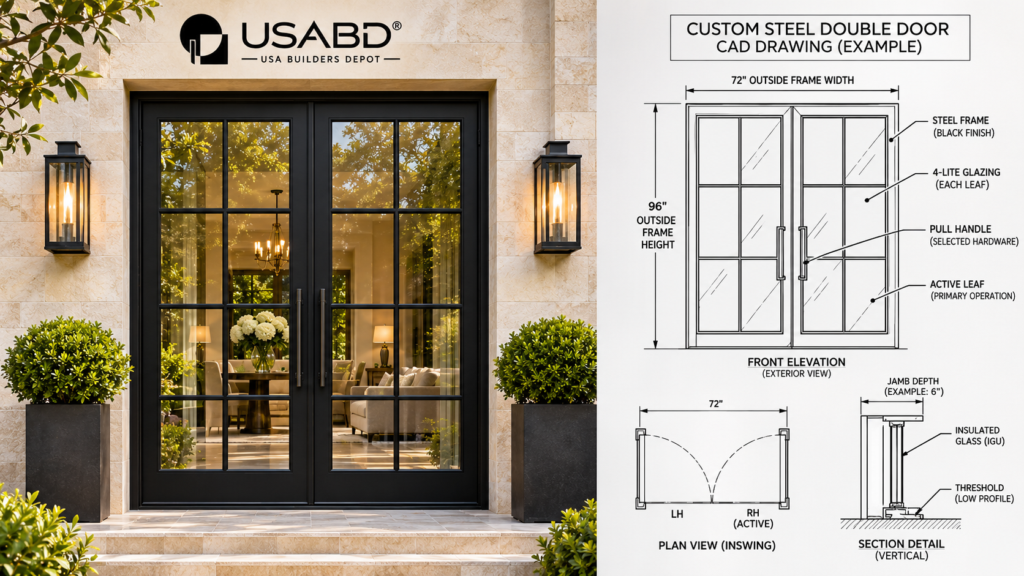
The nominal door size may differ from the outside dimensions of the complete frame.
Measure the opening
Record the actual opening width and height at multiple locations.
Check the opening
Verify that the opening is suitably plumb, level, and square.
Confirm the wall depth
The door frame must coordinate with the actual wall thickness.
A custom wine cellar may use a wall assembly that differs from an ordinary interior partition.
Confirm the finished floor
The final flooring height can affect the door and threshold.
Confirm the frame dimensions
The required structural opening should be based on the specific door’s documented frame dimensions and installation requirements.
Determine the swing direction
Confirm the location of the hinges and the intended door movement.
Coordinate hardware
Handles, locks, and other components must work with the complete door assembly.
Approve fabrication details
For custom orders, review the final approved drawing before production.
This should include the intended glass configuration, frame, hardware, sealing details, and dimensions.
12. How to Coordinate the Door With the Wine Cellar’s Construction
A refrigerated wine cellar must be planned as a complete enclosure.
The door cannot correct deficiencies in the surrounding construction.
Wall insulation
The walls should have an insulation strategy appropriate for the intended temperature conditions.
Ceiling insulation
The ceiling can be an important source of heat gain.
Moisture control
The wall assembly requires an appropriate vapor-control strategy.
The placement and type of vapor-control materials depend on the complete assembly and applicable building conditions.
Air sealing
Air leakage through gaps and penetrations can affect the cellar’s performance.
Door installation
The frame-to-wall connection must be properly detailed.
Cooling equipment
The cooling system must be selected for the actual enclosure, including the door and glass.
Construction coordination
The architect, builder, and cooling-system specialist should establish the required performance characteristics before the final door is ordered.
13. Steel Wine Cellar Door Design Ideas
There are several attractive ways to incorporate steel-and-glass wine cellar doors into a luxury residence.
Design A: Black Steel With Walnut Wine Racks
Combine a black steel-and-glass entrance with floor-to-ceiling walnut wine storage.
Use warm integrated lighting to highlight the bottle arrangement.
Design B: Steel Wine Cellar Door With Limestone Walls
Natural limestone can provide a refined backdrop for a black steel door.
The contrast creates a balance between metal and stone.
Design C: Modern Wine Cellar Beside the Dining Room
Position the wine room where it can be viewed from the dining area.
A glazed entrance allows the wine collection to become part of the interior architecture.
Design D: Wine Cellar Beneath the Staircase
Under-stair spaces can sometimes accommodate compact wine displays.
However, a temperature-controlled installation requires careful evaluation of insulation, available equipment space, and the enclosure.
Design E: Contemporary Wine Room With Bronze Steel
A selected bronze or dark metal finish can coordinate with warm wood cabinetry and natural stone.
The final finish should be confirmed against physical samples and product availability.
14. How to Coordinate Wine Cellar Lighting
Lighting has an important role in both appearance and function.
Integrated shelf lighting
Lighting within the wine racks can emphasize the arrangement of bottles.
Architectural accent lighting
Concealed lighting can highlight stone, wood, and other interior finishes.
Glass reflections
Large glazed doors can reflect surrounding lights and interior objects.
The lighting design should consider the intended viewing angles.
Heat considerations
Lighting contributes to the cellar’s internal heat load.
Select appropriate fixtures and coordinate their operation with the cooling-system design.
UV considerations
Where the design requires protection from ultraviolet light, review the documented performance of the selected glazing and lighting.
A decorative glass finish or a Low-E coating should not automatically be assumed to provide a particular UV-blocking percentage.
15. Common Steel Wine Cellar Door Mistakes
Several problems can occur when the door is selected without sufficient technical planning.
Mistake 1: Choosing by appearance alone
A beautiful steel-and-glass door does not automatically have suitable thermal performance.
Mistake 2: Assuming all double-pane glass is identical
Different insulated glass units can have different thermal characteristics.
Mistake 3: Ignoring the frame
Glazing performance does not establish the performance of the steel frame.
Mistake 4: Forgetting the bottom seal
A door may have perimeter weatherstripping but still experience air movement at the bottom.
Mistake 5: Ordering before confirming the cooling system
The cooling specialist may identify specific thermal or air-sealing requirements.
Mistake 6: Using an inappropriate rough opening
The nominal door size may not equal the required structural opening.
Mistake 7: Forgetting the finished floor
An improperly coordinated floor elevation can affect the threshold and door operation.
Mistake 8: Ignoring condensation
The temperature difference between the cellar and surrounding room may create condensation concerns.
Mistake 9: Assuming decorative cold-rolled steel is thermally broken
Cold-rolled steel describes material processing. It does not establish that a door has a thermal break or particular insulation performance.
Mistake 10: Approving fabrication without reviewing the complete specification
The final order should reflect the intended application, not simply the preferred glass pattern and size.
16. What to Know About USA Builders Depot Steel Wine Cellar Doors
USA Builders Depot offers a custom-crafted three-lite cold-rolled steel wine cellar door.
Selected sizes are available through the current product listing, along with options for custom dimensions.
The product features a glass-forward architectural appearance intended to showcase the wine collection beyond the door.
Current product information identifies an estimated delivery period of 8–12 weeks.
Actual specifications, options, and delivery requirements should be confirmed before purchase.
Important for temperature-controlled wine cellars
The standard product listing should not be interpreted as confirmation that every configuration is suitable for a refrigerated wine cellar.
If the project requires specific insulation, air sealing, glazing, or thermal performance, provide those requirements to USA Builders Depot before ordering.
The appropriate complete door configuration and available documentation must be confirmed.
Custom orders
For a custom quotation, provide the proposed door size, opening dimensions, frame requirements, glass preferences, finish, hardware, and intended cellar conditions.
The final fabrication details should be reviewed before production.
17. Steel Wine Cellar Door Specification Checklist
Before ordering, confirm:
- Whether the space is decorative or temperature-controlled.
- Intended cellar temperature and humidity.
- Temperature conditions outside the cellar.
- Door width and height.
- Actual rough opening.
- Wall thickness and required jamb depth.
- Single or double configuration.
- Door handing and swing.
- Frame construction.
- Required thermal performance.
- Glazing construction and safety requirements.
- Any required insulated glass or Low-E specifications.
- Perimeter weather seals.
- Bottom seal and threshold.
- Hardware and latching requirements.
- Condensation considerations.
- Cooling-system requirements.
- Finish and color.
- Required technical documentation.
- Approved fabrication drawing.
- Installation responsibilities.
- Project location and delivery requirements.
- Custom fabrication and delivery schedule.
The objective is to confirm the complete system before manufacturing.
Frequently Asked Questions
Can a steel door be used for a wine cellar?
Yes, when the complete steel-door assembly is suitable for the intended application.
Do wine cellar doors need insulated glass?
For temperature-controlled wine cellars, insulated glazing is an important consideration. The final requirements depend on the intended temperature conditions and complete enclosure design.
Are all steel wine cellar doors thermally broken?
No. A door described as steel or cold-rolled steel is not automatically thermally broken.
Does a wine cellar door need weatherstripping?
A temperature-controlled enclosure generally requires an appropriate air-sealing strategy. The exact door seals depend on the selected system.
Can a wine cellar door have a threshold?
Yes. A compatible threshold may be used as part of the door’s bottom-sealing arrangement.
Why does condensation form on steel wine cellar doors?
Condensation can occur when a metal or glass surface becomes colder than the dew point of the surrounding air.
Can Low-E glass help a wine cellar door?
Low-E coatings can reduce radiative heat transfer, but the final performance depends on the complete glazing and door assembly.
Can a wine cellar have full-height glass doors?
Yes, where the glazing, framing, cooling capacity, and other enclosure requirements are appropriately designed.
Does a larger glass door increase cooling requirements?
It can. The effect depends on the glass area, thermal characteristics, and temperature difference.
Can I use a standard interior steel door for a refrigerated wine cellar?
Do not assume that a standard decorative interior door has the required thermal and sealing performance.
Can wine cellar doors be custom-sized?
Selected specialty steel doors can be custom-manufactured. Confirm the available sizes and final specifications with the manufacturer.
How long do USABD custom wine cellar doors take?
The current USABD wine cellar door listing identifies an estimated 8–12-week delivery period. Confirm the schedule for the exact order.
What should I send when requesting a custom wine cellar door?
Provide the opening dimensions, desired design, glass requirements, finish, swing direction, intended cellar conditions, and any performance requirements established by the project team.
What is the most important thing to confirm?
For a temperature-controlled wine cellar, verify that the complete door assembly is suitable for the required operating conditions before ordering.
Final Thoughts: Design the Wine Cellar Door as Part of the Complete Room
A steel-and-glass wine cellar door can create a sophisticated architectural entrance.
The combination of slender metal profiles, illuminated wine storage, natural stone, and warm wood finishes can make the cellar an attractive feature within a luxury home.
However, a decorative door and a door intended for a refrigerated room are not necessarily the same product.
For a temperature-controlled wine cellar, glazing, frame construction, thermal performance, air sealing, threshold details, and cooling-system requirements must be evaluated together.
The best results come from coordinating the door with the complete cellar design before fabrication.
Choose the architectural appearance you want, then confirm the technical construction required for the space.
Explore Steel Wine Cellar Doors at USA Builders Depot
USA Builders Depot offers custom-crafted architectural steel wine cellar doors in selected sizes and finishes.
Explore our current steel wine cellar door design and request a custom quotation for your project.
For temperature-controlled wine rooms, provide the relevant thermal, glazing, and sealing requirements before ordering so the appropriate specifications can be reviewed.
USA BUILDERS DEPOT
Build a Better Tomorrow.