Steel Door Condensation: Why It Happens and How to Reduce It
You walk up to your steel entry door on a cold morning and notice water droplets on the frame. Or maybe the glass is fogged. Or the bottom of the door feels damp.
The first reaction is often: “My door is leaking.”
But visible moisture on a steel door does not automatically mean water is entering from outside. It may be condensation.
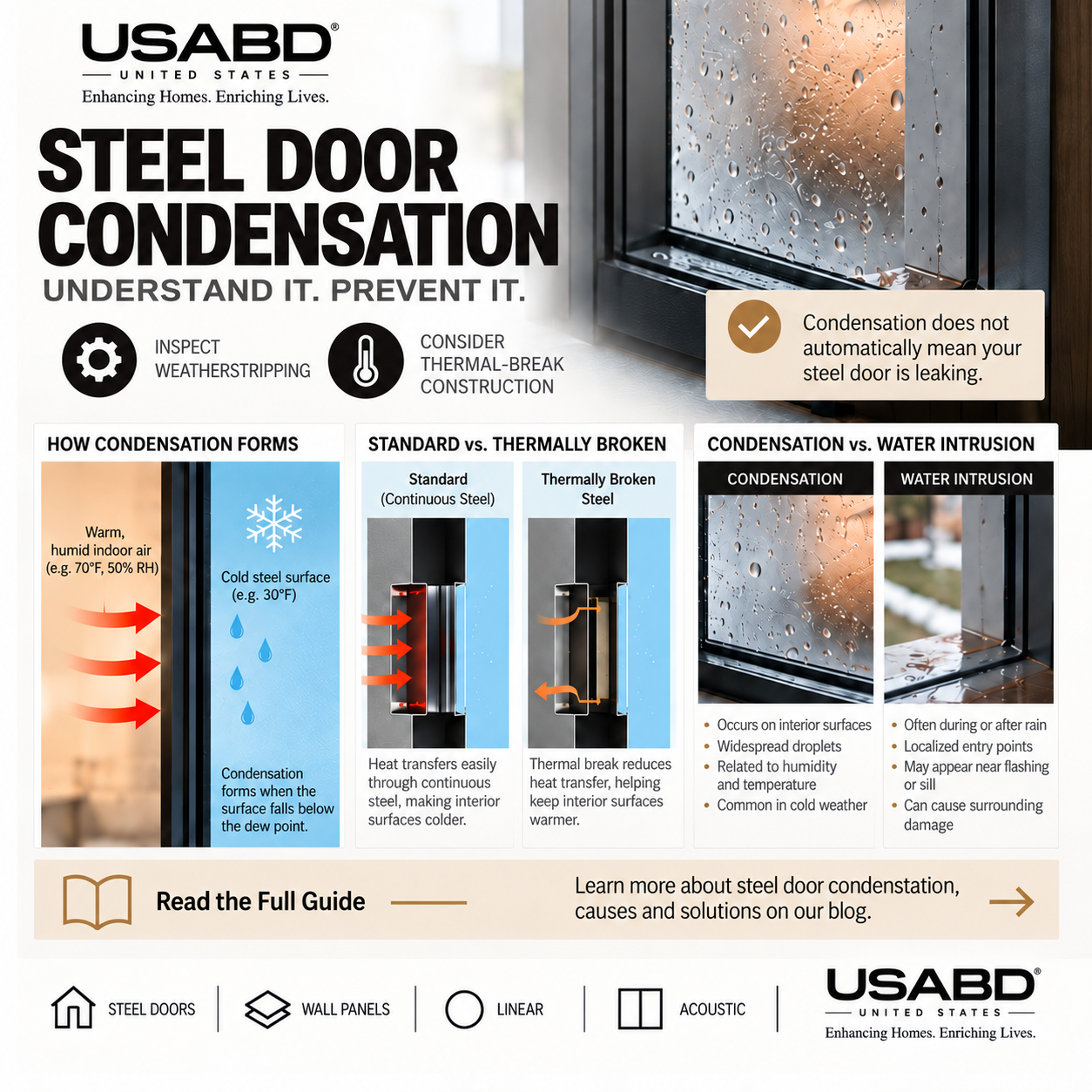
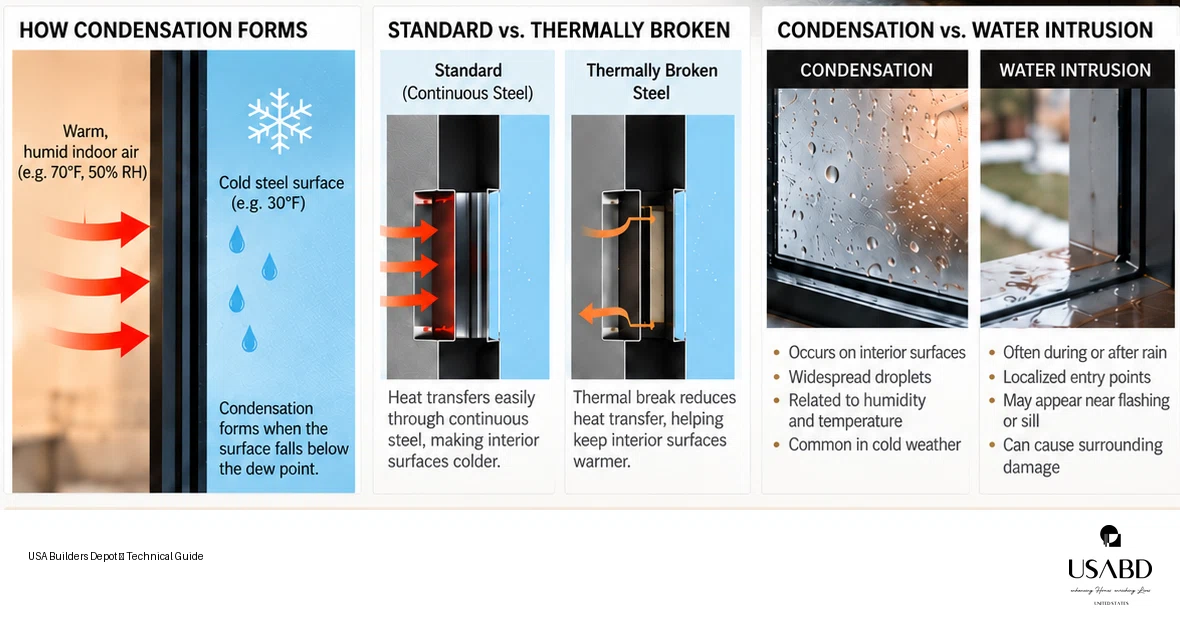
Condensation happens when warm, moisture-containing air comes into contact with a surface cold enough to fall below the air’s dew point.
That can happen on steel frames, steel door profiles, glass, thresholds, hardware, sidelights and transoms.
And because steel conducts heat efficiently, thermal design matters more than many homeowners expect.
Quick Answer: Why Is My Steel Door Sweating?
A steel door can “sweat” when the interior-facing metal or glass becomes colder than the dew point of the indoor air.
The most common factors are high indoor humidity, very cold outdoor temperatures, conductive steel profiles, non-thermally-broken frames, poorly performing glass, air leakage, damaged or compressed weatherstripping, threshold leakage, poor frame alignment, insufficient insulation around the rough opening and installation gaps.
What Is Condensation?
Condensation is liquid water that forms when water vapor in the air changes into liquid on a cooler surface.
Think about a cold glass of water on a humid summer day. The water on the outside of the glass did not leak through the glass. It formed because the surface became cold enough for moisture in the surrounding air to condense.
The same thing can happen on a steel entry door.
What Is the Dew Point?
The dew point is the temperature at which moisture in the air begins condensing onto a surface.
If the interior surface of your steel door stays above the dew point, condensation is less likely. If the surface drops below the dew point, moisture can form.
That means condensation depends on two things working together:
- The temperature of the door surface.
- The amount of moisture in the indoor air.
This is why two identical doors installed in different houses can behave differently.
Why Steel Doors Can Show Condensation
Steel is a strong and visually attractive architectural material. It is also highly conductive.
Without a thermal break or other thermal-control features, heat can move efficiently through a continuous metal profile. During winter, that conductive path can cool interior-facing portions of the frame.
If those surfaces become cold enough, indoor moisture can condense on them. This is called thermal bridging.
What Is a Thermal Bridge?
A thermal bridge is a path through which heat moves more easily than through the surrounding construction.
Continuous steel can create a strong thermal bridge because metal conducts heat efficiently. A thermally broken profile interrupts that direct conductive path.
What Is a Thermally Broken Steel Door?
A thermally broken steel door uses a separating material or engineered profile to reduce direct heat flow through continuous metal.
The purpose is to reduce conductive heat transfer. A thermal break can help keep interior-facing surfaces warmer in cold weather, improve comfort near the door, reduce conductive heat loss and lower the risk of condensation.
But it is important to use the word reduce. A thermal break does not make condensation physically impossible.
For a deeper explanation, read our Thermal Break Steel Doors Guide.
Can a Thermally Broken Steel Door Still Condense?
Yes. Suppose outdoor conditions become extremely cold while indoor humidity remains high.
Even a thermally improved interior surface can potentially fall below the indoor-air dew point. That does not automatically mean the thermal break failed.
The entire condition has to be evaluated.
Indoor Humidity Is One of the Biggest Variables
The more moisture indoor air contains, the easier it becomes for condensation to form on cold surfaces.
Common indoor moisture sources include showers, cooking, boiling water, humidifiers, drying clothes indoors, plants, large numbers of occupants, newly installed concrete or drywall, poorly ventilated bathrooms and indoor pools or spas.
What Indoor Humidity Should You Maintain?
There is no single humidity percentage that guarantees zero condensation under every weather condition.
The colder it gets outside, the lower indoor humidity may need to be to prevent moisture from forming on cold surfaces.
The correct target depends on outdoor temperature, building envelope, HVAC system, ventilation, door and window performance, and occupant comfort.
Condensation vs. Water Leakage
This distinction is critical.
Condensation
Condensation typically appears when outdoor temperatures are cold, indoor humidity is high, and moisture forms on cold interior metal or glass.
Water intrusion
Water intrusion may appear during or after rain, near flashing joints, around the sill, around frame-to-wall transitions, or at specific penetrations.
A door can experience both problems at the same time, so do not diagnose purely from one photograph.
Condensation vs. Air Leakage
Air leakage is another separate issue. A draft means air is moving through or around the door assembly.
Common air-leakage locations include weatherstripping, corners, meeting stiles, threshold, door sweep, frame perimeter, installation gap and hardware penetrations.
Cold air leakage can lower interior surface temperatures and make condensation more likely.
So air leakage and condensation are different phenomena—but they can contribute to each other.
Weatherstripping Matters
Weatherstripping creates a compressible seal around the operating perimeter of the door.
If the door is not properly aligned, weatherstripping may barely touch in some areas, compress excessively in others, leave visible gaps, pull away at corners or become damaged over time.
A thermally broken steel door cannot compensate for major air leakage around poorly adjusted seals.
Check Door Alignment
A door should close consistently against the seals.
If the frame is out of square or the door leaf is misaligned, compression can vary around the perimeter.
Check hinge alignment, latch engagement, top corners, meeting stiles on double doors, threshold contact, sweep contact and weatherstrip compression.
For new projects, proper opening preparation is one reason our Steel Door Rough Opening Guide is important.
The Threshold Can Condense Too
The threshold is often overlooked, but the bottom of the door is one of the most complicated thermal areas in the entire assembly.
It may interact with interior flooring, exterior paving, slab, waterproofing, drainage, door sweep, metal sill components and weather seals.
A conductive threshold can become cold. Air leakage at the bottom can make conditions worse.
For a detailed bottom-of-door guide, see the Steel Door Threshold & Sill Guide.
Condensation on Steel Door Glass
Glass can also develop condensation. The same dew-point principle applies.
If the interior glass surface becomes cold enough, water vapor can condense on it.
Glass performance can depend on single vs. insulated glazing, number of panes, spacer system, Low-E coating, gas fill, glass size, frame design, edge-of-glass conditions and air leakage.
Modern steel exterior doors with glass can contain large areas of glazing, which makes the glass package increasingly important to overall thermal behavior.
Does Low-E Glass Stop Condensation?
Not necessarily. Low-E coatings are designed to influence radiant heat transfer and can contribute to improved thermal performance depending on the exact glazing system.
But Low-E glass alone does not guarantee that condensation will never occur.
Does Double-Pane Glass Help?
Insulated double-pane glass can help keep interior glass surfaces warmer than comparable single-pane glass under similar conditions.
That can reduce condensation risk. But the exact glass assembly matters.
Why the Edge of the Glass Can Condense First
The center of an insulated glass panel may remain relatively warm while the perimeter is colder.
The glass edge sits near spacer systems, steel framing, glazing stops and seals. That can create localized colder surfaces.
So condensation may first appear as a narrow band near the glass perimeter.
Condensation on the Frame but Not the Glass
This pattern can indicate that the steel frame is acting as the colder thermal path.
That is one reason thermally broken frame construction matters.
Condensation on Glass but Not the Frame
The opposite can also happen. The frame may be thermally improved while the glass package becomes the colder surface.
That is why thermal performance should be evaluated as a complete opening, not as one material.
Single vs. Double Steel Doors
Double steel doors introduce additional joints.
The meeting point between the two leaves can include weatherstripping, astragals, flush bolts, lock hardware, thresholds and overlapping seals.
Poor adjustment at the meeting stile can increase air leakage and lower local surface temperatures.
Steel French Doors and Condensation
Steel French doors usually contain relatively large glass areas.
That makes both the steel profiles and glass package important. For a large glazed entry, thermal behavior may be affected by the door profile, glass specification, frame, threshold, active/inactive leaf seals and installation.
Custom-Size Steel Entry Doors
Custom-size steel entry doors deserve early thermal coordination.
Oversized doors can have taller profiles, more glass, larger perimeter lengths, custom frames, sidelights and transoms.
That does not mean they will automatically perform poorly. It means the complete configuration should be reviewed rather than assuming performance from a smaller standard door.
Why Condensation May Be Worse on Very Cold Mornings
The colder it gets outside, the greater the temperature difference across the door.
That can pull the interior surface temperature downward. A door that remains dry at 35°F outside may show condensation during a much colder event if indoor humidity remains the same.
Why Condensation May Appear After a Shower
A shower can cause indoor humidity to rise quickly.
If the entry door is already cold, the increase in moisture can push the indoor dew point upward. The door surface may suddenly fall below that new dew point.
Why New Construction Can Have More Moisture
New homes can contain significant construction moisture. Concrete, joint compound, paint and other building materials may release moisture while drying.
A newly completed house can therefore experience unusually high indoor humidity during its first heating season.
What About Summer Condensation?
Condensation is not exclusively a winter phenomenon.
In hot, humid weather, a strongly air-conditioned interior can cool exterior-facing components enough that outdoor moisture condenses on them.
First identify which side of the door is wet.
How to Reduce Steel Door Condensation
1. Check indoor humidity
Use a hygrometer. If indoor humidity is very high during cold weather, reduce moisture sources where appropriate.
2. Use exhaust ventilation
Run bathroom fans during showers. Use kitchen exhaust during cooking. Make sure dryers vent outside.
3. Inspect weatherstripping
Look for tears, gaps, hardening, flattened seals and loose corners.
4. Verify door alignment
Make sure the leaf compresses the weatherstripping evenly.
5. Inspect the threshold
Check for gaps at corners, sweeps, meeting stiles and sill transitions.
6. Check perimeter sealing
The gap between the frame and rough opening should be appropriately insulated and sealed according to the exact installation requirements.
7. Evaluate the thermal design
If condensation is a persistent concern in a cold climate, evaluate thermal-break construction, U-factor, glass package, condensation resistance, air leakage and threshold design.
What Is Condensation Resistance?
Some rated windows, doors and skylights carry a Condensation Resistance value.
If a project specifically requires this rating, request documentation for the exact model and configuration. Do not transfer a rating from another door.
What Is U-Factor?
U-factor measures heat transfer through a fenestration assembly. Lower U-factor means lower heat transfer.
A lower U-factor does not directly mean “no condensation,” but improving thermal performance can help keep interior surfaces warmer.
Does Condensation Mean the Door Is Defective?
Not automatically.
Condensation is a physical interaction between indoor moisture, outdoor temperature, surface temperature, product performance, installation and air leakage.
A properly installed high-performance door can still experience condensation under sufficiently demanding conditions.
On the other hand, persistent or unusually severe condensation can also signal an installation, sealing or product-performance issue worth investigating.
When Should You Investigate Further?
- Condensation occurs during mild weather.
- Water is dripping heavily.
- Condensation appears only at one corner.
- Surrounding drywall becomes wet.
- Moisture appears during rain rather than cold weather.
- Significant drafts are present.
- Ice forms repeatedly.
- Weatherstripping is damaged.
- The door does not close squarely.
- Water appears beneath the threshold.
- The frame installation gap may be uninsulated.
Do Not Immediately Caulk Every Joint
Adding sealant everywhere can hide symptoms without correcting the actual problem.
Some joints are part of drainage, pressure equalization, glazing or threshold systems. Do not block intentional drainage paths.
Thermally Broken Steel Doors for Cold-Weather Projects
When condensation resistance and thermal comfort are priorities, thermally broken steel doors are worth considering.
USA Builders Depot offers a dedicated thermally broken steel-door collection in single, double, sidelight and custom configurations.
Performance varies by model, so project-specific thermal documentation should be confirmed for the exact door.
Documentation-First Specification
If the project depends on a particular thermal rating, request the exact current documentation.
Relevant documents may include U-factor, NFRC rating, Condensation Resistance, glass specification, thermal-break construction, air leakage and installation requirements.
Use the Steel Door Technical Resources page and confirm the exact selected profile before relying on any performance claim.
Steel Door Condensation Troubleshooting Checklist
| Question | Check |
|---|---|
| Is the moisture on the interior or exterior? | □ |
| What is the outdoor temperature? | □ |
| What is the indoor relative humidity? | □ |
| Is condensation on glass, metal or both? | □ |
| Is the frame thermally broken? | □ |
| Is the weatherstripping intact? | □ |
| Does the door compress seals evenly? | □ |
| Is the threshold properly sealed? | □ |
| Does moisture occur only during rain? | □ |
Frequently Asked Questions
Why is my steel door sweating?
Because the interior-facing metal or glass may have fallen below the dew point of the indoor air.
Is steel door condensation normal?
Some condensation can occur under sufficiently cold or humid conditions, even on improved products. Persistent or severe condensation should still be investigated.
Does condensation mean my steel door is leaking?
No. Condensation and water intrusion are different phenomena.
Will a thermally broken steel door stop condensation?
It can reduce the risk by limiting conductive heat transfer, but it cannot guarantee zero condensation under every indoor humidity and outdoor temperature condition.
Can high humidity cause steel door condensation?
Yes. Higher indoor humidity raises the dew point, making condensation more likely on cold surfaces.
Can damaged weatherstripping make condensation worse?
Yes. Air leakage can cool localized surfaces and contribute to condensation.
Why does condensation form around the frame instead of the glass?
The frame may be the colder thermal path, especially if continuous metal creates stronger thermal bridging.
Can steel French doors get condensation?
Yes. Their large glass areas and meeting-stile seals make the complete door and glazing configuration important.
Can modern steel exterior doors with glass be energy efficient?
They can be, depending on the exact frame, thermal break, glazing, threshold, seals and verified performance data.
What if water appears only when it rains?
That pattern may indicate water intrusion rather than simple condensation and should be investigated accordingly.
The Bottom Line
Steel door condensation is not simply a “door problem.” It is a temperature + humidity + surface-performance + installation problem.
The most effective approach is to determine where the moisture is, when it occurs, what the indoor humidity is, how cold the surface is, whether air is leaking, and how the door is constructed and installed.
From there, the response may involve humidity control, weatherstrip adjustment, threshold correction, installation repair, glass evaluation or selecting a more thermally improved door system.
Explore modern steel entry doors or thermally broken steel doors.
Written by USA BUILDERS DEPOT