
Choosing Wall Panels: Materials and Sustainability Checklist
If environmental considerations are part of your wall-panel selection, start with specific questions rather than broad labels. Compare the exact product, its intended use, the documentation available and how it will be installed and maintained. A natural appearance or an “eco” description is not enough to establish a product’s environmental performance.

1. Define what matters to your project
Write down the criteria you want to evaluate: material sourcing, recycled content, emissions information, repairability, maintenance or disposal options. Separate these from appearance and budget so each can be checked on its own terms. If your project has a formal specification, give it to the supplier before selecting a product.
Consider whether the existing wall finish can be retained or repaired. If new paneling is appropriate, decide how much coverage the design needs. A feature area or partial-height treatment may achieve your visual goal without covering every wall.
2. Compare the exact construction
Browse our wall panel collection and record the product name, construction, finish, dimensions and intended location. Avoid assuming every panel in a broad category contains recycled material or carries the same documentation.
| Material description | Questions to resolve |
|---|---|
| Solid wood or natural veneer | What species, backing, finish and sourcing information apply to this product? |
| MDF-based panel | What is the complete construction, and what emissions and finish documentation is available? |
| WPC or another composite | What composition is declared? Is recycled content documented for the exact selection? |
| PVC or another polymer panel | What use and care limitations apply? Are local disposal or recycling options confirmed? |
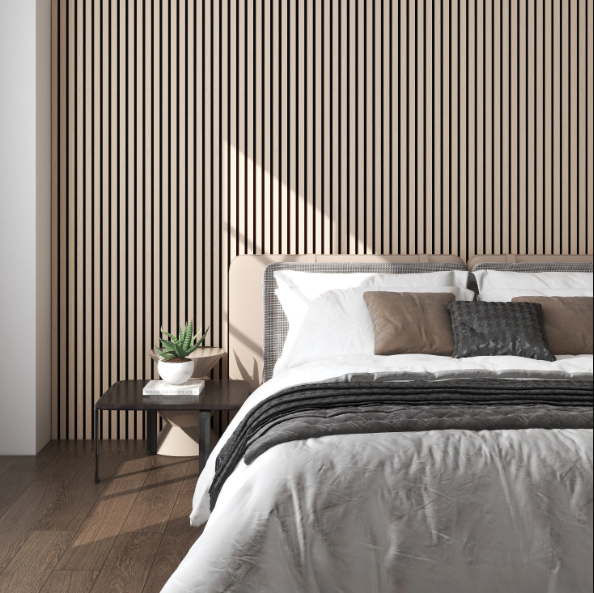
| Slatted acoustic panel | What are the face and backing materials? Which acoustic or other performance claims have supporting documentation? |
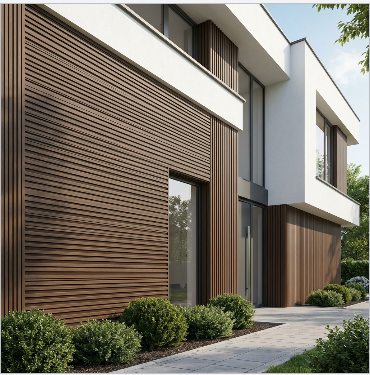
Material appearance does not establish wet-area suitability. Confirm exposure limits and the installation system separately for kitchens, bathrooms, ceilings or outdoor locations. Decorative paneling should not be treated as a waterproofing system or insulation without applicable documentation.

3. Ask for evidence behind each claim
Request documents tied to the exact product or clearly identified product range. Record who issued them, what they cover and whether they remain current. Ask the supplier to clarify any mismatch between the listing and the documentation.
- For a sourcing claim, ask which product and supply-chain information supports it.
- For recycled content, ask what percentage is declared and which components it covers.
- For emissions requirements, ask for the relevant testing or certification and its scope.
- For acoustic, thermal or fire-performance requirements, ask which tested product and installation arrangement the information describes.
These are separate questions. Evidence supporting one claim should not be used as proof of every other benefit. Do not promise healthier rooms, energy savings or a particular service life based only on a panel category.
4. Plan cuts, finishes and accessories together
Draw wall dimensions, openings, panel joints and edge details before calculating quantities. Have the installer recommend an allowance based on the layout, rather than adding an arbitrary amount. Discuss which offcuts can be used and whether spare material should be retained for repairs.
Approve samples with the flooring, furniture and lighting so the selected finish is right before installation. Include matching trims in the order. For veneer projects, review the natural veneered corner trims and confirm compatibility. Our half-wall paneling guide covers partial-height layout and top-edge decisions.

5. Review maintenance and future replacement
Ask how the finish should be cleaned, whether damaged sections can be replaced and how the attachment method affects removal. Do not add coatings or use a cleaner simply because it is described as natural; confirm compatibility with the selected surface.
Check local reuse, recycling or disposal arrangements before assuming a removed panel will be accepted. Keep the product code, finish name, installation instructions and supplier details with your project records. Where replacement matching matters, discuss available spare material and storage requirements.

6. Use a documented selection checklist
- Exact product, construction, finish and intended application.
- Evidence for the specific environmental or performance claims important to the project.
- Approved layout, quantities, accessories and installation method.
- Current availability, delivery charges and applicable return terms.
- Care instructions and a practical repair or replacement plan.
Call or email USA Builders Depot with your wall dimensions, preferred finish and documentation requirements to discuss current options. Visits to our Marietta showroom are by appointment only.