
How to Mount Outdoor Wall Lights on Exterior WPC Cladding: Flashing, Backing & Fluted-Panel Details
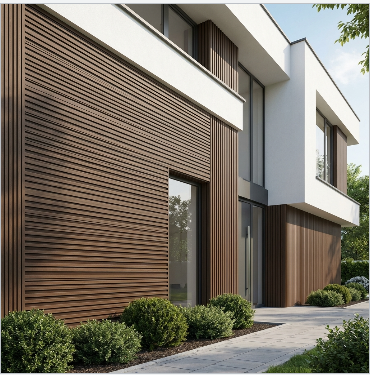
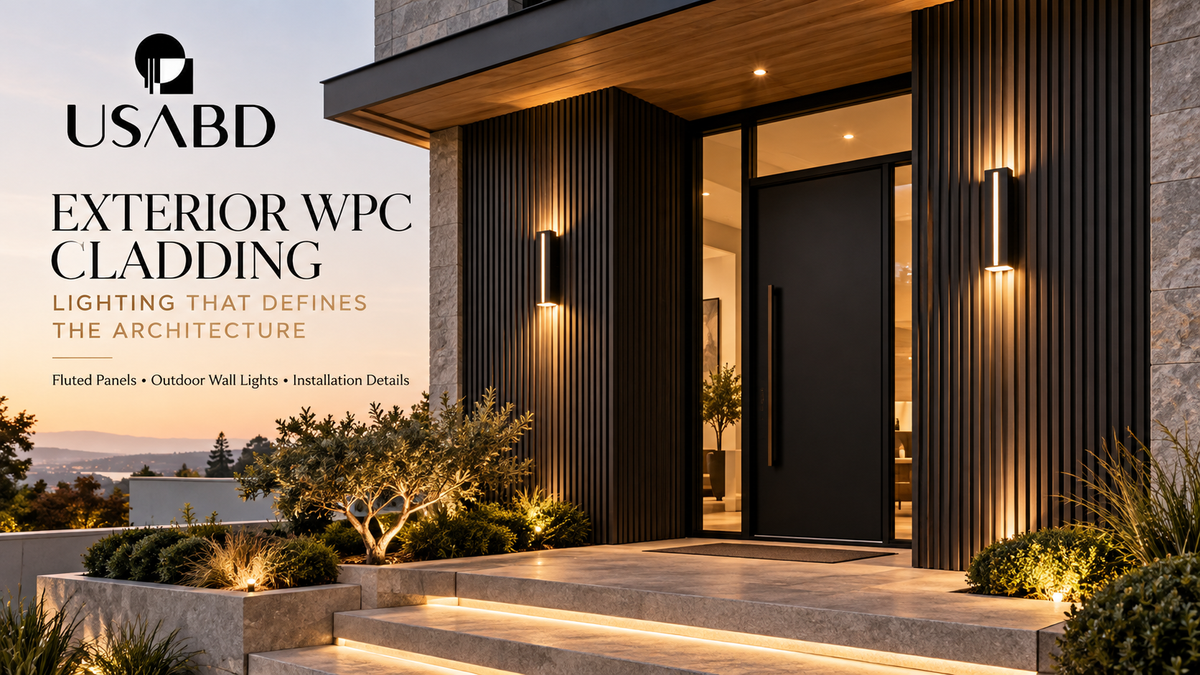
Exterior lighting can transform a home. By day, modern façades may feature warm wood-look cladding, steel entry doors, and carefully proportioned windows. At night, architectural wall lights can reveal the texture of these materials. Vertical fluted WPC cladding is especially attractive when light crosses the raised and recessed profiles. But installing outdoor lights on exterior WPC cladding requires coordination among the fixture, electrical box, structural backing, cladding system, and the wall's water-management details. The finished installation should be visually refined, securely supported, suitable for exterior exposure, and integrated into the building envelope.
Quick Answer: Can You Install Outdoor Wall Lights on WPC Cladding?
Yes. Outdoor wall lights can be incorporated into WPC-clad walls when the mounting system is supported properly, the electrical installation complies with applicable requirements, and wall penetrations are correctly flashed and sealed. The decorative panel should not automatically be treated as the fixture's structural support. Some WPC products include hollow sections or profiles unsuitable for concentrated loads. Confirm the actual WPC profile, fixture weight and mounting plate, electrical box, structural wall, water-resistive barrier, and panel movement requirements. Coordinate lighting before cladding installation where possible. A qualified electrician should handle electrical work.
Why Fluted WPC Cladding Looks Beautiful With Outdoor Lighting
Fluted cladding introduces texture through repeating ridges and grooves. Light cast across the surface forms alternating shadow and illumination. Narrow up-and-down sconces can emphasize vertical proportions, while appropriately positioned grazing lights may highlight the depth of the flute pattern. Black or dark bronze fixtures can complement Golden Teak, Brown Walnut, Ash Gray, and Charcoal/Black architectural finishes. The right visual effect depends on fixture optics, distance from the wall, and the actual profile geometry. Plan the overall composition of entry door, windows, porch and landscape together.
1. Understand What Is Behind Exterior WPC Cladding
Exterior WPC is typically a visible finish over an assembly that may include framing, sheathing, air-control layers, a water-resistive barrier (WRB), insulation, furring, a drainage cavity, and supporting members. Not every wall has the same construction. Decorative cladding should not automatically be considered the primary waterproofing system or the structure supporting accessories. A light's attachment or wiring may penetrate several layers. Without properly coordinated water management, rainwater may enter behind the finish. Exterior penetrations should be integrated with the applicable air- and water-control layers. Treat a wall light as part of the assembly, not merely as a decorative accessory.
2. Can You Mount a Wall Light Directly to a Fluted WPC Panel?
Do not assume so. A wall sconce typically has a flat backplate, while fluted cladding has raised and recessed surfaces. An uneven interface can leave gaps, compromise stability, and look unfinished. Some composite panels have hollow or partially hollow profiles; a screw's ability to enter the material does not establish adequate long-term load support. Plan an appropriate connection to the underlying structure. Depending on the system, that may involve a compatible mounting block, a listed electrical box assembly, or other designed support. Do not rely on decorative cladding alone unless the precise product and attachment arrangement are approved for that use.
3. What Is a Wall Light Mounting Block?
A mounting block creates a suitable mounting surface or transition between a fixture and siding. Some blocks are decorative trims; others are part of a listed electrical box assembly. These are not equivalent. A decorative block does not automatically serve as a junction box, and a listed box must still be mounted according to its instructions. Mounting blocks can make a fixture backplate sit properly and create a clean termination around textured cladding. Standard blocks designed for lap siding or other profiles may not fit deep WPC flutes. Check intended applications, dimensions, electrical listing where relevant, cladding geometry, and attachment details. Manufacturers such as Arlington Industries offer purpose-designed siding mounting box products, but compatibility with any specific USABD panel and wall assembly must be independently established.
4. Why Waterproofing Matters When Installing Outdoor Lights
A light fixture may face rain, wind-driven moisture, humidity, and temperature changes. An exterior-rated fixture does not itself waterproof the penetration behind it. The WRB protects underlying materials against water that bypasses the outer cladding, while properly integrated flashing helps manage water at openings and penetrations. The required detail depends on the electrical box, wall layers, flashing system, and project requirements. If the cladding assembly has a drainage or ventilated cavity, the fixture's blocking should not obstruct necessary pathways. A surface bead of caulk is not a complete substitute for correctly integrating the concealed WRB and flashing. Complete and inspect water-control details before they are hidden by decorative panels.
5. Where Should the Electrical Box Be Installed?
For a hardwired exterior light, the electrical connection and mounting usually require an appropriate approved box or another arrangement permitted by the fixture's listing and instructions. A qualified electrician should select the correct box, confirm structural support and mounting height, coordinate its projection relative to the final cladding surface, and address wiring, accessibility, exposure, and code requirements. An electrical box meant for conventional flat siding is not necessarily suited to a deep fluted panel. Determine the full electrical-and-cladding detail before cutting materials.
6. New Construction vs. Retrofitting Outdoor Lights
New construction: Coordinate rough wiring, structural backing, the box or mounting block, WRB transitions, and cladding cuts before installing finish materials. This usually makes it easier to achieve a deliberate appearance. Retrofit: An existing WPC wall may require investigation of hidden framing, drainage, and the WRB. Selected panels may need to be removed and reinstated to install the necessary support and water-control detail. Do not assume that drilling a hole through finished panels and caulking the sconce perimeter provides a complete retrofit solution.
7. How to Plan Lighting Before Installing Exterior Fluted Panels
Step 1: Confirm the exact WPC profile, dimensions, finish, fastening method, and installation instructions. Step 2: Select the exact fixture and review its backplate, weight, exterior rating, and optical effect. Step 3: Prepare an elevation locating lights in relation to the door, windows, panel joints, and grade. Step 4: Review a wall section showing structure, WRB, subframe, drainage, and final cladding plane. Step 5: Select and coordinate the mounting assembly with the electrician and installer. Step 6: Resolve waterproofing and flashing. Step 7: Plan the panel cutouts, terminations, and movement allowances. Step 8: Inspect support, alignment, electrical safety, and concealed water details before final acceptance. This is a coordination checklist, not an electrical installation procedure.
8. How to Create a Clean Lighting Detail on Fluted Cladding
Flat mounting interface: A compatible flat surface can present a clean transition for the light backplate, with proper structural and water-control details behind it. Recessed architectural reveal: Designers may position sconces in a separate flat zone between fluted areas. Contrasting mounting detail: A dark metal interface may tie into black steel doors and windows when its material and attachment are suitable. Adjacent mounting surface: A sconce might be better placed on a nearby flat wall or structural architectural element. The correct solution should look intentional and meet all actual mounting, electrical, and flashing requirements.
9. Does WPC Cladding Need Expansion Space Around a Light Fixture?
Some WPC cladding systems need movement allowances to accommodate temperature-related changes in length or width. The exact requirements depend on the product, profile, fastening system, and conditions. A permanently mounted light or block is a fixed obstruction. If cladding is cut too tightly around it, temperature movement can create problems. Follow manufacturer-specified clearances at penetrations and fixed terminations rather than borrowing dimensions from an unrelated product. A tidy joint must still allow the movement and water management required by the selected system.
10. Choosing Outdoor Wall Lights for a WPC-Clad Exterior
Evaluate both the light and the architectural composition. Exterior suitability: Choose fixtures rated or listed for the exposure, such as a wet location when required. Scale: Check the backplate and overall proportions against the entry elevation. Light direction: Up, down, and bidirectional fixtures emphasize different portions of the flute pattern. Color temperature: Warm white can complement wood-look finishes, while actual lighting needs determine the final choice. Finish: Black, bronze, and similar materials can coordinate with door hardware and window frames. Mounting load: Confirm structural attachment instead of assuming a lightweight fixture may be screwed into a hollow composite surface.
11. Can You Install Other Accessories on Exterior WPC Cladding?
The same principles apply to house numbers, cameras, doorbells, outlets, hose bibs, outdoor speakers, decorative signs, and brackets. Their needs differ: cameras and doorbells require wiring and sealing, outlets require appropriate electrical assemblies and covers, hose bibs require plumbing support and water detailing, while signs and numbers raise attachment and movement concerns. Heavy accessories and structural brackets deserve particular caution. Do not treat decorative cladding as the load-bearing structure. Any penetration through water-control layers must be detailed as part of the wall assembly.
12. Common Mistakes to Avoid
Common mistakes include mounting to unsupported cladding; ignoring how a flat backplate contacts the fluted surface; using an unsuitable electrical box; cutting panels before the mounting arrangement is confirmed; relying on caulk alone; blocking drainage; ignoring panel thermal movement; installing a fixture unsuitable for exterior exposure; and forgetting maintenance access. Prevent them through early coordination among the electrician, cladding installer, and project designer.
13. A Practical Installation-Planning Checklist
Before finalizing the exterior, check: (1) exact WPC profile and finish, (2) panel thickness and geometry, (3) underlying structure and water-control layers, (4) fixture model, weight, and backplate size, (5) exterior exposure rating, (6) structural attachment, (7) correct electrical box or approved alternative, (8) WRB and flashing integration, (9) cladding movement requirements, (10) cuts and trim, (11) fixture alignment and light spread, (12) qualified installation and inspection responsibilities, and (13) future fixture service access. For larger projects, coordinate an exterior elevation with a wall-section detail before ordering.
Frequently Asked Questions
Can outdoor wall lights be installed on WPC cladding? Yes, with appropriate structural support, electrical installation, flashing, and product compatibility.
Can I screw a fixture into a fluted panel? Not automatically. Verify the panel's load-support and fastening instructions; hollow profiles may not provide adequate support.
Do I need a mounting block? One may provide a suitable flat interface, but the required arrangement depends on the cladding, fixture, and electrical assembly.
Can I use a standard siding mounting block? Only when the block is compatible with the actual panel profile and installation.
How do I keep water out? Integrate penetrations with the wall's WRB and flashing system rather than relying solely on surface caulk.
Can lights be added after cladding installation? Possibly; it may require removing panels to install proper support and waterproofing.
Can I drill through WPC panels? Follow the product-specific cutting, drilling, fastening, and movement instructions.
Does the fixture need an electrical box? Hardwired fixtures generally require an approved wiring and mounting arrangement; a qualified electrician should determine the specifics.
Do panels need clearance around mounting blocks? Some do; use the applicable manufacturer's movement allowances.
What lighting suits vertical fluted siding? Carefully positioned up-and-down or grazing lighting can highlight texture when suitable for the site.
Can cameras or house numbers be installed? Potentially, with appropriate fastening, sealing, and service access.
Can USA Builders Depot help with product selection? Customers can review available exterior cladding and architectural lighting products and submit the specific project requirements for guidance.
Final Thoughts: Beautiful Lighting Starts Behind the Finished Wall
Exterior lighting can reveal the dimensional character of fluted WPC cladding, coordinate with black steel doors and windows, and create a welcoming nighttime façade. The best-looking installation begins with details hidden behind the finish: structural support, electrical box, flashing, water management, and cladding movement allowances. Aim for a system that is elegant, secure, compatible with the wall assembly, and practical to maintain.
Explore exterior WPC cladding and lighting at USA Builders Depot. Coordinate the chosen materials with your drawings, qualified installer, and applicable project requirements. For a project inquiry, provide the wall dimensions, preferred cladding profile, fixture model, and installation conditions.
USA BUILDERS DEPOT — Build a Better Tomorrow.