
Can Acoustic Wood Slat Panels Go Around a Fireplace? Heat, Clearances & Media-Wall Design
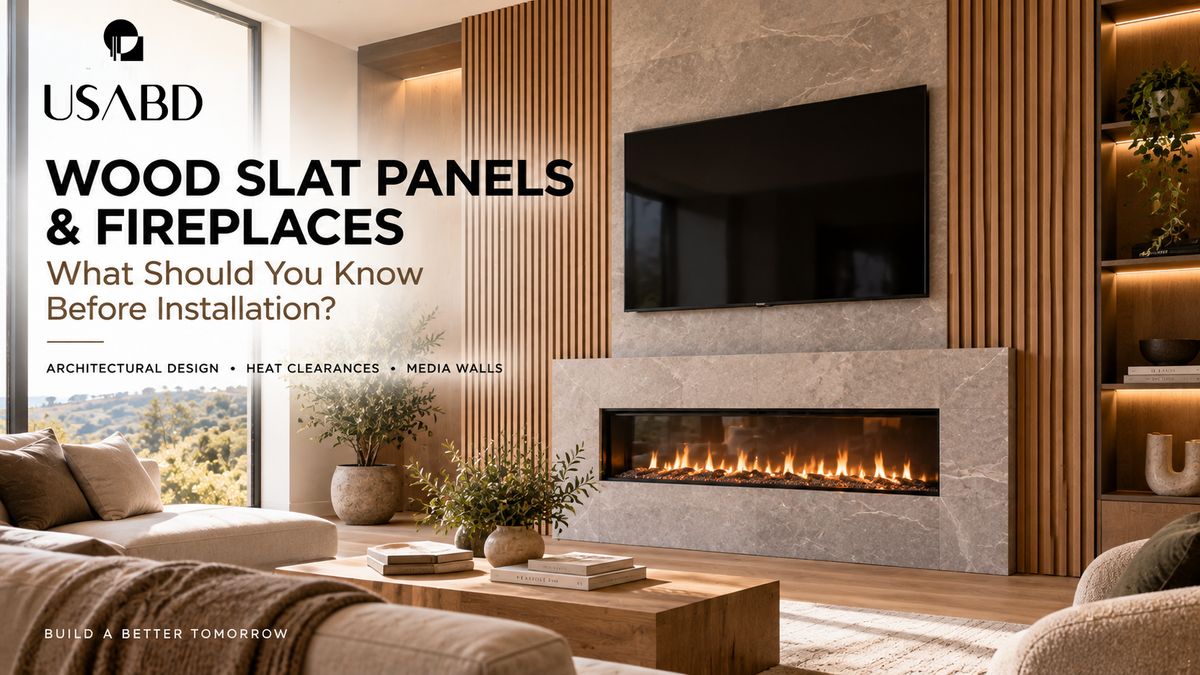
A modern fireplace wall can become the architectural centerpiece of a living room. Picture a wide linear fireplace, warm oak slat panels, a television integrated into the architecture, and carefully planned lighting. The combination creates depth and texture, but the important question comes before installation: can acoustic wood slat panels safely be installed around a fireplace? The answer depends on the exact fireplace, panel construction, clearances, and the complete wall assembly. Not every decorative wall panel is suitable near a heat-producing appliance. A Class A surface-burning classification does not automatically make a panel noncombustible or approved for direct fireplace surrounds. USA Builders Depot explains the key considerations for wood slat fireplace walls, electric and gas appliances, television mounting, acoustic performance, and material selection.
Quick Answer: Can Acoustic Wood Slat Panels Be Installed Around a Fireplace?
Acoustic wood slat panels may be suitable on decorative portions of a fireplace feature wall when the exact panel, mounting system, and fireplace manufacturer permit their use at the planned location. They should not automatically be installed against the appliance opening or in any zone requiring noncombustible materials. Review the precise appliance model, combustible clearances, heat-discharge direction, panel face and backing materials, adhesive or mechanical fasteners, wall construction, and applicable requirements. Where the fireplace requires noncombustible finishing, do not substitute ordinary wood, MDF, felt-backed, or WPC panels without supporting approval. Start with the fireplace installation manual, not the decorative elevation.
Why Wood Slat Fireplace Walls Are Popular in Modern Interiors
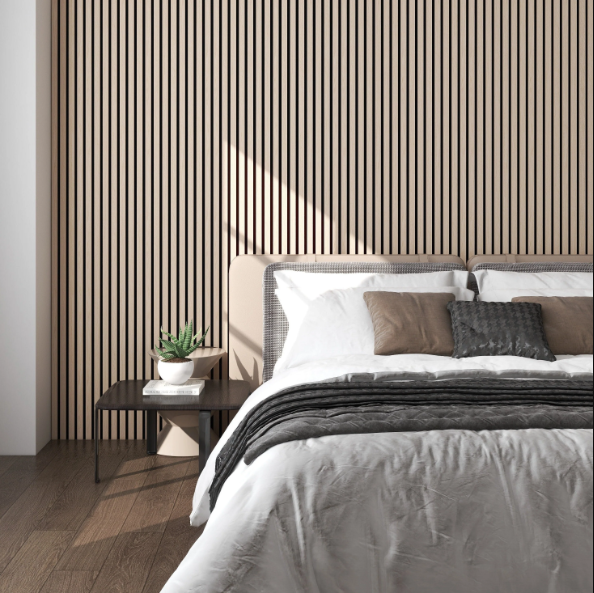
A modern fireplace wall can combine a suitable stone surround, natural-looking wood slats, architectural lighting, built-in cabinetry, and a television. Vertical slats introduce repeating shadow lines and can visually emphasize room height. Warm oak-inspired finishes can contrast effectively with stone, porcelain, concrete, and black metal. Slatted areas can frame a central fireplace or define adjacent accent areas. Certain acoustic slat products also offer tested sound-absorption performance when installed correctly, but acoustic performance does not establish fireplace safety.
1. Understand the Difference Between a Fireplace Surround and a Decorative Feature Wall
The fireplace surround is the finish immediately around the appliance opening. The broader feature wall may extend beside and above the fireplace. The immediate surround may require noncombustible materials, whereas panels may be permissible elsewhere if manufacturer instructions and applicable clearances allow them. Think of three conceptual areas: the immediate surround governed by the appliance finishing rules; adjacent wall surfaces where clearances and panel limits must be checked; and the remaining feature wall, where more finish flexibility may exist. These are not universal clearance zones or dimensions; use the exact appliance documentation to establish their actual boundaries.
2. Electric Fireplaces: Can You Install Wood Slat Panels Around Them?
Electric fireplaces may offer flame effects and built-in heaters, but do not assume that an electric fireplace creates no relevant heat. Heated air may discharge from a top, front, or other appliance vent. The manufacturer may restrict combustible finishes, framing, mantels, or nearby wall surfaces. A flame-only mode does not automatically cancel requirements for an appliance capable of operating with heat. Never cover ventilation intakes or outlets with panels, shelves, or trim. A linear electric fireplace with the specified surround material and decorative slat panels elsewhere on the wall can be an attractive composition if the complete arrangement is allowed.
3. Gas Fireplaces: Additional Heat and Clearance Considerations
Gas fireplaces may have sealed glass fronts, direct venting, or engineered heat-management systems. Adjacent surfaces can reach elevated temperatures and some models demand noncombustible finishes within specified areas. Similar-looking gas fireplaces can have very different limits for the opening, mantels, framing, sidewalls, heat discharge, and television placement. Consult the precise model's installation diagrams. Slats beside a gas fireplace should be considered only after confirming appliance-required separation and the panel assembly's suitability for the exposure.
4. Wood-Burning Fireplaces: A Different Design Environment
Traditional wood-burning installations may involve considerable radiant and conducted heat, hot components, embers, soot, and venting requirements. A masonry fireplace, listed factory-built fireplace, and wood-burning stove are not interchangeable. Each system has specific installation and clearance requirements. Decorative wood or composite panels must not be treated as suitable fireplace-surround substitutes without evidence. Long-term heat cycling, cleaning, and soot exposure may affect finishes even when an architectural rendering looks attractive.
5. Are Acoustic Wood Slat Panels Combustible?
The answer depends on actual construction and documented testing. Many decorative slat systems combine wood veneer, MDF or other engineered wood, adhesives, and felt or polymer-based backing. Some WPC products use different blends of plastic and wood constituents. The complete system matters, not simply the look of the exposed face. The hidden backing should not be ignored. Unless an exact assembly is documented as suitable for the application, treat decorative slat products as potentially combustible when evaluating fireplace clearances. Acoustic absorption, moisture resistance, and surface-burning classifications are not interchangeable measures of heat suitability.
6. Does a Class A Fire Rating Mean a Wall Panel Can Go Around a Fireplace?
No. ASTM E84 assesses surface-burning characteristics, including flame-spread and smoke-developed indices, of the tested specimen. A Class A surface-burning designation is not the same as proof that a material is noncombustible. It also does not establish a continuous operating temperature or permission to install the product against a particular fireplace. Separate questions need separate evidence: What is the tested ASTM E84 classification? Is the assembly noncombustible under the relevant criteria? Does the appliance manufacturer permit the intended finish and placement? Can the adhesive and backing tolerate the expected conditions? The fireplace manual and actual panel documentation both matter. See our wall-panel fire-rating resources for background, and verify documents for the selected SKU.
7. How to Determine Fireplace Clearance Requirements
First obtain the fireplace maker, model number, and current installation manual. Read its combustible-clearance and finishing sections, including required noncombustible materials. Review drawings carefully: dimensions may be measured from the firebox opening, body, trim, glass, or other specified reference, and those points cannot be interchanged. A projecting mantel or shelf may have different requirements from a flush finish. Evaluate framing, backing, adhesives, fasteners, panels, and decorative trim as a complete assembly. Confirm jurisdiction-specific building and fire requirements and consult a qualified installer or design professional where appropriate. No universal clearance dimension is safe to apply to every electric, gas, and wood-burning appliance.
8. Can You Put Acoustic Wood Slat Panels Above an Electric Fireplace?
Possibly, but the area above an appliance deserves specific scrutiny because warm air and heat can accumulate there depending on the design. Verify the exact clearances, whether combustible finishes are allowed, heat-discharge direction, wall framing, and panel or adhesive limits. If necessary information is unavailable, choose an alternative finish or defer that portion of installation until compatibility is established. Do not attempt to solve an otherwise prohibited installation by adding an arbitrary gap or using generic construction adhesive.
9. Designing a Fireplace Feature Wall With Acoustic Panels
Design A: Stone fireplace surround with wood slat sidewalls. Keep a separately specified stone or porcelain central finish in the required surround area and consider oak slat panels on permitted adjacent wall surfaces. The contrast between smooth stone and textured wood can be striking.
Design B: Centered fireplace with vertical accent columns. Use two outer slat zones to emphasize height and symmetry; verify their exact boundaries against appliance rules.
Design C: Fireplace below a television. Coordinate the fireplace, television bracket, ventilation, wiring, and wood accents as one designed assembly.
Design D: Adjacent acoustic feature wall. Place the slat treatment on a different living-room wall rather than near the appliance, potentially simplifying heat-clearance coordination and placing treatment in a useful reflection zone. In every case, visual design does not demonstrate that actual product clearances are compliant.
10. Can You Mount a Television Over Acoustic Wood Slat Panels?
A television may be incorporated into a slatted media wall, but decorative panels should not automatically be assumed to support its weight. Anchor the mount to appropriate structural backing, framing, masonry, or an engineered system, and plan that support before installing the panels. Confirm fireplace heat exposure against television and appliance instructions. Keep electrical connections, fireplace service openings, and required ventilation accessible. A visually concealed outlet does not mean it may be obstructed.
11. What About LED Lighting on a Fireplace Slat Wall?
LED strips can add depth through perimeter lighting, vertical reveals, or indirect illumination. But strips, drivers, wiring, and adhesive all have temperature and installation limits. Keep lighting out of prohibited fireplace areas, provide necessary access to electrical components, coordinate panel openings with the lighting design, and comply with applicable electrical requirements. The lighting must never obstruct required fireplace airflow.
12. Do Acoustic Wood Slat Panels Actually Improve Fireplace-Room Acoustics?
Some tested acoustic panels may reduce reflections and reverberation within a room when installed as specified. Living rooms with glass, tile, hardwood, stone, and high ceilings may have reflective surfaces. Results depend on panel construction, acoustic backing, mounting cavity, coverage, furnishings, and room geometry. Sound absorption is not soundproofing. Do not claim a particular NRC result without testing for the exact panel and installation. Sound performance does not make a panel safe next to heat-producing appliances.
13. How to Choose Between Wood Slat Panels, WPC and Porcelain
Acoustic wood slat panels add texture and may provide sound absorption, but require combustible-clearance and heat-suitability checks. Interior WPC fluted panels offer decorative texture, yet their fire and heat suitability must also be verified. Porcelain or suitable stone finishes can be options for required fireplace surrounds where the appliance and complete installation assembly permit them. Painted finishes, architectural metal accents, and other materials have their own substrate, fastening, transfer-of-heat, and coating considerations. Selecting porcelain alone does not make an entire wall assembly compliant: the substrate, fixing method, and appliance rules still matter.
14. Common Fireplace Feature-Wall Mistakes to Avoid
Avoid selecting the finish before choosing the fireplace model, assuming electric appliances create no meaningful heat, treating Class A as the same as noncombustible, covering vents, or supporting televisions only with decorative boards. Also avoid inaccessible electrical equipment, generic adhesive without verifying exposure limits, and copying a design photograph as if it were a tested installation. Similar-looking panels can have very different cores, coatings, backings, and instructions.
15. Fireplace and Wood Slat Wall Planning Checklist
Before finalizing a design, verify: exact fireplace manufacturer and model; current installation instructions; appliance type; combustible clearances and measurement references; any required noncombustible surround; vent and heat-discharge positions; exact slat-panel SKU, face, core, and backing; relevant test documents; mounting substrate and method; fastener or adhesive compatibility; structural television support; television heat limits; lighting and electrical access; framing and wall assembly; local building or fire requirements; and final coordinated elevations and sections. For substantial projects, complete this review before framing and finish installation.
Frequently Asked Questions
Can acoustic wood slat panels go around an electric fireplace? Potentially, but only where the appliance and selected panel assembly permit the installation.
Are wood slat panels heat resistant? The product's actual construction and test documentation determine suitability; do not assume ordinary decorative panels are heat-resistant surrounds.
Can I install acoustic panels directly above a fireplace? Only if the exact fireplace clearances and material requirements permit them.
Does Class A make a panel safe around a fireplace? No. Surface-burning classification does not prove noncombustibility or fireplace compatibility.
Can wood slats go next to a gas fireplace? Only where documented appliance clearances and panel limits permit.
Are electric fireplaces automatically safe for slat feature walls? No. Heaters, air outlets, and finishing requirements still apply.
Can WPC fluted panels surround fireplaces? Check exact product and appliance documentation before considering them.
What material is best immediately around the fireplace? Use a finish and complete wall assembly permitted by the appliance and applicable requirements.
Can I mount a TV directly on acoustic panels? Use suitable structural support, not decorative paneling alone.
Can I run LED lighting between wood slats? Only where electrical components, heat exposure, and fireplace instructions allow.
Will slat panels soundproof the room? No. Tested acoustic treatment may reduce reflections but is not the same as sound isolation.
Can I have stone in the center and slats on the sides? Potentially; verify all material transitions and clearances.
Final Thoughts: Combine Fireplace Safety With Architectural Design
An elegant fireplace wall is defined by how well its materials work together. Decorative wood slat panels can introduce warmth and architectural texture; appropriate stone, porcelain, and other finishes may provide a complementary surround. Integrated lighting and television mounting can complete the design. Yet the appliance must determine the permitted finishes and locations. Identify its exact model, check the required clearances, verify the selected panel construction, and coordinate the whole wall assembly before installation.
Explore USA Builders Depot's acoustic wood slat wall panels and contact our team with your fireplace model, wall dimensions, proposed material locations, and technical questions.
USA BUILDERS DEPOT — Build a Better Tomorrow.