

Article: Thermally Broken Steel Windows vs. Insulated Jambs: What's the Difference?
Thermally Broken Steel Windows vs. Insulated Jambs: What's the Difference?
Steel windows are a defining feature of contemporary architecture, bringing refined profiles and distinctive glass divisions to luxury homes. But for exterior installation, appearance is only part of the decision. Homeowners and builders must also evaluate heat transfer, condensation, energy ratings and climate. Are insulated steel windows the same as thermally broken steel windows? Not necessarily. An insulated jamb, insulating glass and a thermal-break frame are different features. Understanding them helps buyers make an informed decision before placing a custom order.
Quick Answer: Are Insulated Steel Windows Thermally Broken?
Not always. An insulated jamb or double-pane glass does not automatically make the steel frame thermally broken. A true thermal break incorporates a lower-conductivity separator that interrupts the relevant direct metal heat-transfer path in a frame or sash profile. An insulated jamb may contain insulating material while other metal parts remain continuous. Double-pane glazing improves performance through the glazing system, not necessarily the steel frame. Evaluate the complete frame, sash, glazing, spacers, seals, installation and applicable ratings.
1. Why Thermal Performance Matters for Steel Windows
Steel offers architectural strength but conducts heat efficiently. A continuous metal path between exterior and interior can act as a thermal bridge. Heat can flow outward during cold weather and inward during hot weather. This may influence indoor surface temperatures and heating or cooling loads. If an interior surface cools below the dew point of adjacent humid air, condensation can form. The outcome depends on the whole assembly and indoor conditions, which is why thermally improved metal windows are an important design option.
2. What Is a Thermally Broken Steel Window?
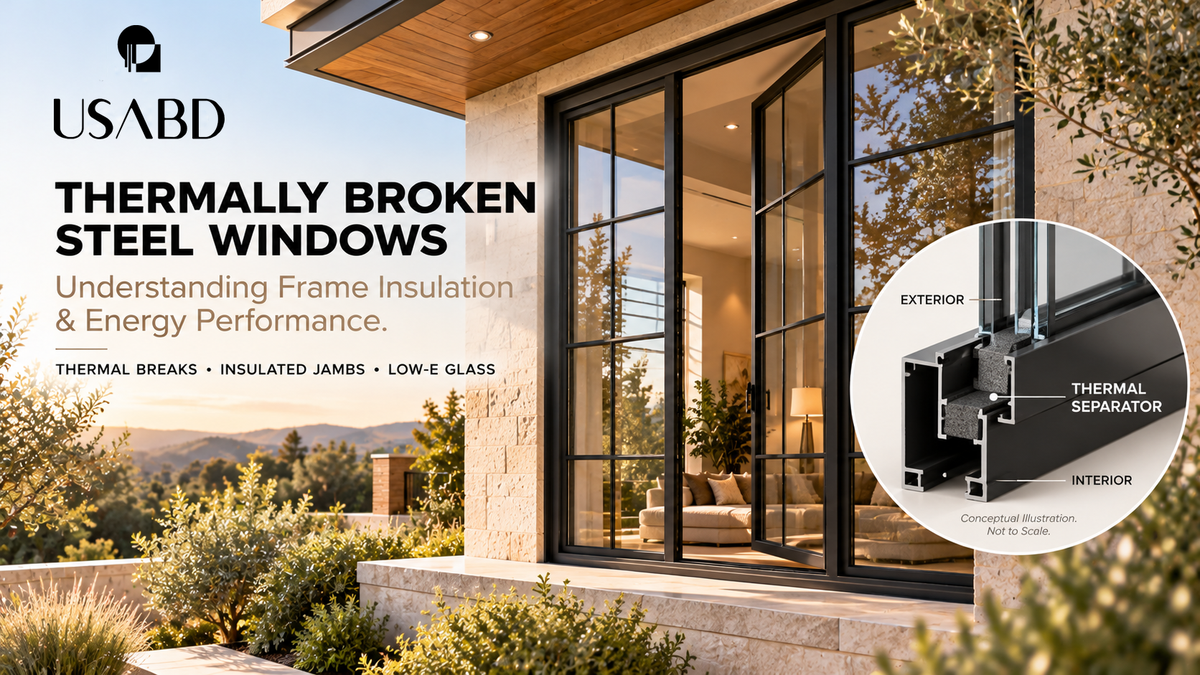
A thermally broken steel profile contains a purpose-designed lower-conductivity component between relevant exterior and interior metal portions. In a conventional continuous profile the metal provides a conductive pathway; in a thermally broken profile a separator reduces that flow. Different manufacturers use engineered polymers or other suitable separating materials and structural joining methods. The precise section must be confirmed from documentation. A thermal break reduces heat movement through its separated portion; it cannot eliminate all heat transfer through glass, spacers and other components.
3. What Is an Insulated Steel Window Jamb?
A jamb forms part of the surrounding window frame. Some steel window jambs incorporate insulating material inside a cavity. That insulation may improve thermal characteristics of the particular area, but it does not prove full thermal separation through the complete frame or sash. One product might have a deeper insulated jamb with continuous steel components; another may use a dedicated separator between exterior and interior metal sections. They should not be described as equivalent without reviewing construction drawings and rated performance.
4. Thermal Break vs. Insulated Jamb vs. Insulated Glass
Thermal-break profile: Interrupts a specified conductive metal pathway.
Insulated jamb: Incorporates insulation within a jamb area, without necessarily separating the steel.
Double-pane insulated glass: Reduces heat flow through the glazing, not necessarily the frame.
Low-E coating: Changes radiant heat transfer through glass.
Argon-filled glazing: May improve insulating glass performance.
Warm-edge spacer: Can reduce edge-of-glass heat transfer.
Weatherstripping: Helps limit air leakage at operable joints.
Several features can work together in one product. No single feature automatically establishes the overall thermal rating.
5. Does Double-Pane Glass Make Steel Windows Energy Efficient?
Double-pane glazing often performs better thermally than comparable single-pane glazing. Two panes are separated by a sealed space that may contain air or specified gas, and some products include Low-E coatings. However, insulated glass does not remove an uninterrupted thermal bridge through the steel frame. A thermally broken frame with unsuitable glazing can also miss a project's requirements. Evaluate the frame and glazing as a complete product.
6. Understanding U-Factor for Steel Windows
U-factor describes the rate of heat transfer through a fenestration assembly, typically expressed in the United States as Btu/(h·ft²·°F). In general, lower values indicate less heat transfer. But verify what is rated. A center-of-glass U-factor concerns the central glazing, while a frame-only value concerns the frame. Whole-window U-factor reflects the evaluated complete assembly under the applicable rating procedure. Comparing a center-of-glass value from one supplier against a whole-window value from another is misleading. Request clear product-specific documentation.
7. What Is SHGC, and Why Does It Matter?
Solar Heat Gain Coefficient (SHGC) represents solar energy admitted through a fenestration product. A lower SHGC generally means less solar heat gain, potentially useful for strongly sun-exposed windows in a cooling-dominated climate. U-factor measures heat transfer and SHGC measures solar gain; they are not interchangeable. Visible transmittance (VT) describes how much visible light enters. Balance all three with daylight, orientation, shading, climate and the home's design.
8. Do Thermally Broken Steel Windows Prevent Condensation?
Thermally improved frames may reduce the chance of condensation in some conditions by maintaining warmer interior frame surfaces during cold weather. They do not guarantee a condensation-free window. Condensation occurs where surfaces are below the indoor air's dew point and is affected by humidity, outdoor temperature, glass edges, frame design, circulation and installation. If condensation is a critical concern, ask for applicable product documentation and consider indoor moisture conditions as part of the design.
9. Are Thermally Broken Steel Windows Better for Cold Climates?
Reducing metal-frame conduction can be especially valuable in cold climates, where low whole-window U-factor, air sealing and condensation control matter. Hot climates can also benefit from lower conductive heat flow, but glazing solar-control properties may deserve substantial attention. An interior steel partition between conditioned spaces is a different application from an exterior window. Select the system based on actual climate and use, not a one-size-fits-all label.
10. What About Steel Windows in Georgia, Texas, and California?
In Georgia, heating and cooling conditions make whole-window performance, air leakage and solar orientation important. In many Texas locations, summer sun, window direction and glazing SHGC can drive the design. In California, applicable projects must meet the state's current energy-code requirements, with the 2025 California Energy Code effective for relevant permit applications beginning January 1, 2026. A description such as “insulated jamb” is not proof of code compliance. In colder regions, lower whole-window U-factor and condensation management may be priorities. The project-specific code and documented configuration control in all locations.
11. Understanding USA Builders Depot's Steel Window Options
USA Builders Depot offers selected fixed, single-casement, double-casement, awning, push-out and specialty steel-window designs. Certain product listings identify 2-inch, 4-inch and 6-inch jamb options, including a 6-inch jamb described as containing thermal-injected insulation. That description should not be taken as confirmation that the complete steel-window frame is thermally broken. Ask for the exact profile construction, glass specification and available performance documentation when your project requires a thermal break, particular U-factor or SHGC, or NFRC certification. Some custom configurations have estimated production and shipping lead times of approximately 8–12 weeks, subject to order confirmation. Resolve performance requirements before approving production drawings.
12. How to Tell Whether a Steel Window Has a True Thermal Break
Request a manufacturer-provided frame cross-section identifying a dedicated thermal separator and which metal parts it separates. Review the insulated-glass makeup and edge spacer. Clarify whether insulation is in a jamb cavity, another frame cavity or a thermally separated profile. Request the exact whole-window performance documentation required by the project and verify that it applies to the proposed size and configuration. Coordinate the surrounding air barrier, water-resistive barrier, insulation, flashing and frame installation so unintended thermal bridges or moisture problems are not introduced.
13. How to Compare Two Steel Window Quotes
Compare exact steel profile and frame construction; whether a thermal break is present; jamb depth and insulation; pane count, glass thickness, coatings and fill; spacers; the rating basis for U-factor and SHGC; available air-leakage information; operable hardware, seals and finish; applicable certification and test documentation; installation requirements; and confirmed lead times. Price alone is not a sufficient technical comparison. Neither a higher price nor a claim of “thermal improvement” establishes compliance with a project's requirements.
14. Common Mistakes When Buying Thermally Broken Steel Windows
Do not assume double-pane glass automatically means a thermally broken frame. Do not confuse injected jamb insulation with a purpose-designed thermal separator. Do not compare a center-of-glass U-factor with another product's whole-window number. Do not assume a performance document for one model applies to every size, sash type or glazing variation. Finally, do not approve a custom order before verifying the project-specific energy requirements and necessary documentation.
15. Questions to Ask Before Ordering Custom Steel Windows
Confirm whether the window serves an interior or exterior opening; its precise dimensions and configuration; fixed or operable type; jamb depth and cross-section; whether the relevant metal profile is thermally separated; the glass package, seals and finish; and any required whole-window U-factor, SHGC, air leakage, NFRC or other documentation. Coordinate the specifications with the architect, energy consultant, builder and installer before fabrication.
Frequently Asked Questions
Are all steel windows thermally broken? No. Products differ in construction.
Is an insulated steel window the same as a thermally broken one? Not necessarily. The insulation may be in a jamb or glass without separating frame metal.
Does a 6-inch insulated jamb mean the frame is thermally broken? No. Review the actual profile.
Can steel windows be energy efficient? Yes, when the complete system and its documented performance meet the application's needs.
Does Low-E glass replace a thermal break? No; they address different heat-transfer mechanisms.
Can a thermally broken steel window develop condensation? Yes, depending on temperature, humidity and other factors.
Can thermally broken windows work in hot climates? Yes, subject to the complete system and solar-control needs.
Are fixed steel windows always more efficient? Not automatically; compare rated assemblies.
Does every steel window require NFRC certification? Requirements vary by application and jurisdiction; confirm project needs.
Can non-thermally-broken steel windows be used in homes? Sometimes, subject to application and code.
Does USABD offer insulated steel-window configurations? Selected listings describe optional thermal-injected jamb insulation; confirm product construction and documentation.
Final Thoughts: Know What You're Ordering
Thermally broken steel windows and insulated steel-window jambs are related but distinct. Thermal breaks interrupt a conductive pathway; jamb insulation may reduce heat transfer through a particular cavity without doing so. Double-pane glazing, Low-E coatings, spacers and weather seals provide further functions. Evaluate the whole-window design and ratings, not marketing shorthand.
Explore USA Builders Depot steel windows and contact our team with your window schedule, dimensions, quantities, glazing preferences, jamb depth, project location and required technical documentation for review.
USA BUILDERS DEPOT — Build a Better Tomorrow.