
Article: WPC Fluted Wall Panels vs. Acoustic Wood Slat Panels: Which Should You Choose?
WPC Fluted Wall Panels vs. Acoustic Wood Slat Panels: Which Should You Choose?
Quick answer: Interior WPC fluted panels create a continuous decorative grooved surface; felt-backed acoustic wood slat panels combine decorative slats with an assembly intended for sound absorption. Neither category automatically provides soundproofing or a guaranteed acoustic rating.
Two modern feature walls can look remarkably similar while using very different materials. One may have molded wood-plastic composite grooves; the other may use individual wood-finish slats over an acoustic backing. Both can suit modern homes, offices and media walls, but their purposes and installation requirements differ. Here's how homeowners, designers and builders can choose between them.
Quick Answer: WPC Fluted Panels vs. Acoustic Wood Slat Panels
Choose interior WPC fluted panels when decorative texture and a continuous wood-inspired grooved profile are the main priorities. Consider purpose-designed acoustic wood slat panels when sound absorption is also important. Acoustic results must be verified for the exact product and installed assembly; neither category should automatically be described as soundproof.
What Are WPC Fluted Wall Panels?
WPC means wood-plastic composite. Interior WPC fluted panels commonly use a molded or extruded repeating pattern to create decorative grooves and shadow lines. They are selected for TV feature walls, living rooms, corridors, offices, bedrooms, reception areas and architectural millwork. Product formulations, finishes, and suitability vary. Exterior suitability should never be assumed for an interior WPC SKU. Browse USA Builders Depot interior wall panels for available options.
What Are Acoustic Wood Slat Panels?
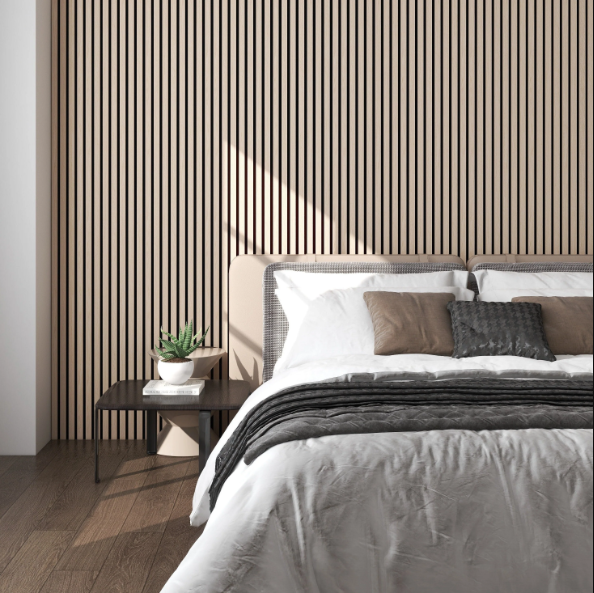
Acoustic wood slat panels combine visible wood-finish slats with a backing system designed to contribute to acoustic treatment. Slat spacing, porous backing, installation method and any air cavity influence behavior. Well-designed acoustic treatments may reduce reflected sound and reverberation, but the presence of felt alone does not establish any particular acoustic rating. Request tested data for the relevant assembly.
WPC vs. Acoustic Panels: Comparison Table
| Feature | Interior WPC fluted panel | Acoustic wood slat panel |
|---|---|---|
| Primary purpose | Decorative wall finish | Decoration and potential sound absorption |
| Construction | Profiled wood-plastic composite | Wood-finish slats and acoustic backing |
| Appearance | Continuous grooved surface | Individual slats with visible gaps |
| Sound absorption | Not established without tests | Tested results depend on assembly |
| Soundproofing | Not inherently soundproof | Not inherently soundproof |
| Cleaning | Depends on finish and grooves | Depends on slats and backing |
| Installation | May use adhesive or clips | May use screws or adhesive |
| Moisture suitability | Product specific | Product specific |
| Fire performance | Verify exact documentation | Verify exact documentation |
1. Appearance: Fluted Grooves vs. Individual Slats
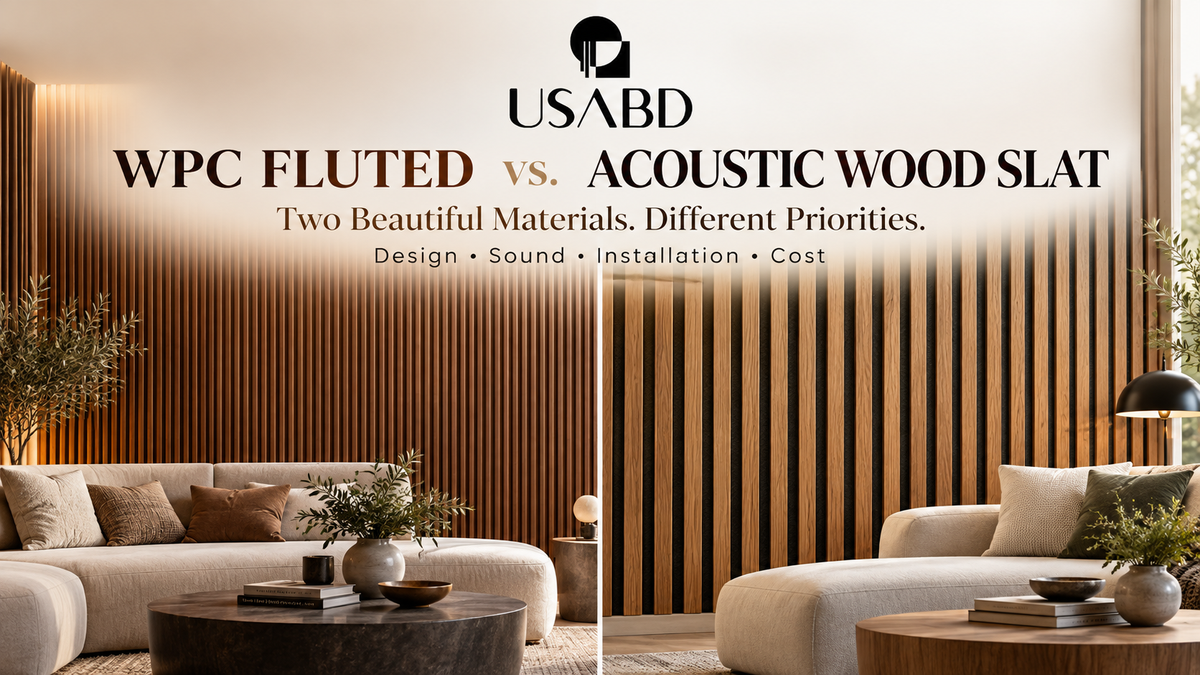
Interior WPC often has a unified ribbed profile formed into the panel. Acoustic panels typically have individual slats separated by contrasting backing, introducing more visible depth between elements. Both can produce premium-looking interiors. Compare actual samples for finish, geometry, edge detail and color. Lighting can accentuate either material but does not change its fundamental purpose.
2. Which Is Better for Sound Absorption?
Decorative fluting may change the direction of some reflections, but it does not prove meaningful sound absorption. Purpose-designed acoustic panels combine geometry and materials intended for absorption; actual performance depends on backing, slat spacing, cavity, mount and sound frequency. NRC (Noise Reduction Coefficient) summarizes absorption across selected frequencies in a standard test but does not quantify sound isolation between rooms. Read the existing acoustic panels versus soundproofing guide for the distinction. Do not assume that placing felt behind WPC creates a known NRC value.
3. Which Material Is Better Behind a TV?
Either material can make an attractive media wall. Choose WPC when decorative texture is the primary objective. Consider acoustic wood slat panels if the room has an identified reverberation issue and the chosen product's acoustic data fit the design. One treated wall may not solve every sound issue in a room. Televisions and heavy shelves must be mounted to suitable underlying structure, not supported by decorative panels alone. Plan outlets, wiring and lighting before installation.
4. Cleaning and Maintenance
Cleaning depends on actual surface materials. Decorative WPC profiles can accumulate dust in grooves. Acoustic panels may need gentle cleaning of both individual slats and exposed backing. Follow each product's written care instructions; do not assume aggressive cleaning chemicals, water, or pressure washing are acceptable. Keep finishes, joints and exposed edges in good condition.
5. Bathrooms and Humid Rooms
Some WPC formulations resist moisture, but WPC does not automatically mean bathroom- or shower-approved. Wood veneer, acoustic backing, adhesives and other materials may have their own limitations. For laundry rooms, bathrooms and other humid areas, confirm product suitability for the expected humidity and direct water exposure. Do not install either product in wet areas without applicable manufacturer approval.
6. Installation Differences
Installation methods vary by SKU. Selected USABD interior WPC panels may use clips or adhesive; selected acoustic slat panels may use screws or adhesive. Verify substrate, flatness, attachment requirements, layout, edges, any movement allowances and compatible trims. For acoustic panels, the installed mount may also change sound absorption. Ceiling installation requires separate confirmation; a wall-rated panel is not automatically suitable for overhead attachment. Around electrical devices, coordinate safe cutouts and boxes before closing the wall. See how to cut acoustic panels around outlets and edges.
7. Cost and Material Quantities
Unit prices cannot be compared fairly without considering panel size, effective installed coverage and packaging. Total cost should account for waste, trims, adhesives or fasteners, subframing, electrical modifications, labor, freight and samples. For large projects, prepare a takeoff from the elevation and confirm actual dimensions, overlaps and layout symmetry. The lowest-priced individual panel is not always the least expensive installed wall.
8. Comparing Actual Panel Dimensions
Representative USABD listings illustrate why product selection matters: an interior Ebony WPC fluted panel has been listed at approximately 114 × 8 × 1 inches, commonly sold in boxes of ten, while a medium Classic Oak acoustic panel has been listed at approximately 114 × 12.8 × 7/8 inches, commonly sold in boxes of four. These are example configurations, not universal specifications. Confirm the current SKU, size, availability and effective coverage before ordering. A wider panel may need fewer pieces but may create different seams and offcuts.
9. Which Panel Fits Each Room?
| Application | Consider | Main question |
|---|---|---|
| Living room | Either | Decorative priority or reverberation issue? |
| Home theater | Acoustic slat panel | Does tested absorption support room needs? |
| TV feature wall | Either | Look, acoustics and structural mounts? |
| Hallway | Either | Cleanability and exposure? |
| Conference room | Acoustic panel | Speech clarity and acoustic objectives? |
| Reception wall | Either | Appearance and codes? |
| Bedroom accent wall | Either | Warmth, texture and comfort? |
| Humid spaces | Exact approved product only | What moisture exposure is allowed? |
10. Choosing the Right Finish
USABD interior WPC options include selected ebony, classic wood and walnut-inspired tones. The acoustic wood slat assortment includes selected Classic Oak, Light Brown Oak, Smoked Oak, Dark Ebony, Raw White Oak, and White Oak with Grey Felt variants. Light wood complements Scandinavian and minimalist interiors; warmer medium finishes can coordinate with walnut furnishings; dark finishes create contrast with pale walls and stone. Always compare physical samples next to flooring, cabinetry, interior doors and lighting in the intended space.
11. Can WPC and Acoustic Panels Be Used Together?
Yes, provided each material is suitable for its location. One design might use WPC on a decorative media wall and acoustic slat panels elsewhere to support a reverberation-control objective. Another could combine WPC at a reception desk and acoustic treatments in adjacent seating areas. Match material tones and check changes in wall depth, corners, grooves, seams, trims and lighting to keep the result cohesive.
12. Fire Safety and Environmental Claims
Interior finish fire requirements depend on building use, jurisdiction and selected assemblies. Request documentation for the exact product instead of assuming materials that look alike share the same classification. Sustainability also cannot be established by category alone: recycled content, wood sourcing, emissions, maintenance and environmental declarations vary by manufacturer and SKU. Use supported claims only.
13. Buying Checklist
| Specification | Confirm |
|---|---|
| Category | Decorative WPC or acoustic slat |
| Exact product | SKU and variant |
| Dimensions | Length, width, thickness, effective coverage |
| Finish | Physical sample and backing color |
| Installation | Approved adhesive, clips or screws |
| Accessories | Corners, trims and edge finishes |
| Location | Wall or ceiling, moisture exposure |
| Acoustics | Applicable assembly data if required |
| Fire | Applicable classification |
| Packaging | Box quantities and availability |
| Order | Waste, lead time and freight |
Frequently Asked Questions
Are WPC fluted panels the same as acoustic wood slat panels?
No. Decorative WPC profiles and purpose-designed acoustic slat systems use different construction approaches and performance objectives.
Do WPC panels absorb sound?
Do not assume a meaningful absorption rating without applicable testing.
Are acoustic slat panels soundproof?
No. Sound absorption and sound isolation are different properties.
Which is better behind a television?
Either can be visually suitable; acoustic panels may be appropriate for documented room-acoustics goals. TV hardware requires independent structural support.
Are WPC panels more durable?
Not categorically; compare exact finishes, installation and exposure.
Can acoustic panels go in bathrooms?
Only if the exact product is approved for the environmental conditions.
Are WPC panels real wood?
WPC typically combines wood-derived and polymer constituents; the decorative surface may simulate wood grain.
Do acoustic panels use wood veneer?
Some do, but exact construction varies.
Can both be installed vertically?
Many wall systems allow vertical arrangements, subject to the product instructions.
Can I combine both?
Yes, with coordinated appearance, installation and usage.
Does USABD stock both?
USA Builders Depot offers interior WPC fluted panels and acoustic wood slat panels in selected finishes and configurations.
Final Thoughts: Which Should You Choose?
Choose interior WPC fluted panels for decorative texture and a consistent wood-inspired pattern. Consider acoustic wood slat panels when you also need documented sound-absorption potential. The right solution depends on the actual product, room conditions, mounting, appearance and budget.
Explore USA Builders Depot interior wall panels and the acoustic wood slat panel collection to compare finishes and sizes. For specification help, review applicable technical resources or contact USA Builders Depot.
USA BUILDERS DEPOT — Build a Better Tomorrow.