


Article: WPC vs. Fiber Cement Siding: Which Exterior Cladding Is Right for Your Project?
WPC vs. Fiber Cement Siding: Which Exterior Cladding Is Right for Your Project?
Choosing exterior cladding is not simply a matter of deciding which material looks best in a rendering.
The cladding becomes part of the building envelope. It has to work with rain, sunlight, temperature changes, wind, wall penetrations, fasteners, corners, windows, doors and the drainage system behind it.
Two materials frequently considered for modern homes and commercial façades are wood-plastic composite, commonly called WPC, and fiber cement.
Both can create clean contemporary exteriors. Both are available in wood-inspired finishes. Both can be used as alternatives to traditional wood in appropriate systems.
But they solve the exterior-wall problem differently.
WPC combines wood-derived material with polymers to create a composite profile. Fiber cement uses a cementitious matrix reinforced with fibers.
Those differences influence appearance, movement, handling, fire behavior, maintenance and installation.
So which one is better?
Neither material is universally better. The right choice depends on what the wall needs to do.
Quick Comparison: WPC vs. Fiber Cement
| Decision factor | WPC exterior cladding | Fiber cement siding |
|---|---|---|
| Typical visual strength | Wood-look, slatted, fluted and dimensional profiles | Lap siding, panels, smooth or wood-grain finishes |
| Material family | Wood/plastic composite | Cementitious fiber-reinforced board |
| Painting | Many finished WPC profiles do not depend on field painting; verify exact product | Commonly factory-finished or painted; maintenance depends on finish |
| Thermal movement | Expansion and contraction must be considered | Generally dimensionally stable but comparatively rigid |
| Impact behavior | Composite material can provide useful impact tolerance | Strong but comparatively brittle; edges and fasteners matter |
| Fire-led selection | Exact test documentation required | Often the stronger material-family starting point for fire-sensitive applications |
| Moisture strategy | Still requires a properly detailed exterior wall system | Still requires a properly detailed exterior wall system |
| Design character | Strong for warm modern wood-look accents and continuous fluting | Strong for crisp flat planes, lap siding and painted façades |
What Is WPC Exterior Cladding?
WPC stands for wood-plastic composite. The exact formulation varies by manufacturer and product, but WPC generally combines wood-derived material with a polymer component and other additives.
For exterior architecture, that composite can be formed into profiles that would be difficult or expensive to reproduce consistently in natural wood.
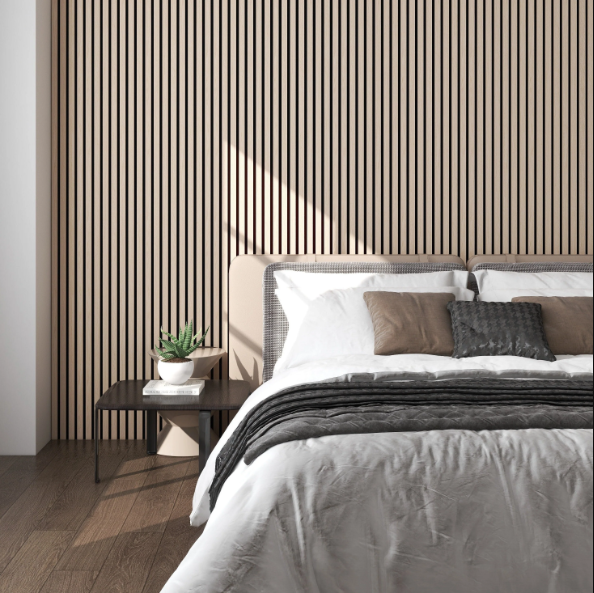
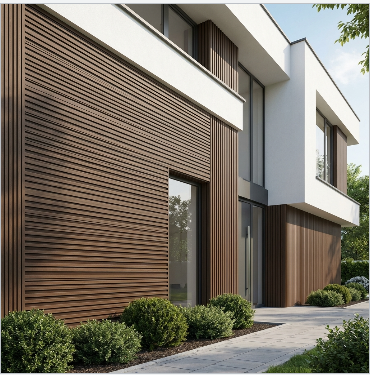
That is one reason WPC is particularly common in fluted façades, vertical slat walls, shiplap-style cladding, entry walls and modern mixed-material elevations.
USA Builders Depot carries exterior WPC products in both fluted and shiplap-style exterior profiles.

Exterior WPC can create pronounced wood-look depth and shadow lines. Exact substrate, substructure, fastening, drainage and ventilation requirements should be confirmed for the selected product.
What Is Fiber Cement Siding?
Fiber cement is a cement-based exterior material reinforced with fibers. Depending on the product family, it can be supplied as lap boards, large panels, shingles, trim or architectural siding systems.
Its visual character can range from smooth minimalist panels to traditional horizontal lap siding and embossed wood-grain finishes.
Like WPC, the generic category name is not enough for specification. Thickness, finish, fastening, joint treatment, approved substrates, clearances and performance documentation vary by product.

Fiber cement is a cementitious exterior material that can suit broad flat planes, lap siding and fire-led material selection, depending on the exact product and assembly.
The Biggest Visual Difference
WPC has an advantage when the design itself depends on depth.
A fluted WPC panel can create pronounced shadow lines that change throughout the day. This gives a modern WPC elevation a dimensional quality that is difficult to achieve with a flat sheet.
Fiber cement excels at a different architectural language. It can create broad clean planes, precise panel grids, horizontal lap rhythm, monolithic painted façades and restrained minimalist elevations.
Before comparing technical specifications, ask a simpler question:
What should this wall look like?
Do Not Compare Materials Only by the Sample
A six-inch sample can tell you color, texture, surface sheen, grain and profile depth.
It cannot show you how the material looks across 2,000 square feet, where joints will occur, how corners terminate, what happens around windows, how the base is detailed, how water drains or how the façade moves during temperature changes.
For a large project, create a mock-up of at least one corner, opening and termination condition whenever practical.
Moisture: The Cladding Is Not the Whole Water-Control System
The visible siding should not be treated as the building's only waterproofing layer.
Exterior walls need a drainage and drying strategy behind the cladding so incidental water can move back to the exterior rather than accumulating in the wall.
That principle applies whether the visible material is WPC, fiber cement, wood, metal, vinyl, stone or another siding.
The better question is not “Which board is waterproof?”
It is:
“How does the complete wall manage water when rain gets behind the cladding?”
For broader envelope planning, see the USA Builders Depot Exterior Wall Cladding Guide.
The Rainscreen Principle
A rainscreen approach separates the exterior cladding from the underlying water-control layer with a drainage or drying space.
Depending on the system, that space may be created with furring strips, battens, a drainage mat or another documented subframing method.
Behind that space is typically a properly integrated water-resistive barrier.
Do not automatically copy a fiber-cement rainscreen detail for WPC—or a WPC detail for fiber cement. The exact product instructions control the required spacing, fastening and ventilation details.
WPC and Thermal Movement
WPC contains a polymer component. Like many exterior materials, it expands and contracts as temperature changes.
That means installers need to pay attention to panel length, orientation, fastener placement, end clearances, joint details, temperature during installation and the required expansion allowances.
If movement has nowhere to go, problems can appear later, including buckling, distorted joints, misalignment or stress around fasteners.
Use the instructions for the exact WPC profile rather than assuming one universal expansion gap.
Fiber Cement and Movement
Fiber cement generally behaves differently. Its cementitious construction can provide good dimensional stability, but the material is comparatively rigid.
That makes correct fastening and edge distances important. A rigid board can crack if it is mishandled, incorrectly supported or improperly fastened.
Neither material eliminates installation discipline. They simply require different discipline.
Which Is Better for Impact?
This comparison is more nuanced than “cement is stronger.”
Composite materials can provide useful impact tolerance because they may flex rather than crack under certain localized impacts.
That does not mean every WPC panel is automatically impact-rated. Panel geometry, backing, subframing, thickness, attachment spacing and the exact test all matter.
For hail, wind-borne debris or other impact-sensitive projects, request product-specific documentation.
Fire Performance Is Where the Comparison Changes
If fire performance is a primary project requirement, do not treat WPC and fiber cement as equivalent material families.
Fiber cement is often the stronger starting point for a fire-led or noncombustible-material specification because it is cementitious.
That does not mean every fiber cement wall automatically meets code or every WPC panel automatically fails code.
Fire compliance can depend on the exact product, surface-burning test, wall assembly, building type, height, occupancy, jurisdiction and project-specific code requirement.
The correct process is:
Identify the required performance first, then ask which documented system satisfies it.
ASTM E84 Is Not the Same as a Complete Wall Rating
A surface-burning test and a complete fire-rated exterior-wall assembly answer different questions.
If a WPC or fiber-cement product has an ASTM E84 result, that may provide useful information about surface flame spread and smoke development under that test.
It does not automatically establish every other fire requirement that could apply to the building.
Which Material Handles Humidity Better?
High humidity does not remove the need for good detailing.
In places such as Florida, the Gulf Coast, the Southeast and coastal regions, the wall may experience frequent wetting and long periods of elevated humidity.
A suitable exterior WPC profile can be attractive in these environments because it does not depend on the same finish cycle as exposed natural wood.
Fiber cement is also commonly used in humid regions.
With either material, performance still depends on drainage, clearances, flashing, fasteners, joints, wall drying and the exact product documentation.
What About Coastal Projects?
A coastal project adds salt exposure, higher wind, wind-driven rain, corrosion risk and potentially stricter local requirements.
For either WPC or fiber cement, confirm the fastener material, subframing, design pressure or wind requirement where applicable, edge and corner fastening, flashing metals and exposure limitations.
Do not assume that because the cladding itself tolerates moisture, every fastener behind it will.
Which Is Easier to Install?
This depends heavily on the product format.
A narrow WPC profile can be easier to handle than a large cementitious sheet. A long WPC profile may also require careful management of thermal movement and straight starting lines.
Fiber cement may require heavier handling and specific cutting, fastening and joint procedures.
Labor should be compared by system, not by material name.
Horizontal vs. Vertical Installation
Orientation changes the architecture and can change the installation detail.
Vertical WPC fluting can visually make a building feel taller. Horizontal shiplap can make a long elevation feel wider.
Fiber cement lap siding naturally creates horizontal lines, while panel systems can be designed in multiple orientations.
Do not rotate a product simply because the rendering looks good. Confirm that the exact panel and attachment system support the proposed direction.
Corners Matter More Than Most Renderings Show
Architectural renderings often show perfect sharp corners. Real cladding needs a detail.
That detail may use a matching corner trim, edge trim, miter, metal termination, reveal or another approved transition.
USA Builders Depot carries compatible trim and accessory products for selected WPC systems, including corner and edge trims.
Windows and Doors Need a Drainage Strategy
Cladding should never simply stop against a window and depend on a bead of sealant as the entire water-control system.
Windows and doors interrupt the drainage plane.
Coordinate head flashing, jamb conditions, sill drainage, WRB laps, trim, clearances and cladding terminations before installing the façade.
This is true for both WPC and fiber cement.
Maintenance: Neither Material Is Literally Maintenance-Free
Every exterior requires inspection.
WPC surfaces may need periodic cleaning. Fasteners, trims, joints and damaged pieces may need attention.
Fiber cement finishes may eventually require cleaning, touch-up or recoating depending on the exact product and finish system.
The useful question is:
“What maintenance does this exact system require over the time I expect to own the building?”
WPC Can Be Strong for Wood-Look Architecture
One of WPC's clearest advantages is aesthetic consistency.
A WPC façade can provide a controlled repeating wood-inspired finish across entry volumes, garage returns, garden structures, commercial storefronts, feature walls and mixed-material façades.
That makes WPC particularly useful when the design needs warmth without making natural timber the dominant exterior maintenance material.
Fiber Cement Can Be Strong for Broad Façade Coverage
Fiber cement can work particularly well where the architecture calls for large painted wall areas, subtle panel grids, traditional lap siding or a mineral-based exterior expression.
It may also be the first material a design team evaluates where the project has demanding wildfire or noncombustible-material requirements.
Can You Use Both Materials on the Same House?
Yes—when the design is coordinated.
A modern elevation might use fiber cement across the primary wall planes, WPC fluting around the front entry, stone at the base and dark metal around windows.
The contrast works because each material has a distinct role.
Which Material Looks More Expensive?
That depends much more on detailing than on the material label.
A modestly priced panel with consistent alignment, well-planned reveals, clean corners, organized fastening, coordinated lighting and precise window transitions can look more expensive than a premium material installed carelessly.
Cost: Compare the Installed Wall, Not the Board
For an actual project, compare material quantity, waste, subframing, WRB, flashings, fasteners, trims, labor, finish work, freight, equipment and future maintenance.
That is the real cladding cost.
WPC vs. Fiber Cement in Cold Climates
Cold climates introduce freeze-thaw exposure, snow, ice and large seasonal temperature swings.
With WPC, thermal movement and the exact exterior exposure requirements deserve special attention.
With fiber cement, the installation and finish system must accommodate the manufacturer's cold-climate and moisture requirements.
WPC vs. Fiber Cement in Hot Climates
Hot climates can produce intense solar exposure, high surface temperatures, UV exposure and major daily thermal cycles.
With WPC, confirm the exact product's finish, exposure requirements and thermal-movement details.
With fiber cement, confirm the coating and installation requirements.
WPC vs. Fiber Cement in High-Wind Areas
The siding material is only part of wind resistance.
Fastener type, spacing, edge zones, corner zones, substructure, sheathing and building geometry can all affect performance.
Do not substitute generic “hurricane resistant” language for an actual project-specific wind requirement.
Which Should a Homeowner Choose?
Choose based on the project's non-negotiable requirement.
- Dimensional wood-look architectural feature: start by evaluating exterior WPC.
- Broad painted siding with a strong fire-led material path: start by evaluating fiber cement.
- Lowest installed cost: price the complete wall systems before deciding.
- Lowest maintenance: compare written care instructions and warranties.
- High-wind or coastal performance: begin with attachment and exposure documentation.
What Should a Builder or Architect Verify?
- Exact product and SKU
- Exterior-use designation
- Panel dimensions and thickness
- Approved orientation
- Substrate or subframing requirements
- Fastener or clip system
- Fastener material
- Expansion or movement requirements
- WRB and drainage details
- Ventilation requirements where applicable
- Window and door flashing transitions
- Base-of-wall drainage
- Corner and termination details
- Fire documentation where required
- Wind/design-pressure documentation where required
- Finish and UV documentation where relevant
- Maintenance instructions
- Written warranty and exclusions
Frequently Asked Questions
Is WPC better than fiber cement?
Not universally. WPC can be especially attractive for dimensional wood-look, fluted and composite façade designs. Fiber cement can be a stronger starting point where a mineral-based material or demanding fire path drives the specification.
Is WPC siding waterproof?
Do not use “waterproof” as a substitute for proper wall design. Even moisture-tolerant exterior cladding needs an appropriate drainage plane, flashing and wall assembly.
Is fiber cement waterproof?
It should not be treated as the building's sole waterproof layer either. The wall still needs WRB, flashing and drainage according to the applicable system and code.
Which is better for a modern house?
WPC is particularly effective when the design calls for vertical fluting, dimensional slats or a consistent wood-inspired accent. Fiber cement is very effective for large flat planes, panel grids and clean lap-siding compositions.
Which is better for fire resistance?
At the broad material-family level, fiber cement has the stronger fire-performance position. Actual project compliance still depends on the exact product, tested assembly and jurisdiction.
Which is better in Florida?
Both material families can be used in appropriate Florida projects, but humidity is only one consideration. Wind, rain, UV, attachment, corrosion, drainage and local code requirements should all be verified for the exact system.
Does WPC require painting?
Many finished exterior WPC products are supplied with their final decorative surface and are not installed as field-painted siding. Verify the care and refinishing requirements of the exact product.
Does fiber cement require painting?
That depends on whether it is factory-finished, primed or supplied unfinished. Follow the exact manufacturer's coating and maintenance instructions.
Which material is cheaper?
There is no universal winner. Material price, subframing, trims, cutting, waste, labor, freight and maintenance all affect total installed cost.
The Bottom Line
WPC and fiber cement are not two versions of the same product.
They create different architecture. They move differently. They are installed differently. They carry different material-level strengths.
For a modern façade, WPC can be an excellent option when the project wants dimensional wood-inspired texture, fluting or shiplap-style composite cladding and the exact exterior system fits the exposure.
Fiber cement can be the stronger option when the project wants flat or lap-siding architecture, a cementitious material, or a fire-led specification path.
But neither material succeeds by itself.
The better exterior is the one that combines:
the right cladding + the right drainage + the right fasteners + the right details + the right documentation.
Explore USA Builders Depot Exterior Wall Panels, review the WPC Exterior Cladding Buyer's Guide, and compare it with the Fiber Cement Exterior Siding Guide.
Written by USA BUILDERS DEPOT