
Acoustic Slat Panels for Conference Rooms: Speech, Echo and Layout
Choose conference-room acoustic panels around the sound problem, the seating layout and the complete mounting assembly. Decorative slat coverage alone does not establish clearer speech, a target reverberation time or conversational privacy.
A room can look finished yet remain tiring to use. Participants may hear a lingering echo, remote callers may struggle with microphone pickup, or people outside the room may hear conversations. Those are different problems and should not be bundled into a single promise that panels will “soundproof” the room.
Describe the problem during a real meeting
Test the room with its normal table, chairs, screen and conferencing equipment in place. Ask where speech is difficult to understand and whether the problem affects people in the room, remote participants or both. Note HVAC noise, corridor noise and any rattling equipment separately.
A phone recording can help explain a complaint, but it is not an acoustic performance test. For a room with contractual speech or privacy requirements, ask an acoustics professional to define measurements and acceptance criteria.
Separate absorption from privacy
Slat-and-felt products may contribute to sound absorption as part of a tested assembly. They should not be assumed to stop conversation passing through a door, partition or ceiling route. Our guide to acoustic panels and soundproofing explains that distinction.
USABD’s Raw White Oak acoustic panel information identifies mounting method, air space, coverage and room conditions as relevant factors. Request a current report tied to the exact product and installation before adopting a numerical absorption claim.
Coordinate the wall with the equipment
| Room feature | Planning question |
|---|---|
| Display and camera | Will panels, trims or lighting obstruct the camera view or screen service access? |
| Microphones | Is microphone placement and configuration appropriate before judging the room treatment? |
| Glazing | Which large hard surfaces remain exposed, and can treatment be distributed elsewhere? |
| Doors and circulation | Will added panel depth interfere with handles, door travel or routes through the room? |
| Services | Can controls, vents and access points remain usable? |
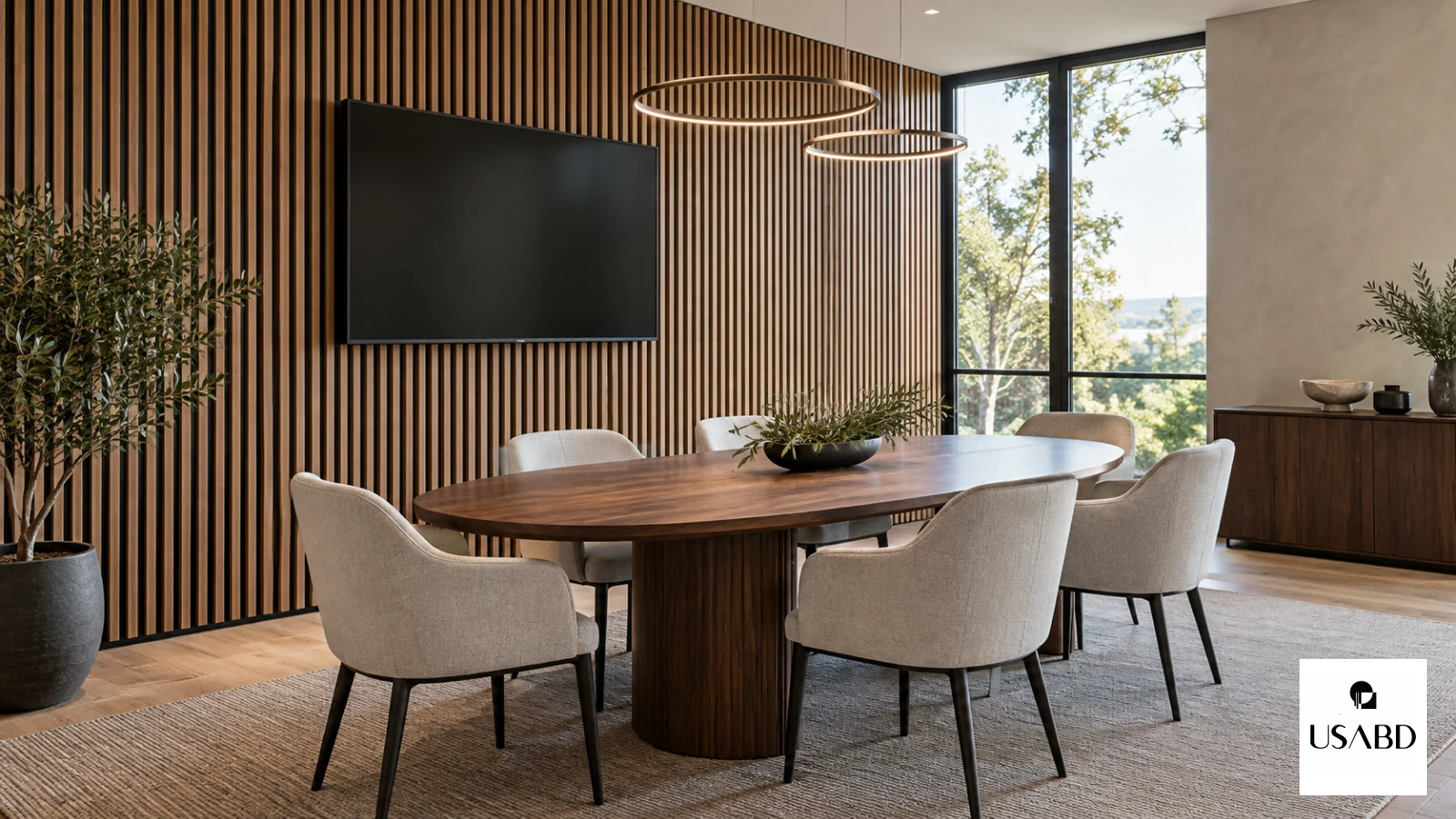
Develop elevations with the actual furniture layout. A visually balanced feature behind the screen may be useful, but the best acoustic locations should follow the room assessment. Avoid automatically covering every wall or treating a single narrow decorative strip as a complete solution.
Compare equivalent proposals
Ask each proposal to identify panel model, finish, area, mounting method, backing or air space, edge treatment and installation scope. If one quotation assumes direct mounting and another assumes battens, they are not the same assembly.
Read our NRC guide before comparing headline ratings. Keep the performance objective distinct from design preferences such as oak versus walnut or horizontal versus vertical slats.
Before ordering, confirm commercial-use documentation, cleaning requirements and replacement arrangements. Reserve a labeled sample and photographs of the finished installation so future repairs can be matched to the approved work.
Frequently asked questions
Will acoustic panels fix poor video-call audio?
They may help with room reflections when appropriately specified, but microphone placement, equipment settings and background noise also need evaluation.
Does adding more panels guarantee better results?
No. Coverage and distribution should follow the intended outcome and the tested assembly. More decorative material is not a substitute for a room-specific plan.
Share the room dimensions, photographs and conferencing layout with USABD when discussing panel options. Include any acoustics consultant’s specification so the finish selection can support the agreed design.