
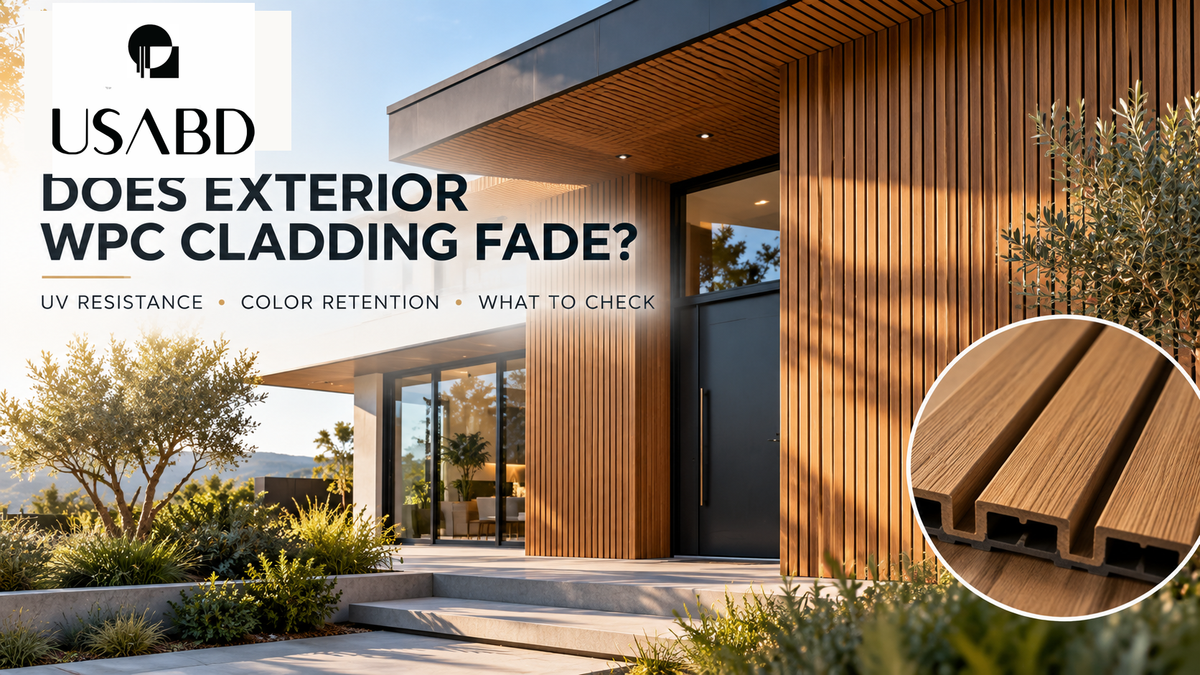
Does Exterior WPC Cladding Fade in the Sun? UV Resistance, Color Change & What to Check

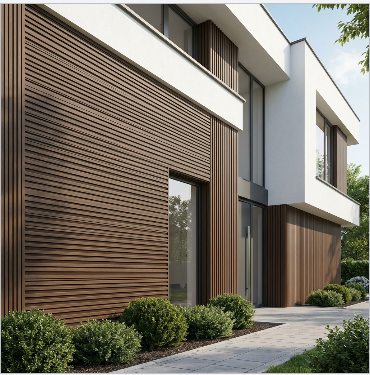
Exterior WPC cladding creates clean architectural lines on contemporary homes, commercial façades and outdoor accent walls. With finishes ranging from charcoal to warm wood tones, it is an appealing alternative to conventional decorative siding. One important question deserves a clear answer before a finish is selected: does exterior WPC cladding fade in the sun?
Quick answer: It can. UV exposure and weather may change the appearance of exterior wood-plastic composite, but the amount of change depends on the specific formulation, pigments, surface construction, mounting arrangement and climate. “UV-resistant” does not mean “fade-proof.” This guide explains what to check before purchasing, how to evaluate color differences and how to plan a long-lasting exterior appearance without relying on unsupported performance promises.
1. Why Exterior WPC Can Change Color
Wood-plastic composite is a category of engineered materials, not one standard formulation. Manufacturers use different combinations of polymers, fibers or fillers, pigments, additives and surface treatments. Sunlight can alter some of these components at the exposed surface. Moisture, temperature cycles and environmental contamination also affect appearance.
UV-related changes may appear as lightening, shifts in tone or a different surface texture. Visible discoloration, however, does not automatically prove permanent UV damage: dirt, pollen, mineral deposits and cleaning residue can create a similar impression.
2. What Does UV-Resistant WPC Mean?
UV resistance means that a material is designed or evaluated to withstand ultraviolet exposure under stated conditions. A manufacturer's general claim does not, by itself, establish how long a product will retain its original color. Ask for documentation identifying the specific panel, finish and tested construction.
Testing or marketing claims for composite decking, a different cladding profile or another finish cannot automatically substantiate performance of the panel under consideration. Avoid treating the words “weather resistant,” “UV resistant” and “no fading” as interchangeable.
3. Does Black or Charcoal WPC Fade Faster?
Darker surfaces often absorb more sunlight and may become hotter than lighter surfaces under comparable conditions. This can create demanding exposure conditions and increase the importance of proper movement allowances. It does not prove every dark composite finish fades faster than every light one. Pigment chemistry, protective surface design and the exact product matter.
A small change in a charcoal panel may also be visually noticeable when it sits immediately beside a black steel door, window frame or metal trim. For strongly exposed façades, request product-specific color-retention and thermal-use guidance.
4. Comparing Exterior WPC Colors
USA Builders Depot offers selected exterior fluted WPC finishes including Ash Gray, Charcoal/Black, Golden Teak and Brown Walnut. Each serves a different architectural direction:
- Ash Gray: a restrained option for concrete, stucco and modern neutral façades.
- Charcoal/Black: strong contrast with lighter masonry and contemporary glazing.
- Golden Teak: a warm wood-inspired appearance that pairs with stone and landscape planting.
- Brown Walnut: a rich, darker wood-look complement to entry accents and outdoor feature walls.
Color descriptions are design guidance, not a ranking of UV performance. Review samples of the actual exterior product and request applicable technical information before specifying a finish.
5. Capped Versus Uncapped Composite Cladding
Some composite systems have an exposed core formulation, while others use a separately engineered protective surface or cap. Some products use decorative films or coatings. Each construction has different properties and limitations.
A protective layer may be designed to improve weathering or stain resistance, but its performance depends on the specific materials and tests. Do not label a USABD product “capped” without confirmation for that SKU; likewise, do not assume a capped product will never change color.
6. Does Wall Orientation Matter?
Exposure varies across a building. In many Northern Hemisphere locations, south-facing façades receive substantial annual sunlight, but west-facing walls can experience intense afternoon sun. Latitude, roof overhangs, trees, surrounding buildings and reflective surfaces all matter.
Partly shaded elevations may develop a different appearance from adjacent exposed areas. Review the actual site and elevations before selecting a finish for highly visible walls.
7. Can Exterior WPC Fade Unevenly?
Yes. Unequal sun exposure is one possible explanation, but differences in manufacturing batches, installation ages, surface contamination or lighting can also make panels look unlike one another. Fluted profiles cast strong directional shadows, so compare finishes under consistent daylight before drawing conclusions.
When ordering a large project, ask about lot consistency and retain product records to assist with future replacement or warranty questions.
8. Fading or Dirt? How to Inspect the Surface
Start with the pattern. Streaks below windows, localized marks near planting or deposits in recessed flutes may point to surface contamination rather than permanent color change. Inspect shaded and exposed areas under similar light.
If the manufacturer allows it, use the prescribed cleaning method in a small area. Never resort to aggressive chemicals, abrasive sanding or high-pressure washing simply to test the color. If visible changes remain after approved cleaning, review the product documentation or seek manufacturer guidance.
9. Can WPC Color Change Be Prevented?
No universal approach guarantees that all exterior composite finishes will look exactly the same indefinitely. Reduce avoidable risk by selecting a panel intended for exterior use, reviewing the surface construction, checking available weathering documentation and complying with installation requirements.
Plan for drainage, ventilation, movement joints, fastening and heat exposure where required by the system. Routine approved cleaning may remove deposits, but cleaning cannot reverse every weathering-related chemical change.
10. What About Hot and Sunny Climates?
Projects in Georgia, Texas, Arizona, Florida and California encounter different combinations of sunlight, heat, humidity, salt exposure and wetting/drying. Product suitability cannot be established from the state name alone.
Air temperature is not the same as panel surface temperature. Dark materials can heat substantially in sun, and concentrated reflections may create localized exposure. Consider material limitations and installation tolerances separately from claims about long-term color retention.
11. How Is UV Resistance Tested?
Weathering assessments may involve laboratory exposure, outdoor testing and color measurement. ASTM G154 describes fluorescent UV exposure apparatus for nonmetallic materials; it is not a universal pass/fail certification that a cladding panel is fade-proof.
When reviewing a test report, identify the exact specimen, exposure procedure, test duration, measurement method and result. If a report measures color change, ask how that result relates to the intended appearance. Do not convert an accelerated test duration into a fixed number of outdoor years without an appropriate validated correlation.
12. How Long Will the Color Last?
There is no single dependable color-retention period covering every exterior WPC product. Service life, structural performance, surface appearance and color retention are separate considerations. A general product-lifespan claim should not be read as a guarantee of unchanged color.
If appearance retention is a critical specification, obtain the manufacturer's current written performance statement or warranty for the exact panel and finish.
13. Does Exterior WPC Include a Fade Warranty?
Warranty terms differ by manufacturer and SKU. Review covered defects, any defined color-change thresholds, duration, exclusions, maintenance obligations, installation requirements and claim procedures. Normal weathering may be treated differently from a warranted defect.
Even if a replacement is available, a newly installed panel may not exactly match material that has already weathered. Check color-matching language before assuming uniform replacement appearance.
14. Can Faded Composite Panels Be Restored?
That depends on what changed. Dirt or deposits may respond to manufacturer-approved cleaning. A permanently changed decorative layer may not. Do not assume that a factory-finished WPC panel can be repainted, stained, pressure-washed or sanded safely. Unauthorized refinishing can damage the surface and affect warranty coverage.
For significant permanent changes, ask the supplier or manufacturer whether restoration or selective replacement is recommended for the exact product.
15. Buying Checklist for Lasting Exterior Appearance
- Confirm that the exact product is approved for the intended exterior installation.
- Verify the finish, profile, dimensions and surface construction.
- Review any product-specific weathering documentation and avoid unverified numerical fade claims.
- Examine samples beside windows, doors, masonry and roofing in natural light.
- Consider sun exposure, shadows and possible reflected heat on each elevation.
- Review the fastening, drainage, ventilation and thermal-movement instructions.
- Confirm compatible edges, corners, trims, packaging and batch-matching guidance.
- Read the actual written warranty and care instructions before ordering.
For related details, consult our guides on cleaning exterior WPC cladding and WPC cladding expansion gaps.
Frequently Asked Questions
Does exterior WPC cladding fade in direct sunlight?
It can. The amount depends on the formulation, protective surface, pigments and exposure.
Is UV-resistant WPC fade-proof?
No. UV resistance should not be understood as a promise of zero color change.
Is black WPC always more likely to fade?
No. Dark surfaces often heat more under sun, but actual color retention is product-specific.
Does capped WPC perform better?
Some caps are designed to improve weathering resistance, but the actual result must be verified for the specific construction.
Can exterior WPC fade unevenly?
Yes. Sun exposure, shading, contamination, production variation and installation age can all influence visible appearance.
Does 1,000 hours of UV testing equal a certain number of years outdoors?
Not automatically. Laboratory exposure cannot be converted into a universal real-world lifespan without relevant validation.
Can faded WPC be cleaned back to its original color?
Cleaning may remove deposits but not necessarily reverse permanent weathering changes.
Can you paint faded WPC?
Only where the specific product manufacturer approves a compatible finishing system.
Do lighter WPC colors always last longer?
No. Solar heat absorption and color retention are separate characteristics influenced by the exact product.
Should I order exterior WPC samples?
Yes, particularly for a large or finish-sensitive façade. Compare actual samples under natural light and review current technical specifications.
Explore Exterior WPC Cladding at USA Builders Depot
Exterior fluted WPC can create a sophisticated architectural appearance when the finish, installation system and realistic performance expectations are considered together. Explore USA Builders Depot exterior WPC cladding, compare available colors and request product details or finish samples before placing a project order.
For project-specific support, provide the approximate wall dimensions, preferred finish, project ZIP code, estimated quantity and any required technical documentation.
USA BUILDERS DEPOT — Build a Better Tomorrow.