
Acoustic Wood Slat Panels Behind a Bed: Headboard Wall Design & Installation Guide

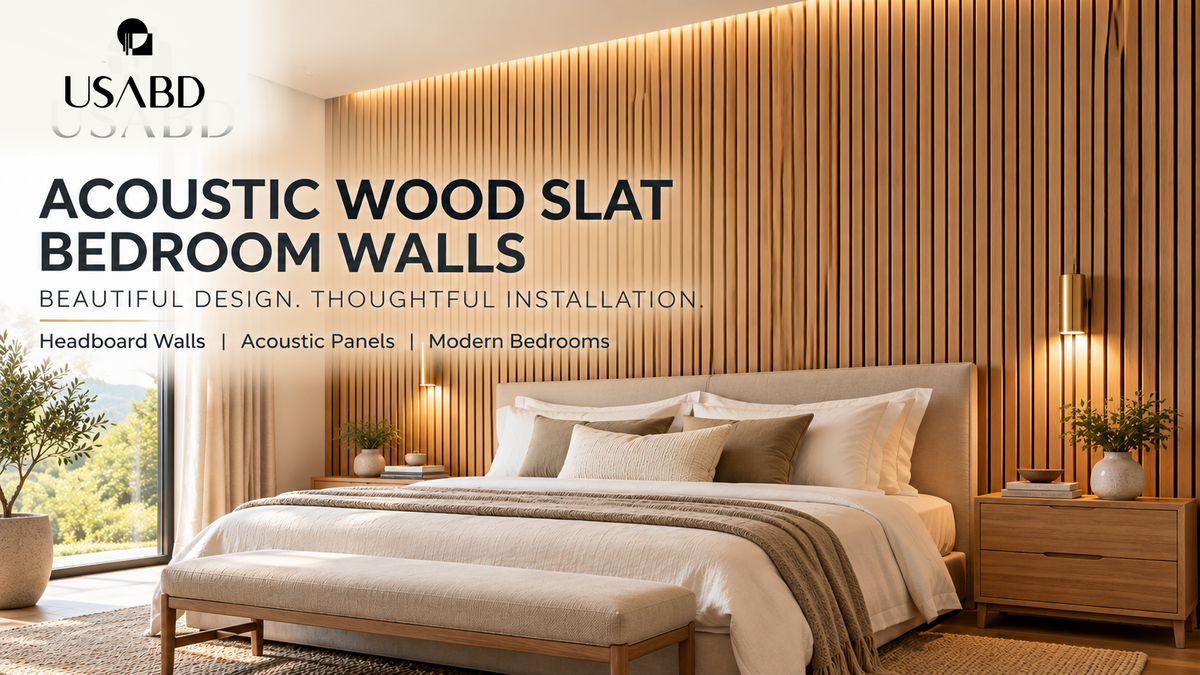
A bedroom feature wall can transform an ordinary room. Instead of relying only on paint or wallpaper, homeowners, builders, and designers can use vertical acoustic wood slat panels to add warmth, texture, and architectural depth behind a bed.
Before installation, decide how tall and wide the feature should be, which finish works with the furniture, whether the panels meet your acoustic goals, and how to accommodate outlets, wall lighting, and headboard supports. This guide walks through each decision.
Quick Answer: Can Acoustic Wood Slat Panels Go Behind a Bed?
Yes. Compatible interior acoustic wood slat panels can create a distinctive headboard feature wall when installed with the manufacturer's approved mounting system. They can frame the bed, complement bedroom lighting, and—when appropriately designed and tested—absorb some reflected sound. They are not structural headboard supports or a complete soundproofing solution.
1. Why Choose a Wood Slat Headboard Wall?
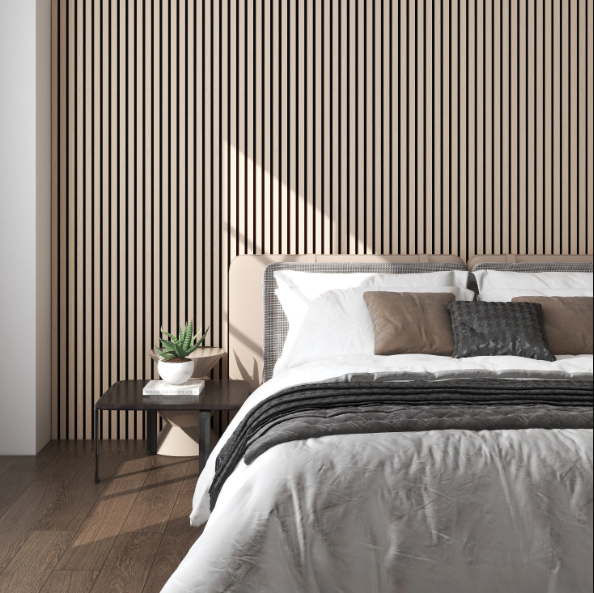
Vertical slats add texture, rhythm, and subtle shadows to bedroom interiors without elaborate custom millwork. A slatted backdrop can connect the bed, nightstands, and wall lighting into a cohesive composition. Natural and wood-inspired finishes complement modern, transitional, Scandinavian, and Japandi design.
When the product has an acoustic backing, it may also control some interior sound reflections. How much depends on the exact panel, mounting arrangement, and room conditions—not simply whether the surface has slats.
2. Three Design Layouts for a Bedroom Slat Wall
Full-height, full-width
Covering the complete bedroom wall creates a continuous architectural backdrop. Coordinate panel edges around corners, baseboards, ceiling transitions, and electrical devices.
Centered behind the headboard
A narrower feature can extend slightly beyond the headboard while leaving painted drywall at the sides. This approach works well for compact bedrooms and more restrained designs.
Extended behind the bed and nightstands
Extend the panel feature beyond both sides of the headboard so it visually unifies the sleeping area. Align the edges with the complete furniture grouping rather than the mattress alone.
3. How High Should Panels Extend?
There is no universal height. Full-height panels emphasize ceiling height; partial-height panels create a more contained backdrop. Measure the finished height at several points rather than assuming an eight-foot ceiling is exactly 96 inches. Plan how the panel ends at the top and bottom; exposed ends should be finished with an appropriate detail.
If cutting is necessary, confirm that the specific panel permits it and follow the manufacturer's trimming and finishing instructions.
4. How Wide Should a Headboard Feature Wall Be?
Measure the actual headboard, not only the mattress. Consider the placement of nightstands, sconces, switches, and wall outlets. A centered bed usually benefits from balanced margins, although deliberate asymmetry can suit a contemporary room. Avoid stopping a panel at an arbitrary point that conflicts with lighting or furniture edges.
5. Choosing the Right Bedroom Finish
USA Builders Depot offers selected acoustic slat panels in finishes including Raw White Oak, Light Brown Oak, Classic Oak, Smoked Oak, Dark Ebony, and White Oak & Grey Felt. Lighter oak finishes suit airy interiors; richer tones can establish contrast and depth; darker finishes pair well with cream bedding and carefully placed ambient lights.
Review physical samples in the intended room. Daylight, lamps, paint, flooring, and furnishings can substantially change how a finish appears. Compare the dimensions and construction of the exact listing before ordering.
6. Will Acoustic Slat Panels Make a Bedroom Quieter?
Sound absorption and sound isolation are different. Absorption manages some reflections inside a room. Sound isolation reduces sound passing between spaces. An acoustic slat feature may reduce reverberation, but it should not be represented as blocking traffic noise through windows or footsteps from the room above.
An NRC (Noise Reduction Coefficient) claim must relate to the tested product and installation assembly. Never assume all felt-backed wood slat panels achieve the same result. For more context, read our guide to acoustic panels versus soundproofing.
7. Should You Cover the Whole Wall?
For a purely decorative goal, a centered panel section may be enough. If sound control is a significant objective, coverage should respond to the room's dimensions, upholstery, curtains, flooring, windows, and other reflective surfaces. The best design placement is not automatically the best acoustic-treatment placement.
8. Measure Before Ordering
- Measure the finished feature width at more than one height.
- Measure from the intended lower edge to the upper termination.
- Mark the location of outlets, switches, sconces, windows, and other interruptions.
- Confirm the selected panel's usable installed coverage, not just its nominal advertised dimensions.
- Calculate whole panels from the usable width, and allow for cuts, edges, offcuts, and reasonable waste.
- Check packaging quantities and any minimum-order restrictions for the exact product.
For a more detailed coverage calculation, see How Many Acoustic Wall Panels Do I Need?.
9. General Installation Process
- Inspect the wall: repair damaged drywall and address moisture or loose finishes.
- Verify mounting: use adhesive, mechanical fasteners, battens, or other methods only where permitted for the product and substrate.
- Locate services: identify framing, plumbing, and concealed wiring before drilling.
- Lay out the wall: establish level, plumb, and balanced starting points.
- Dry-fit: check panel seams, outlet openings, and edge locations.
- Cut carefully: use tools suitable for the backing and slat materials.
- Attach securely: follow the actual manufacturer's fastening or adhesive instructions.
- Finish and inspect: complete exposed edges and check alignment before replacing furniture.
Do not treat these general steps as a universal fastener spacing or adhesive specification.
10. Can a Headboard Attach Directly to the Panels?
Do not rely on decorative slats or acoustic backing to support a heavy headboard unless the complete assembly has been specifically engineered and approved for that load. Wall-mounted headboards should transfer loads to appropriate framing, blocking, or other structural support. A freestanding bed may simplify the installation, but leave suitable clearance to avoid rubbing or damaging the panel finish.
11. Wall Sconces and Integrated Lighting
Plan bedside lights before fitting panels. Fixtures require appropriate support independent of decorative backing, and electrical boxes must be installed and accessible as required. Additional panel depth may change the relationship between the fixture and the wall box.
Warm, dimmable light often complements oak finishes, while thoughtful placement minimizes glare for reading. LED strips may be used in compatible purpose-designed channels, subject to product restrictions, heat management, electrical safety, and future service access. See our LED lighting guide for acoustic wood slat panels.
12. Coordinating Outlets and Switches
Mark every device location before installation. Do not bury electrical boxes behind permanent decorative panels. Additional thickness may require listed box extensions and appropriate cover plates; qualified electricians should handle electrical changes. Where possible, coordinate nightstand height and device locations early in the design.
13. Do Acoustic Panels Need an Air Gap?
Not always. Some products are designed for direct mounting, while others can be installed on battens or a supporting framework. The depth of any cavity can influence acoustic performance, but an air gap alone does not guarantee a specific NRC. Follow tested assembly documentation if measurable sound absorption is a project requirement.
14. Install Before or After the Bed?
On new construction and full bedroom renovations, panel installation before placing the bed usually provides better access and easier coordination of electrical work. For occupied rooms, carefully move or protect furniture and flooring. Avoid working around immovable furnishings if doing so prevents accurate cutting, fastening, or inspection.
15. How to Finish Exposed Panel Edges
Full-wall installations may terminate at inside corners. Centered feature walls have visible outer edges that deserve an intentional finish. Selected acoustic systems offer matching end slats or finishing pieces; verify that the chosen accessory matches the panel's finish and construction. Do not assume every trim piece is interchangeable.
16. Common Mistakes to Avoid
- Measuring the mattress instead of the full headboard and furniture layout.
- Selecting a color without checking a physical sample in bedroom lighting.
- Installing over moisture damage or unstable drywall.
- Using unapproved adhesives, fixings, or cutting methods.
- Mounting headboards or sconces through decorative panels without structural support.
- Covering electrical boxes or overlooking panel thickness.
- Leaving exposed ends unfinished.
- Assuming decorative acoustic panels completely soundproof a room or have identical fire and acoustic ratings.
17. How to Select Panels for Your Project
First establish the desired appearance and overall wall dimensions. Then choose a finish, verify product dimensions and installation requirements, and plan lighting, outlet access, headboard support, and trim. For projects where acoustic or fire performance is regulated or specified, request documentation for the exact product and assembly.
Before ordering, review samples and confirm current finish, size, packaging, and shipping availability.
Frequently Asked Questions
Can acoustic wood slat panels go behind a bed?
Yes, with a suitable interior product and manufacturer-approved mounting system.
Should the panels reach the ceiling?
Either full-height or partial-height designs can work. Use the room proportions and intended visual effect to decide.
How wide should the feature wall be behind a king bed?
Measure the real headboard, nightstands, and wall conditions rather than relying only on mattress width.
Will panels soundproof the room?
No. Sound absorption within a room is not the same as blocking sound through walls, windows, or floors.
Can I fasten a headboard to the slats?
Not as a default. Use appropriately designed structural support behind or independent of the decorative panels.
Can I install bedside sconces?
Yes, when fixtures have adequate support and electrical installations comply with applicable requirements.
Can outlets pass through the panel surface?
Yes, with properly designed electrical-box and cover-plate details. Do not conceal junction boxes.
Is an air gap required?
Not universally. Follow the product and, where relevant, tested acoustic assembly requirements.
Do small bedrooms work with wood slat accents?
Yes. A centered feature can provide texture without covering the entire wall.
Are different finishes available?
Yes. USA Builders Depot carries selected oak-inspired and dark acoustic slat finishes. Confirm dimensions and stock for the specific listing.
Create Your Bedroom Feature Wall with USA Builders Depot
Acoustic wood slat panels can turn a plain headboard wall into a sophisticated architectural feature. The best results come from coordinating panel dimensions, wall conditions, lighting, headboard attachment, and finishing details before installation.
Explore USA Builders Depot Acoustic Wood Slat Panels and compare available finishes and sizes. For a project quotation, share your wall measurements, preferred finish, ZIP code, quantity, and timeline with the USABD team.
USA BUILDERS DEPOT — Build a Better Tomorrow.