

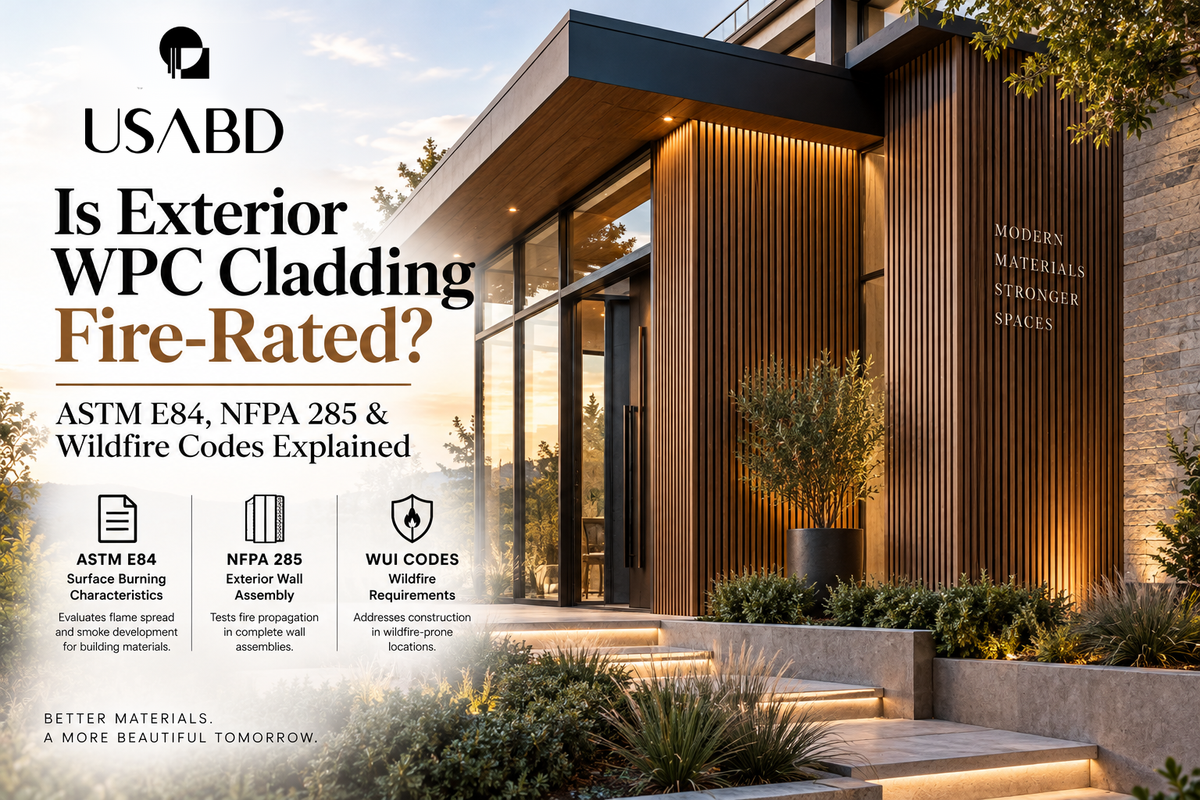
Is Exterior WPC Cladding Fire-Rated? ASTM E84, NFPA 285 & Wildfire Codes Explained

Exterior wood-plastic composite (WPC) cladding is increasingly used to create modern façades and dimensional architectural accents. But does it meet the fire-safety requirements for your building? There is no single universal fire rating for WPC cladding. The answer depends on the specific panel, its construction, where it is installed, and whether the complete wall assembly must satisfy other tests. This guide explains ASTM E84, NFPA 285, wildfire-zone construction considerations, and the documentation to request before specifying exterior composite panels.
Is WPC Exterior Cladding Fire-Rated?
Some WPC cladding products have documented fire-performance results, but there is no universal fire rating for wood-plastic composites. Formulations, profiles, thicknesses, and installation methods vary. A test on one product or decking profile does not automatically apply to another exterior cladding panel. Evaluate the exact SKU and, where required, the entire exterior wall assembly.
What Does Fire-Rated Cladding Mean?
The phrase may refer to surface-burning characteristics, fire propagation, fire resistance, noncombustibility, or wildfire exposure. These are different performance concepts. Surface-burning tests examine how a material burns under specific test conditions. Assembly tests may consider spread through wall components. Fire resistance refers to the performance of particular assemblies for a specified period, while noncombustibility is a separate classification. Do not use these terms interchangeably.
What Is ASTM E84?
ASTM E84, often called the Steiner Tunnel Test, evaluates surface-burning characteristics. It produces a Flame Spread Index (FSI) and Smoke Developed Index (SDI). Common interior finish classes are shown below.
| Classification | Flame Spread Index | Smoke Developed Index |
|---|---|---|
| Class A | 0–25 | 450 or less |
| Class B | 26–75 | 450 or less |
| Class C | 76–200 | 450 or less |
These results do not establish that a material is noncombustible, fireproof, or approved for every exterior application. The relevance of ASTM E84 depends on the applicable code and product use.
Does ASTM E84 Class A Mean WPC Is Fireproof?
No. A Class A result indicates that the tested material achieved specified surface-burning indices in the relevant test. It does not establish a one-hour or two-hour fire-resistance rating or demonstrate the fire behavior of an unrelated wall assembly. Exterior walls include insulation, sheathing, barriers, framing, furring, fastening systems, cavities, and cladding. Their interaction matters.
What Is NFPA 285?
NFPA 285 is a test method for evaluating fire propagation of specified exterior wall assemblies containing combustible components. It examines an assembly, not merely a loose cladding sample. The scope of any evidence depends on the tested configuration and permitted variations. A designer should verify the particular cladding, insulation, sheathing, barriers, attachment system, and cavity geometry when NFPA 285 is required. The National Fire Protection Association publishes the standard, and adopted building codes determine applicability.
ASTM E84 vs. NFPA 285
| Question | ASTM E84 | NFPA 285 |
|---|---|---|
| Principal purpose | Surface-burning characteristics | Exterior wall fire propagation |
| Typical subject | Material or tested configuration | Specified wall assembly |
| Result | Flame spread and smoke indices | Assembly performance against test criteria |
| Proves noncombustibility? | No | No |
| Proves hourly fire resistance? | No | No |
Neither automatically substitutes for the other. Calling a component “NFPA 285 rated” without identifying an applicable assembly can be misleading.
When Is NFPA 285 Required?
Applicability depends on the adopted building code edition, building construction type, wall height, combustible components, relevant sections and exceptions. Some exterior walls on Type I, II, III or IV buildings may require assembly evaluation. Do not infer that all commercial structures require NFPA 285 or that all residential projects are exempt. The architect and authority having jurisdiction should determine the specific requirements.
Can WPC Cladding Be Used on Homes?
Potentially. A detached residence and a multistory multifamily building may be governed by different building-code provisions. Even detached houses may be subject to local cladding, fire-separation, or wildfire-exposure requirements. The label “for exterior use” does not demonstrate approval for every jurisdiction. Verify that the intended material and installation are appropriate for the actual building.
What About Wildfire-Prone Locations?
Wildfires expose structures to embers, radiant heat, and direct flame. Those conditions are not equivalent to an ASTM E84 classification. California has specific Wildland-Urban Interface requirements addressing construction in designated wildfire-prone areas, with exterior-wall provisions and potential local amendments. Determine which adopted code and jurisdiction apply. Where relevant, consult the California Office of the State Fire Marshal Building Materials Listing and the local building department. Do not assume any USABD cladding SKU has wildfire approval without its exact documentation.
Does WPC Need a California State Fire Marshal Listing?
Not every exterior product follows the same compliance route. Applicable provisions may permit different documented approaches. The designer and local authority should identify the accepted pathway for the project rather than assuming a universal listing requirement or exemption.
Fire-Resistant vs. Noncombustible Cladding
A material may demonstrate a favorable fire-test characteristic and still be combustible. Noncombustibility is a distinct classification established under relevant standards and code criteria. The presence of mineral-looking finishes, metallic surfaces, or decorative coatings does not establish the underlying material's classification. A fire-resistant backing also does not automatically make the complete WPC wall system compliant.
Does Installation Affect Fire Performance?
Yes. Exterior cladding assemblies can include vertical or horizontal furring, clips, insulation, air and water barriers, drainage spaces, fasteners, sheathing, and flashing. Altering these elements can create a configuration different from one that was tested. Do not substitute attachment methods or wall components merely for installation convenience when a specific approved assembly is required.
Can WPC Be Installed Over Existing Siding?
Installation over existing brick, concrete, stucco or siding requires assessment of attachment, structure, drainage, flashing, moisture management and relevant fire provisions. Adding composite cladding changes the wall configuration, so substrate suitability and code compliance cannot be assumed. Review the USABD installation guide for masonry and stucco alongside the selected manufacturer's requirements.
What Fire Documentation Should You Request?
- Exact identification: manufacturer, SKU, profile, size, finish and intended use.
- ASTM E84 evidence: where required, identify the tested product, mounting method, FSI and SDI.
- NFPA 285 evidence: where applicable, review the actual tested or appropriately evaluated exterior wall assembly.
- Wildfire documentation: verify any necessary approvals, listings or accepted code approach.
- Installation instructions: check substrate, subframe, fasteners, clearances, trims, orientation and details.
- Project review: obtain acceptance from the responsible design professional and authority where required.
Exterior Cladding Fire-Documentation Checklist
| Document | Purpose |
|---|---|
| Product specification | Identifies exact cladding |
| Material composition | Supports classification review |
| ASTM E84 report, if relevant | Surface-burning results |
| NFPA 285 assembly evidence, if relevant | Exterior wall propagation review |
| Wildfire documentation, if relevant | Location-specific compliance |
| Installation instructions | Approved construction details |
| Assembly drawings | Defines wall components |
| Project approval | Applicable acceptance |
Not every item applies to every project; identify the relevant requirements early.
Can Fluted WPC Be Used on Commercial Buildings?
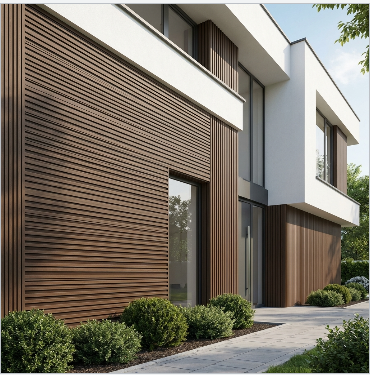
Potentially, when the exact product and installed wall assembly meet the project requirements. Contemporary fluted cladding can create dimensional shadow lines on entrances, commercial façades, offices and hospitality properties. Aesthetic suitability should be considered separately from fire, wind, structural fastening, and weather-resistance requirements.
What About WPC Soffits and Exterior Ceilings?
A product approved for vertical exterior walls is not automatically appropriate overhead. Soffits, eaves and other projections may have separate fastening and fire-safety requirements, particularly in wildfire areas. Request explicit installation and product approval for the proposed overhead location.
Are Exterior WPC and Interior Acoustic Panels Rated the Same?
No. Exterior composite WPC and interior veneer-and-felt acoustic slats are different product categories. Their formulas, cores, backings and testing may differ. Do not transfer a fire-test result from an acoustic panel or decking product to an exterior WPC cladding SKU. Review the USABD guide to interior acoustic panel fire classifications for that separate category.
Common Mistakes When Evaluating Fire Ratings
Common mistakes include assuming exterior-use labeling guarantees code compliance; confusing Class A with noncombustibility; reusing a report for an unrelated profile; believing a favorable material result proves assembly compliance; overlooking changes to insulation or cavities; and treating ASTM E84 as a wildfire approval. Avoid these by checking the complete documentation against the project requirements before ordering.
How to Specify Exterior WPC Correctly
First identify location, adopted code, construction type, wall assembly and relevant fire requirements. Next, evaluate products with documentation appropriate to those conditions. Only then compare finish, dimensions, profiles and trims. Coordinate the selected panel with insulation, water-resistive barriers, drainage, flashing, attachment and any assembly limitations. Obtain required project approvals before construction.
Frequently Asked Questions
Is WPC exterior cladding fireproof?
No universal fireproof rating applies to all WPC materials.
Can WPC be Class A?
Some products may achieve Class A surface-burning results; verify the report for the exact product.
Does Class A mean it will not burn?
No. It does not establish noncombustibility.
How do ASTM E84 and NFPA 285 differ?
E84 evaluates surface burning; NFPA 285 evaluates propagation in specified exterior wall assemblies.
Does every commercial building need NFPA 285?
No; check the adopted code and construction.
Does ASTM E84 replace NFPA 285?
No.
Can WPC be used on single-family homes?
Potentially, subject to local requirements and product suitability.
Can WPC be used in wildfire zones?
Only where the product and construction meet applicable wildfire requirements.
Are all WPC profiles rated alike?
No. Formulation and tested configuration matter.
Can a decking report prove wall cladding compliance?
Not automatically.
Does noncombustible insulation make the assembly compliant?
Not by itself.
What should I ask my supplier?
Request exact product information, applicable tests, installation instructions and project-specific documents.
Explore Exterior WPC Cladding at USA Builders Depot
USA Builders Depot offers contemporary exterior WPC cladding in fluted and shiplap-inspired profiles, with selected wood-look and charcoal finishes. These materials can provide architectural texture where the product and proposed installation are suitable for the project. Explore the exterior wall-panel collection or the exterior fluted WPC collection. For specification-driven work, consult the Architect & Specifier Center and provide the exact product, building type, and location when requesting technical information.
Final Thoughts
Exterior WPC cladding can make a striking addition to modern architecture, but material selection must account for the building's fire-safety requirements. ASTM E84, NFPA 285, fire resistance, noncombustibility and wildfire provisions describe different performance considerations. Confirm the exact product and full wall assembly against project requirements, rather than relying on broad claims. USA Builders Depot — Better Materials. A More Beautiful Tomorrow.
Technical reference points: National Fire Protection Association, ASTM International and California Office of the State Fire Marshal. These references explain standards generally and do not establish any particular USA Builders Depot product certification.
%20cladding%20is%20increasingly%20used%20to%20create%20modern%20fa%C3%A7ades%20and%20dimensional%20architectural%20accents.%20But%20does%20it%20meet%20the%20fire-safety%20requirements%20for%20your%20building?%20...)