

Are Acoustic Wood Slat Panels Low-VOC? Formaldehyde, MDF & Certifications Explained

Acoustic wood slat panels bring warmth and dimensional texture to modern homes, offices and hospitality environments. Beyond appearance and sound absorption, customers increasingly ask about indoor air quality: Are acoustic wood slat panels low-VOC? The answer depends on materials, manufacturing and evidence for the exact product. This guide explains MDF, formaldehyde, EPA TSCA Title VI, CARB Phase 2, voluntary emissions certifications and the documentation you should request before ordering.
Are Acoustic Wood Slat Panels Low-VOC?
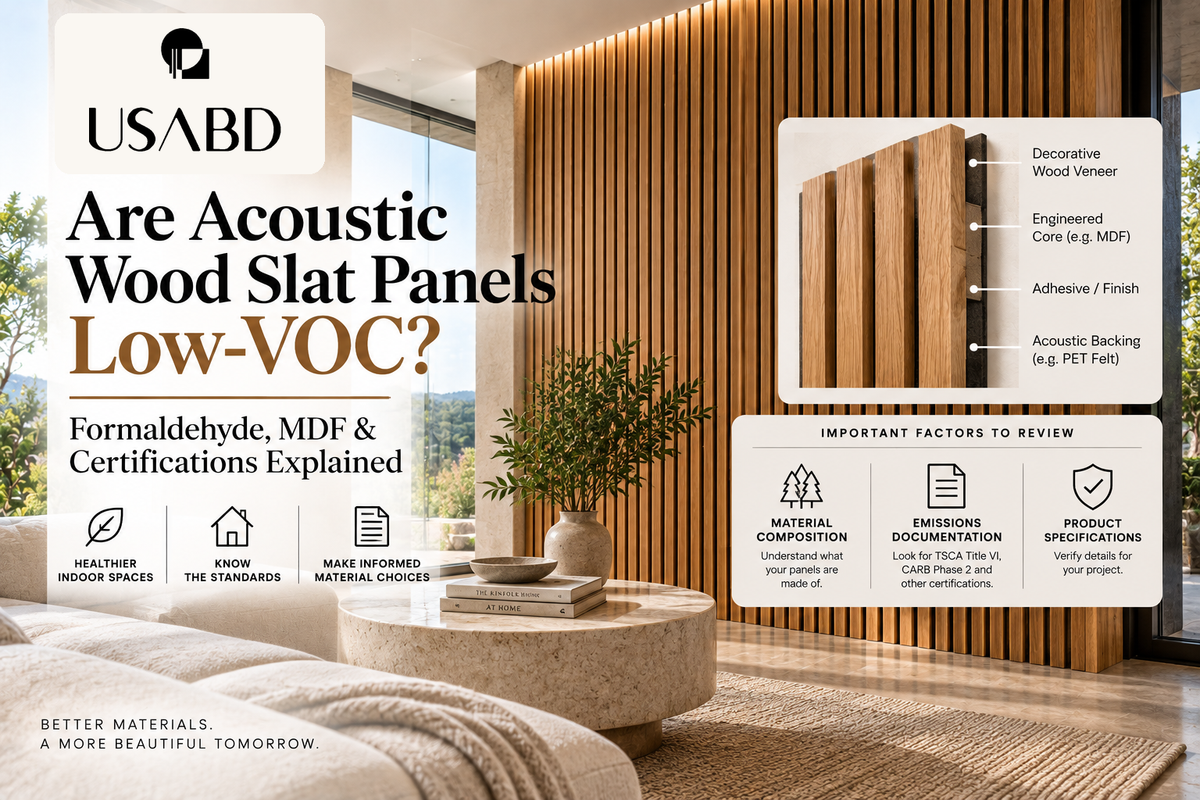
Some acoustic wood slat panels meet defined low-emission criteria, but not every decorative panel has been tested or certified as low-VOC. Depending on the product, components may include wood veneer, MDF or another engineered core, polyester felt, adhesives, and protective finishes. Each can influence the completed product's emissions. Neither a natural appearance nor the presence of synthetic felt proves low- or high-emission performance. Request documentation for the exact product and construction.
What Does Low-VOC Mean?
VOC means volatile organic compound. VOCs can enter indoor air from many building materials, furnishings, coatings, adhesives, and cleaning products. The term low-VOC by itself is not a universal certification. VOC content describes volatile material in a formulation, whereas VOC emissions describe substances released under defined conditions. An adhesive described as low-VOC does not certify the entire assembled wall panel.
Do Acoustic Wood Slat Panels Contain Formaldehyde?
Some panels incorporate regulated composite wood products manufactured with formaldehyde-associated resins, but material formulations differ. Formaldehyde exposure can irritate eyes and respiratory passages, and longer-term exposure has other recognized health concerns. A wood veneer, MDF core, adhesive, and felt backing must not be assumed to have identical emission characteristics.
Does MDF automatically mean high emissions?
No. MDF products use different resin systems and production processes. Compliance documentation for the actual regulated core and any applicable finished good matters far more than the presence of the term MDF alone.
What Is EPA TSCA Title VI?
The Toxic Substances Control Act Title VI formaldehyde rule establishes federal requirements for certain composite wood categories, including hardwood plywood, particleboard, MDF, and thin MDF, with requirements also affecting applicable finished goods and some laminated products.
| Regulated material | Emission standard |
|---|---|
| Hardwood plywood | 0.05 ppm |
| Particleboard | 0.09 ppm |
| MDF | 0.11 ppm |
| Thin MDF | 0.13 ppm |
These values are specified product-testing limits, not permissible ambient room concentrations. Additional manufacturing, testing, labeling and certification provisions apply. Whether a particular slat-panel construction is subject to provisions for laminated products depends on its actual composition and resin system. A certificate for an unrelated MDF panel cannot establish compliance for a different finished assembly.
What Does CARB Phase 2 Mean?
CARB refers to the California Air Resources Board. Its Phase 2 composite-wood formaldehyde limits informed the corresponding federal limits. CARB's state framework and EPA's federal TSCA Title VI framework share corresponding emission limits but have distinct jurisdictional, labeling, and certification considerations. A CARB Phase 2 label alone should not be assumed to satisfy every applicable current federal label requirement.
What Is GREENGUARD Gold Certification?
UL GREENGUARD Gold is a voluntary third-party chemical-emissions certification with criteria extending beyond the formaldehyde limits applicable to regulated composite wood. It is different from mandatory TSCA Title VI compliance. A product may meet applicable federal composite-wood requirements without holding GREENGUARD Gold; voluntary certification does not replace independent legal obligations. Confirm the exact product and certificate's current status in the issuing organization's database before advertising a certification.
Does No-Added Formaldehyde Mean Formaldehyde-Free?
Not necessarily. No-added-formaldehyde claims commonly concern specific resin systems. They do not guarantee zero measured formaldehyde emissions in a finished assembly. EPA provisions for qualifying resin systems have specific requirements. Distinguish resin formulation claims, measured emission results, regulatory compliance, and voluntary low-VOC certifications.
Do Acoustic Felt Backings Release VOCs?
Acoustic backing materials vary: polyester, recycled fibers, binders and coatings may be involved. Recycled-content claims are different from emissions claims. Do not assume that a polyester backing makes the completed panel emissions-free or that documentation for the backing necessarily covers the attached slats and adhesives.
Can Installation Adhesives Affect Indoor Air Quality?
Yes. Construction adhesives and related coatings may contribute their own emissions during installation and curing. Choose an adhesive approved for the exact wall panel and substrate, and check its emissions documentation if the project specifies limits. Mechanical fastening can sometimes reduce reliance on adhesive, but must follow the panel manufacturer's approved attachment methods. It does not eliminate the need to assess emissions from the panel itself.
How to Verify Low-VOC Claims Before Buying
- Identify the precise product: record the SKU, dimensions, veneer, backing and configuration.
- Confirm the core: identify MDF, particleboard, plywood, or other construction.
- Request applicable TSCA Title VI evidence: check documentation for any regulated composite wood components and finished good requirements.
- Verify voluntary certifications: confirm the exact listed product and current certificate status.
- Review the entire assembly: face, core, backing, adhesives and finishes.
- Review installation products: including adhesive and surface coatings.
- Retain submittals: keep product-specific evidence with project records.
Acoustic Wall Panel Certification Checklist
| Document | What it supports |
|---|---|
| Product specification sheet | Identified materials and dimensions |
| Core material declaration | Composite wood classification |
| TSCA Title VI documentation | Applicable federal compliance |
| CARB documentation | Applicable California compliance |
| GREENGUARD Gold certificate, if held | Defined voluntary emissions criteria |
| VOC test report, if available | Measured emissions under stated conditions |
| Installation instructions | Approved mounting materials and methods |
| Acoustic report | Tested sound absorption |
| Fire classification | Documented fire performance |
Acoustic performance, fire performance and chemical emissions are separate characteristics. A certificate or rating for one does not establish the others.
Are Low-VOC Acoustic Panels Better for Bedrooms?
Documented low-emission materials may support a wider indoor-air-quality approach in bedrooms, home offices and living spaces. However, no one product certificate guarantees overall room air quality. Ventilation, furnishings, moisture, cleaning products and other building materials also influence exposure. Select panels using product-specific emissions documentation and an appropriate installation.
What About Commercial Acoustic Wall Panels?
Commercial projects may require evidence for acoustic absorption, fire classification, indoor chemical emissions, durability, cleaning suitability and approved mounting systems. Architects should specify each attribute independently. A hospitality or office project's fire-rating document is not a substitute for a low-emission test report, and a low-emission certificate is not proof of NRC performance.
Can Acoustic Panels Be Used in Schools or Healthcare Spaces?
Potentially, subject to the project's precise requirements for emissions, fire behavior, cleanability, durability, maintenance and installation. A wood-slat design that looks appropriate may not satisfy the written specification. Confirm required certifications and complete assembly requirements before ordering.
How Does Humidity Affect Material Emissions?
Temperature and humidity can influence emissions from some building materials, but effects vary by formulation and conditions. Operate suitable ventilation and moisture-control systems; ventilation does not replace choosing compliant materials. For moisture-location decisions, see the USABD guide to acoustic wood slat panels in bathrooms.
How to Choose Acoustic Wood Slat Panels for a Modern Interior
Select an architectural finish suited to the design, from light natural oak to darker wood tones. Review sound-absorption testing for the exact mounted configuration, installation directions, ceiling approval if required, material construction, emissions compliance, cleaning restrictions and fire classifications for the project. The combination—not just the appearance—determines suitability. See the NRC ratings guide, fire classification guide and technical resources.
Frequently Asked Questions
Are acoustic wood slat panels low-VOC?
Some are independently evaluated as low-emission; verify the exact SKU and report.
Do they contain formaldehyde?
Some constructions may include formaldehyde-associated composite wood resins. Testing and classifications differ.
Is MDF safe for interior panels?
Review applicable product compliance documentation and intended use rather than assuming identical emissions among MDF products.
What does TSCA Title VI compliant mean?
Applicable formaldehyde regulations for regulated composite wood and certain finished goods are met.
Are CARB Phase 2 and TSCA Title VI identical?
They have corresponding limits, but jurisdictional, labeling and documentation requirements differ.
Does GREENGUARD Gold mean zero VOCs?
No. It means a specific certified product met the program's defined emissions criteria.
Are felt-backed panels automatically low-VOC?
No. The complete construction matters.
Is real wood veneer enough to prove low emissions?
No. Core, adhesive and finish are also relevant.
Will low-VOC adhesive make any panel low-VOC?
No. Adhesive emissions do not describe the entire assembly.
Does an NRC rating confirm low VOCs?
No. NRC addresses sound absorption only.
What documents should I request?
Specifications, applicable TSCA Title VI evidence, and any required voluntary emissions reports or certificates.
Can another manufacturer's certificate be used?
No. Claims must match the actual product and relevant configuration.
Explore Acoustic Wood Slat Wall Panels at USA Builders Depot
USA Builders Depot offers decorative acoustic wood slat panels for contemporary residential and commercial interiors, including selected oak and darker finishes. Before specifying panels for a project with emissions requirements, verify documentation for the exact product and its construction. Explore the acoustic wood slat wall-panel collection, review technical resources, and contact the team with product details and your project-specific requirements.
Final Thoughts
Wood slat panels can combine architectural texture with useful sound absorption when properly specified. But indoor air quality decisions require more than appealing finishes or broad marketing language. Confirm what materials make up the complete product, which formaldehyde requirements apply, and which voluntary emissions certifications—if any—are actually held. Do not assume that all acoustic wood slat panels have identical emissions performance. At USA Builders Depot, we support thoughtful material selection. Better Materials. A More Beautiful Tomorrow.
Technical references: U.S. EPA Composite Wood Formaldehyde Standards; UL SPOT Product Database. These explain general requirements and do not establish certifications for a USABD SKU.