

Article: Double Steel Door Hardware Explained: Active vs. Inactive Leaf, Astragals & Flush Bolts
Double Steel Door Hardware Explained: Active vs. Inactive Leaf, Astragals & Flush Bolts

A double steel entry door may look simple from the front: two matching door leaves, one frame, one center joint.
Behind that symmetry, however, the two leaves often do different jobs.
One leaf may be used every day while the second stays secured most of the time. One may carry the primary lockset while the other carries flush bolts. A center astragal may help close the meeting joint between the leaves. Handing, locking, threshold details, hardware preparation, and opening sequence all depend on how the pair is configured.
Understanding these terms before ordering is important because double doors should not be treated as two unrelated single doors placed beside each other.
They operate as one coordinated opening.
This guide explains the parts homeowners, builders, architects, designers, and installers should understand before selecting or approving a double steel entry door.
Quick Answer: How Does a Typical Double Steel Door Work?
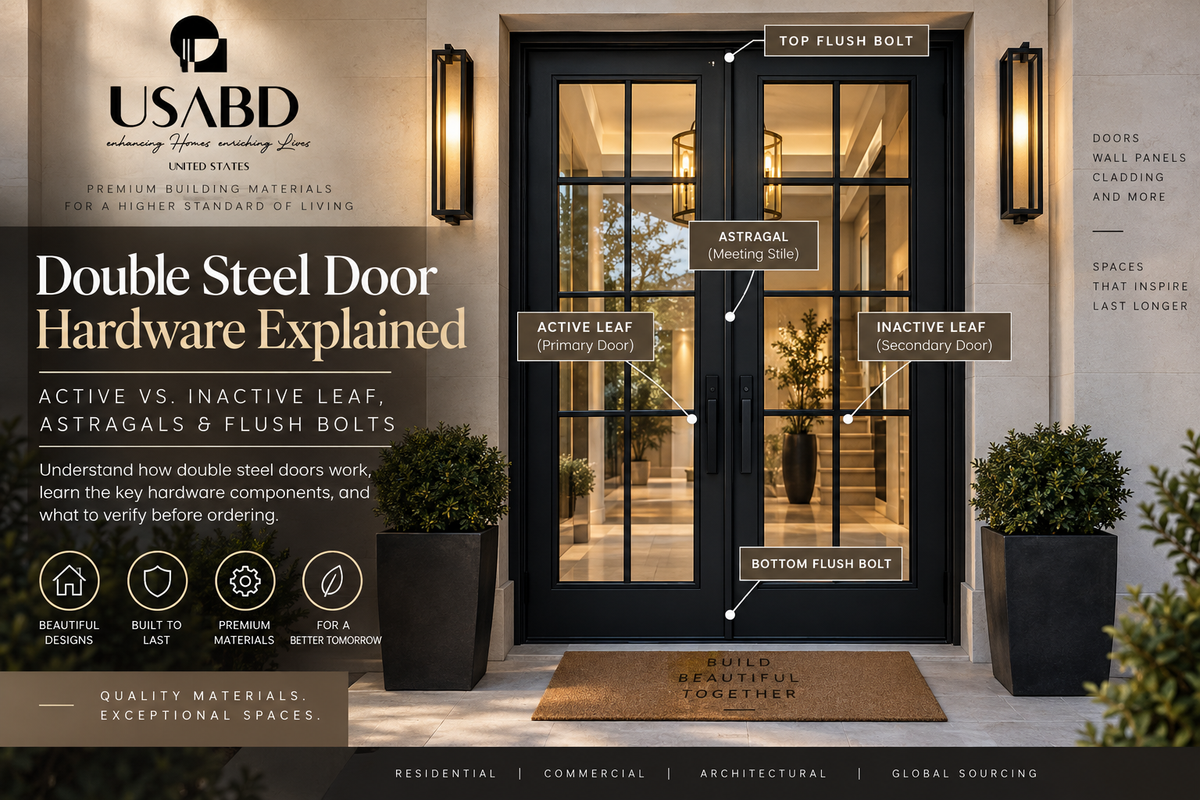
In a common active/inactive double-door configuration, one door leaf is designated the active leaf.
That is normally the leaf used for everyday entry and the leaf that carries the primary operating hardware.
The second is the inactive leaf. It normally remains secured until the full opening width is needed.
Flush bolts can secure an inactive leaf at the top and bottom. When the inactive leaf is anchored, the active leaf can latch against the center condition created by the inactive leaf and its associated hardware.
Many double-door systems also use an astragal at the meeting edges to help close the center gap, improve the seal, and support the locking arrangement. Exact hardware varies significantly by door system and application.
What Is a Door Leaf?
A door leaf is simply one movable door panel.
A single entry door has one leaf. A double door has two.
Those two leaves may look identical, but their hardware and operating roles can be different.
The vertical edges where the two leaves come together are called the meeting stiles.
This center joint is important because, unlike the outer sides of the doors, it does not close directly against a conventional side jamb. It needs its own coordinated locking and sealing strategy.
What Is the Active Leaf?
The active leaf is generally the door panel used for normal everyday operation.
If someone enters the home through only one side of the double door, that is usually the active leaf.
Depending on the specific door system, the active leaf may carry:
- primary handle or pull hardware
- lockset
- deadbolt
- smart-lock preparation
- latch hardware
- strike relationship to the opposite leaf
- operating weather seal
- other model-specific hardware
On architectural steel doors, the active leaf should be identified before the door is ordered, because the selection can affect handing, lock preparation, handle location, astragal arrangement, and the fabrication drawing.
What Is the Inactive Leaf?
The inactive leaf is the second panel in a typical active/inactive pair.
It normally remains closed and secured during ordinary use.
When a wider opening is needed—such as for furniture, equipment, large deliveries, or a larger flow of people—the inactive leaf can be released and opened.
In many traditional double-door arrangements, flush bolts secure the inactive leaf into the frame head above and the sill or threshold below.
The word inactive does not mean the door cannot open. It means that it is not normally the primary everyday operating leaf.
Why Identifying the Active Leaf Matters Before Ordering
Imagine ordering a beautiful 72 × 96 black steel double door.
The size is correct. The glass pattern is correct. The finish is correct.
But the active leaf ends up on the wrong side.
Now the primary handle may land opposite the intended circulation route. The open door may interfere with a wall or furniture. A smart lock may be prepared on the wrong panel. The architectural drawing may no longer match the delivered unit.
That is why the active leaf should be selected at the same time as handing and swing.
For more detail on that part of the selection process, use the USA Builders Depot Steel Door Handing Guide.
What Is an Astragal?
An astragal is a component used at the meeting edges of paired doors.
On an exterior double steel door, the easiest way to think about an astragal is:
It helps manage the joint where the two doors meet.
That joint can affect:
- air leakage
- water resistance
- daylight through the center seam
- lock engagement
- security
- closing sequence
- appearance
Not every door pair uses the same astragal design.
Some are mounted to the inactive leaf. Some systems use configurations involving the active leaf. Other door pairs use different meeting-stile designs altogether.
Do not select or install an astragal independently of the actual door system.
Is an Astragal the Same as a Mullion?
No.
This is an important distinction.
An astragal typically moves with one of the door leaves.
A mullion, by contrast, is a fixed or removable vertical member positioned in the center of an opening.
With a mullion in place, each door can effectively close against a central structural or hardware member.
With an astragal arrangement, the opening can usually remain clear across the center once both leaves are opened.
That can be an important advantage at a residential front entry where the purpose of double doors is to create a wide unobstructed opening.
What Are Flush Bolts?
Flush bolts are recessed locking devices commonly used to secure the inactive leaf of a double-door pair.
One bolt can engage upward into the frame head.
Another can engage downward into the sill, threshold, or floor strike depending on the system.
When both are engaged, the inactive leaf is anchored in place.
The active leaf can then close and latch against the secured center condition.
Flush bolts are called flush bolts because much of the hardware is recessed into the edge of the door rather than being prominently surface-mounted.
Manual vs. Automatic Flush Bolts
Manual flush bolts
These are physically operated by the user.
To open the inactive leaf, the user first opens the active leaf and then manually releases the bolt or bolts.
This can work well in applications where the inactive panel is opened only occasionally.
Automatic flush bolts
Certain commercial and rated door systems use automatic or self-latching hardware that coordinates with the operation of the door pair.
Do not assume that a manual residential flush bolt can be substituted into a fire-rated, commercial, egress, or other regulated assembly.
When an opening has a required rating, use the exact listed hardware and approved assembly documentation.
Why Tall Double Doors Need Extra Planning
An 80-inch double door and a 96-inch double door do not always present the same practical hardware conditions.
On a tall inactive leaf, the upper flush-bolt control or related hardware needs to remain reasonably accessible.
Different manufacturers solve this differently.
Some tall-door systems may use extended operating mechanisms or other configurations.
The correct solution should come from the exact door design rather than a generic hardware assumption.
USA Builders Depot offers double steel-door configurations in multiple heights, including standard-height and taller architectural entries. Confirm the supplied hardware and current drawings for the exact product before ordering.
What Is the Meeting Stile?
The meeting stile is the vertical edge of each door where the two leaves meet.
On a double door, this location deserves more attention than people usually give it.
The outer edge of each leaf can close against a jamb.
The top closes against the frame head.
The bottom closes against the threshold or sill system.
But the center is door meeting door.
That means the meeting-stile configuration has to coordinate:
- alignment
- center gap
- weather seals
- astragal
- strike
- lock engagement
- closing order
- appearance
If the two leaves are not aligned properly, the center may show light, leak air, fail to latch correctly, or create excessive friction.
Why Door Alignment Is So Important
Double doors are less forgiving of installation errors than many single-door openings.
If the frame is not square, one leaf can sit higher than the other.
If the sill is not level, the center edges may not align.
If the frame is twisted, one leaf may contact the astragal before the other is properly seated.
If the top of the pair is uneven, flush bolts may fail to engage correctly.
Correct installation therefore requires attention to the complete frame:
level sill + plumb jambs + square frame + aligned leaves + correct hardware adjustment.
A premium door installed in a distorted opening can still perform poorly.
Which Door Should Have the Handle?
In a conventional active/inactive arrangement, the primary operating handle is normally associated with the active leaf.
That sounds obvious, but it becomes important on custom steel doors because homeowners often focus on the exterior appearance first.
A balanced pair of long pull handles may look symmetrical.
That does not necessarily mean both leaves operate the same way.
The visible hardware design and the actual locking system should be coordinated before the fabrication drawing is approved.
If the project uses long pull handles, keyed cylinders, deadbolts, smart locks, multipoint hardware, electronic access, or specialty hardware, confirm which leaf carries which function.
Can Both Leaves Be Active?
Yes, some paired-door systems are designed so both leaves function as actively operated doors.
But that is a different hardware arrangement from a traditional active/inactive pair.
Both-active, double-egress, commercial-exit, and specialty paired-door systems can use different latching, strikes, exit devices, astragals, coordinators, closers, and frame preparation.
Do not assume hardware from a conventional residential steel French door can be transferred to one of these systems.
How Does Door Handing Work on a Double Door?
Handing describes the hinge orientation and swing direction of the door.
With double doors, there is another decision layered on top:
Which leaf is active?
A drawing should clearly show:
- exterior side
- interior side
- inswing or outswing
- left leaf
- right leaf
- active leaf
- inactive leaf
- hinge locations
- handle location
Use the Steel Door Handing Guide together with the active-leaf designation.
Active Leaf Does Not Automatically Mean Left or Right
There is no universal rule saying that the left panel must always be active or the right panel must always be active.
The correct configuration depends on:
- floor plan
- circulation
- stairs
- walls
- furniture
- handle position
- exterior approach
- desired swing
- lock requirements
- project drawings
Choose the active leaf because it works for the building—not because it is the default you happened to see on another door.
How the Threshold Interacts With the Inactive Leaf
If the inactive leaf uses a bottom flush bolt, the bottom locking condition has to coordinate with the threshold or sill.
That makes the threshold part of the hardware conversation.
Do not modify, drill, block, or alter a threshold simply to make unrelated hardware fit.
Exterior thresholds can also contain important water-management and sealing details.
Use the intended hardware preparation for the specific door system.
Weather Sealing at the Center of Double Doors
The center joint can be one of the most vulnerable parts of an exterior door pair.
A well-designed system may use some combination of:
- overlapping astragal
- compression seals
- magnetic seals
- bulb seals
- brush seals
- specialized meeting-stile profiles
- interlocking sections
The exact solution varies.
Do not assume that a visible center strip alone establishes a particular air- or water-performance rating.
If a project requires tested air infiltration, water penetration, wind, impact, hurricane, or other regulated performance, request documentation for the exact complete door configuration.
Use the Steel Door Technical Resources page for model-specific documentation pathways.
What About Fire-Rated Double Steel Doors?
A steel door is not automatically a fire-rated door.
A fire-rated opening depends on a tested and listed assembly that can include:
- door leaves
- frame
- hinges
- latching hardware
- astragal where required
- flush bolts
- closers
- coordinator
- glazing
- seals
- other components
Astragal and flush-bolt requirements can differ substantially for rated pairs.
Never add a “fire-rated” description to a door simply because it is steel or because one piece of its hardware carries a rating.
Request the current documentation for the exact assembly.
What About Hurricane or Impact-Rated Double Doors?
The same principle applies.
A standard steel double door should not be described as hurricane-, impact-, or wind-rated without supporting documentation for the exact door assembly.
The active leaf, inactive leaf, center condition, locking system, frame anchors, glass, hardware, and installation can all be relevant to tested performance.
If the project is in Florida or another regulated high-wind region, determine the documentation requirement before ordering.
Common Double Steel Door Ordering Mistakes
Ordering without identifying the active leaf.
The door arrives with the operating side opposite the plan.
Assuming both leaves operate identically.
A symmetrical appearance does not necessarily mean symmetrical hardware.
Choosing the lock after production.
The required bore, backset, strike, or mounting condition may not match the fabricated door.
Ignoring the center joint.
The astragal and meeting-stile condition need to coordinate with the lock.
Changing handing in the field.
Steel frames, hinges, thresholds, hardware preps, and center conditions may prevent an easy reversal.
Drilling the threshold without reviewing the system.
That can interfere with drainage, sealing, or intended hardware preparation.
Assuming the door is rated because it is steel.
Fire, wind, impact, and thermal claims require product-specific documentation.
A Better Way to Order a Double Steel Door
Before releasing an order, confirm the opening as one coordinated system.
Start with the exact width and height.
Then establish which leaf is active.
Confirm the swing and handing.
Confirm where the primary hardware goes.
Review how the inactive leaf secures.
Identify the meeting-stile and astragal configuration.
Review the threshold.
Confirm wall depth and jamb requirements.
Confirm glass.
Confirm any required thermal or code documentation.
Then compare the final fabrication drawing with the architectural plan.
This sequence is far more reliable than selecting the door by appearance first and trying to resolve the operating details after production begins.
Double Door Size Still Matters
Hardware configuration and door size are separate decisions.
USA Builders Depot's steel-door range includes double-door sizes such as 60 × 80, 60 × 96, 72 × 80, and 72 × 96 on selected models.
Larger openings can provide a strong architectural presence and more clear width when both leaves are opened.
Use the Steel Door Sizes Guide to compare common configurations, then use the Steel Door Rough Opening Guide to coordinate the framed opening for the selected unit.
Frequently Asked Questions
What is the active leaf on a double door?
The active leaf is normally the primary door used for everyday operation. It usually carries the main operating hardware in a conventional active/inactive pair.
What is the inactive leaf?
The inactive leaf is the secondary panel that normally remains secured and can be released when the full double-door opening is needed.
What holds the inactive door closed?
In many paired-door systems, flush bolts secure the inactive leaf at the top and bottom. Exact hardware varies by door.
What is an astragal on a double door?
An astragal is a component used at the meeting edges of paired doors. It can help close the center gap, assist weather sealing, and coordinate with locking or security functions.
Is an astragal the same as weatherstripping?
No. An astragal is a meeting-edge component. It may incorporate or work with seals, but weatherstripping is a broader sealing system around the door opening.
Does every double door use an astragal?
Not necessarily. Meeting-stile configurations vary by door system, hardware, rating, and application.
Which leaf gets the lock?
In a conventional active/inactive arrangement, the primary lock normally operates from the active leaf, but the exact lock and strike arrangement should be confirmed for the door.
Can both doors open?
In many residential active/inactive pairs, yes. The inactive leaf can be released when a wider opening is needed.
Can I switch the active leaf after delivery?
Do not assume so. Hardware preparation, astragal, strike, hinges, and frame details may be fabrication-specific.
Is the active leaf the same thing as door handing?
No. They are related but separate. Handing describes hinge/swing orientation. Active leaf identifies which panel is intended for primary use.
Do double doors need special rough-opening dimensions?
The rough opening depends on the complete door and frame. Do not calculate it by simply doubling a single-door dimension.
Are double steel doors fire-rated?
Only when the exact complete assembly has applicable fire-rating documentation.
Should I confirm hardware before approving a custom door drawing?
Yes. Active leaf, inactive leaf, handing, swing, lock preparation, handles, astragal, threshold, and hardware should all be coordinated before fabrication.
The Bottom Line
A double steel door is not just two matching panels.
It is a coordinated operating system.
The active leaf handles everyday entry.
The inactive leaf expands the opening when needed.
Flush bolts may secure the inactive side.
The astragal or meeting-stile system helps manage the center joint.
The lock, threshold, weather seals, frame, and handing all need to work together.
Get those details right before the door is fabricated, and the finished entrance will not only look balanced—it will operate the way the building was designed to work.
Explore Modern Steel Entry Doors at USA Builders Depot and use the Steel Door Technical Resources page when a project requires product-specific drawings, hardware preparation, installation documents, or performance documentation.
Written by USA BUILDERS DEPOT