

Steel Door Handing Guide: Left-Hand vs. Right-Hand Inswing

Ordering the wrong door handing is one of those mistakes that feels impossible after you see it happen.
The opening is right. The size is right. The glass pattern is right. The finish is exactly what the project called for.
Then the door arrives and swings toward the wall where the light switch is supposed to go. Or the handle lands on the wrong side of the entry. Or a double door opens opposite the circulation path everyone assumed it would follow.
Handing sounds like a small line on a door order. In practice, it affects the way the entire entrance works.
If you are ordering a steel entry door, this is one detail worth confirming twice.
What Does Door Handing Mean?
Door handing describes the relationship between the hinge side and the direction the door swings.
For a typical hinged exterior door, you are trying to establish two things: which side the hinges are on, and whether the door swings inward or outward.
For many current USA Builders Depot steel-door listings, the standard choices shown are Left Hand Inswing and Right Hand Inswing.
The words are simple. The confusion usually begins when two people determine “left” from opposite sides of the door.
Start From the Exterior
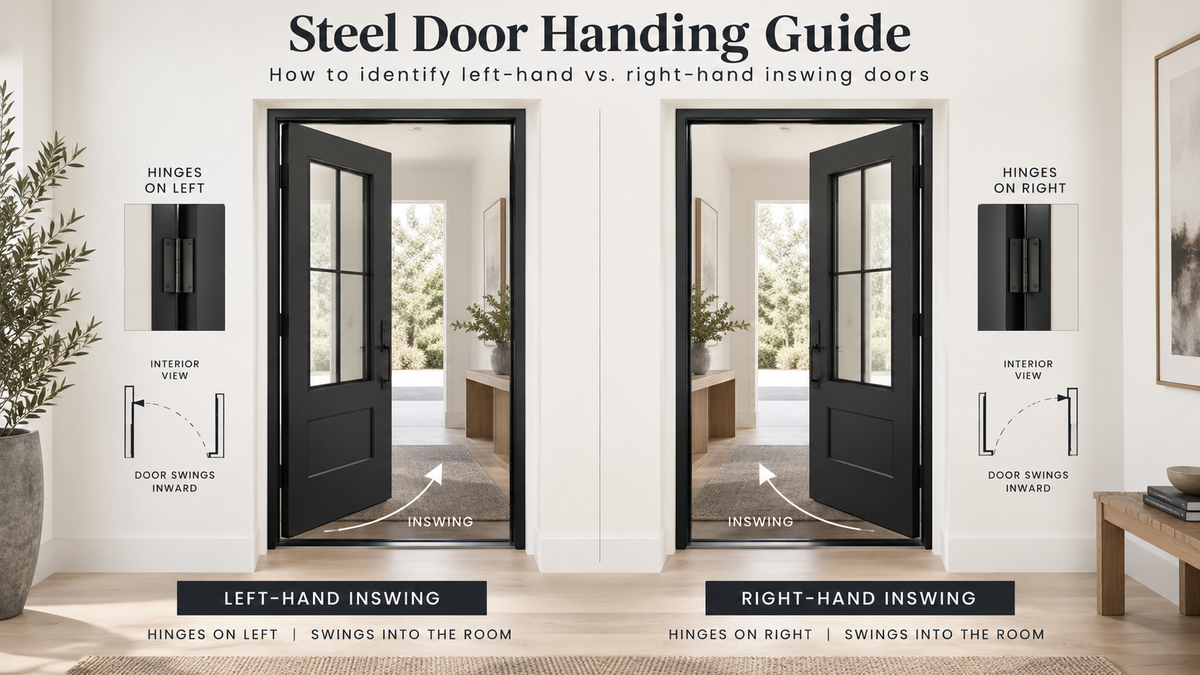
For the handing convention used on current USA Builders Depot steel-door selections, the safest starting point is simple: stand outside the building and face the door.
Do not stand inside the foyer. Do not imagine yourself walking through the opening. Physically—or on the drawing—place yourself on the exterior side looking toward the entrance.
Now look at the hinges.
If the hinges are on your left and the door swings inward, you are looking at a Left Hand Inswing configuration.
If the hinges are on your right and the door swings inward, you are looking at a Right Hand Inswing configuration.
Left Hand Inswing
Stand outside and look at the door. The hinges are on the left side. The handle or lock side is generally on the right. When opened, the door moves into the building.
That is a Left Hand Inswing.
For an entry foyer, this means the open door will occupy space toward the left-hand side of the interior as you enter. That last part matters architecturally. You are not simply choosing a technical label. You are choosing where a large moving object will sit every time someone walks into the building.
Right Hand Inswing
Again, stand outside facing the entrance. The hinges are on the right side. The handle or lock side is generally on the left. The door opens into the building.
That is a Right Hand Inswing.
From inside, the open leaf occupies the opposite side of the foyer compared with a left-hand configuration. A floor plan may show both arrangements fitting physically. Only one may make sense once furniture, switches, wall panels, closets, stairs and circulation are added.
The Fastest Way to Check
If you are looking at a current opening rather than a floor plan, use this simple check:
- Stand outside.
- Face the door.
- Find the hinges.
- For the inswing convention described above: hinges left + inward swing = Left Hand Inswing.
- For the inswing convention described above: hinges right + inward swing = Right Hand Inswing.
- For an outswing door or a reverse-handing label, confirm the supplier’s exact convention on a labeled drawing instead of extending the inswing shortcut.
Do not rely on where the handle happens to be without confirming the hinges and swing. And do not rely on memory from another supplier’s terminology.
Why Door Handing Gets Confusing
There are several door-handing conventions used across the construction industry. You may hear terms such as Left Hand, Right Hand, Left Hand Inswing, Right Hand Inswing, Left Hand Reverse, Right Hand Reverse, Left Hand Outswing and Right Hand Outswing.
Different manufacturers, hardware schedules and trades may describe similar conditions differently. That is exactly why a custom or expensive entry door should never be ordered from a verbal description alone.
Use the terminology shown by the supplier and pair it with a drawing. A simple swing arc and hinge location remove almost all ambiguity.
Inswing vs. Outswing
Handing and swing are related, but they are not the same thing.
Handing identifies the hinge orientation. Swing identifies the direction the door travels.
An inswing exterior door opens toward the interior. An outswing exterior door opens toward the exterior.
That sounds obvious until someone writes “left-hand door” on a purchase order without identifying which way it swings. For any project where the configuration matters, write both pieces of information—for example, Left Hand Inswing rather than simply Left Hand.
Do Not Choose the Swing Only From the Exterior Elevation
Architectural elevations are useful for choosing proportions, lite patterns, finish and overall appearance. They are not always enough to choose handing.
The door needs to be evaluated in plan. Look at what happens behind the door when it opens.
Is there a light switch? A console table? A closet? A stair? A wall-mounted control panel? A thermostat? Decorative wall paneling? Furniture? Another door?
If the leaf opens directly into one of those elements, the “correct” handing on the elevation may be the wrong handing for daily use.
Check the Light Switch
This is one of the simplest tests and one of the most commonly missed.
Ideally, you do not want to walk into the house and have the open entry door covering the main light switch. Imagine entering at night. You unlock the door, push it open, and reach for the switch. If the switch is hidden behind the open door, the entry will feel awkward every day.
On new construction, this is easy to resolve. Either change the handing early or coordinate the switch location before electrical rough-in is finalized.
Check the Main Walking Path
Think about where people are actually coming from. A driveway may approach the house from one side. A front walk may turn toward the entry. Inside, the foyer may naturally direct people toward the kitchen, living room or staircase.
The active door should support that movement instead of fighting it. A technically functional door can still feel wrong if every person entering has to walk around the open leaf.
Think About Furniture Before Ordering
An empty foyer can make almost any handing look acceptable. Furniture changes that quickly.
If the design includes a console table, bench, sculpture, coat storage, large mirror or built-in cabinetry, draw those pieces into the floor plan before choosing the door.
The door needs clear operating space. The furniture needs usable space. Trying to make both fit after the steel door has arrived is a much harder problem.
Tall Steel Doors Make Swing More Noticeable
A 96-inch steel door has more architectural presence than a standard-height interior door. When it opens, the movement becomes part of the room.
That is especially true with black steel-and-glass doors because the frame creates a strong visual plane. If a tall leaf repeatedly opens against a feature wall, decorative panel installation or narrow furniture zone, the conflict becomes visually obvious.
Handing should therefore be considered as part of the interior design—not simply as hardware information.
What About Double Steel Doors?
Double doors add another question: Which leaf is active?
The active leaf is normally the panel used for everyday entry. The second leaf may remain secured most of the time and be opened when a wider passage is needed.
Do not assume the active leaf from a rendering. Confirm it.
For a double steel entry, the project team should identify the active leaf, hinge locations, swing direction and operating sequence. This is particularly important for custom doors.
Review our double-door hardware guide to coordinate the active leaf with the astragal, flush bolts, locks and closing sequence.
Active Leaf Placement Changes How the Entrance Feels
Imagine a 60-inch or 72-inch double entry. If the active leaf is on the side closest to the natural approach from the driveway, entry may feel effortless. If the active leaf is on the opposite side, users may repeatedly approach one panel only to discover that the other panel is the everyday operating door.
That is not necessarily wrong. Sometimes hardware, architecture or interior layout dictates the arrangement. But it should be intentional.
Check the Door Against Exterior Walls Too
Most handing discussions focus on the interior. The exterior needs review as well.
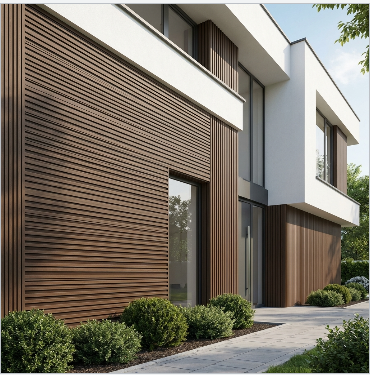
Look for wall returns, columns, stone projections, WPC cladding, exterior sconces, railings, landscaping walls and steps.
If the project involves an outswing configuration, those exterior conditions become even more important because the leaf requires operating space outside the building.
Door Handing and Exterior Lighting
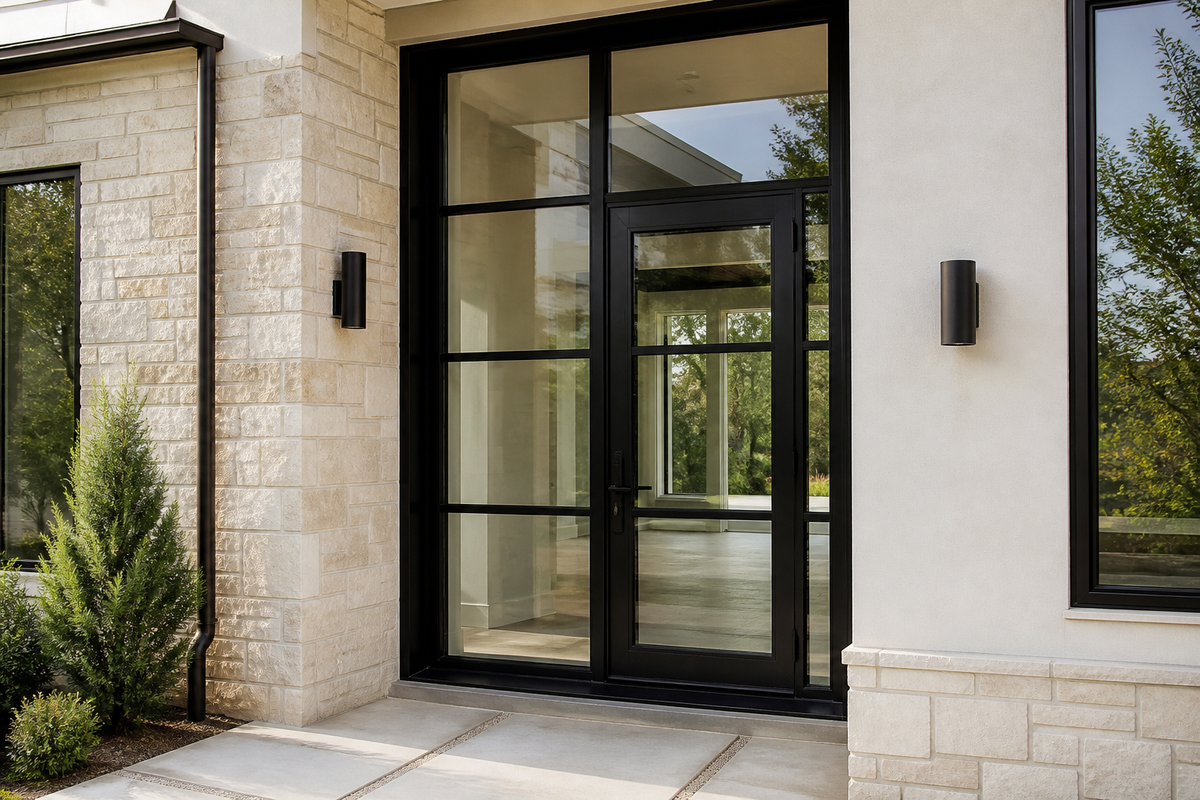
Modern steel doors are often paired with large sconces. That combination looks great—until the door or handle conflicts with the fixture.
The fixture does not need to be directly in the swing path to create a problem. Large pull handles, decorative backplates and the user’s hand also need space.
Coordinate the door handing and lighting layout together.
Handing Matters for Smart Locks and Access Control
Many modern homes now use smart locks, keypad locks, magnetic contacts, electric strikes, access-control readers or integrated security sensors.
Some hardware is reversible. Some is handed. Some requires specific preparation in the door or frame.
Before a custom steel door enters fabrication, identify the exact hardware package and confirm compatibility with the selected handing. That is far easier than field-drilling a finished steel door because the lock plan changed after production.
Replacement Doors Need Extra Care
If you are replacing an existing entry door, it is tempting to order exactly what is already there. First make sure the existing handing actually works.
A replacement project is a rare opportunity to correct something the previous owner tolerated for years. Stand outside. Confirm the hinge side. Open the door. Look at the interior. Would the opposite handing improve the space?
If the answer is yes, discuss it with the installer before assuming the replacement needs to duplicate the original. Changing the swing may affect framing, hardware, switches, code considerations or other conditions, so it needs to be evaluated properly.
New Construction Is the Best Time to Solve Handing
On new construction, the door should be coordinated while the plan can still move—before electrical boxes are finalized, wall panel layouts are fixed, trim packages are ordered, exterior lights are permanently located and furniture plans are forgotten.
The architect or designer should show the swing arc clearly. The builder should check it against field conditions. The purchaser should confirm the same orientation on the order. The installer should review it before the opening is finished.
Four people looking at the same diagram is far safer than four people using the phrase “left-hand door.”
What If the Product Page Only Shows Inswing Options?
Use the options available for that exact product.
Do not assume an outswing configuration is available simply because a similar-looking door from another manufacturer offers one. Current USA Builders Depot product listings may show Left Hand Inswing and Right Hand Inswing as selectable variants. Other configurations may depend on the exact model or custom program.
If the project requires something different, confirm availability before framing or ordering.
Custom Steel Doors Should Have Handing on the Drawing
For custom fabrication, the approved drawing should settle the question.
Look for the door viewed from the correct side, hinge locations, swing direction, active and passive leaves, pull or lever locations, lock preparation, overall dimensions, threshold orientation and any sidelites or transoms.
Do not approve the drawing because the door “looks right.” Trace the movement. Imagine standing outside. Open it mentally. Then imagine standing inside with the door fully open.
That two-minute review can prevent a very expensive correction.
What to put on the confirmation sketch
| Label | What to show |
|---|---|
| Viewing side | Clearly mark exterior and interior; avoid an unlabeled left/right photograph. |
| Hinges and swing | Show hinge locations and a swing arc for each moving leaf. |
| Double-door operation | Mark the active leaf, inactive leaf and required opening or closing sequence. |
| Hardware and obstacles | Identify locks, handles, nearby walls, switches, lights and furniture that affect clearance. |
| Order reference | Include the exact model, supplier option name and drawing revision being approved. |
Ask the supplier and installer to confirm that the drawing and order describe the same configuration. Do not approve a conflicting label on the assumption that everyone means the same thing.
Handing and Rough Opening Are Separate Questions
A correct rough opening does not guarantee a correct door configuration. You can frame the opening perfectly and still receive a door that swings the wrong way.
Likewise, choosing the correct handing does not establish the rough opening. The opening should come from the current dimensions and installation information for the exact door assembly.
Treat these as separate checkpoints: Size, Handing, Swing, Frame, Threshold and Hardware.
Handing Can Affect Weather Exposure
Exterior exposure should also be part of the discussion. A covered entry behaves differently from a fully exposed entrance. Wind, driving rain, overhang depth and threshold conditions can influence the way an entrance should be detailed.
Handing alone does not establish weather performance, and simply choosing inswing or outswing does not guarantee suitability for a particular exposure.
For coastal, high-wind, impact, hurricane or other regulated projects, obtain the applicable documentation for the selected configuration before ordering.
A Simple Door-Handing Checklist
- Stand on the exterior side of the opening.
- Identify the hinge side.
- Confirm whether the door swings inward or outward.
- Confirm the exact handing terminology used on the seller’s order.
- Check the swing against walls, stairs and furniture.
- Check interior and exterior light-switch locations.
- Confirm exterior-light and hardware clearance.
- For double doors, identify the active leaf.
- Confirm smart-lock or specialty-hardware preparation.
- Put the handing and swing on the drawing.
- Compare the drawing with the purchase order.
- Have the installer review the configuration before the order is released.
That may look excessive for one door. It is much less excessive than discovering the problem on delivery day.
Left Hand or Right Hand: Which One Is Better?
Neither.
The correct handing is the one that works with the building.
A Left Hand Inswing is not inherently better than a Right Hand Inswing. One may simply fit the plan better.
The decision should come from circulation, adjacent walls, hardware, furniture, switches and the way the entrance will actually be used.
Before Ordering a Steel Door From USA Builders Depot
Start with the exact product. Confirm the size and configuration. Stand on the exterior side of the opening and identify the hinge orientation. Check the swing against the plan. For a double door, confirm which panel will be active.
Then compare those decisions with the actual product selection and any approved drawings.
USA Builders Depot’s Steel Door Technical Resources guidance recommends confirming the exact size, handing, swing, frame details, glass configuration, hardware preparation and project requirements before production.
Do not order a custom or high-value steel door based on assumptions. Make the configuration explicit.
Explore Modern Steel Doors
USA Builders Depot carries modern single and double steel entry doors in multiple sizes and lite patterns. Current product availability and available handing configurations vary by model.
Browse the Residential Steel Doors & Frames collection, then review the exact product listing before ordering.
For more planning help, see our Steel Doors for New Construction guide, our Steel French Door Sizes and Measuring Guide, or review Custom Steel Doors.
A beautiful entry door should look right from the street. It should also open the right way every single day.
For help confirming a selection, contact USA Builders' Depot with the product link and a labeled swing sketch. Showroom visits are by appointment only. Call or email to arrange a visit.
Frequently Asked Questions
How do I know if I need a left-hand or right-hand inswing door?
Using the handing convention shown on current USA Builders Depot steel-door selections, stand outside facing the door. If the hinges are on the left and the door swings inward, it is Left Hand Inswing. If the hinges are on the right and the door swings inward, it is Right Hand Inswing. Confirm the terminology on the exact product before ordering.
What does inswing mean?
An inswing exterior door opens toward the interior of the building.
What does door handing mean?
Door handing identifies the hinge orientation of a hinged door, normally together with its swing direction.
Is a left-hand door always hinged on the left?
Handing terminology can vary between manufacturers and industries. For current USA Builders Depot selections, use the product terminology and confirm it with the applicable drawing rather than assuming a convention from another supplier.
How do I determine the handing of a double steel door?
Confirm which leaf is active, which side that active leaf is hinged on, how both panels swing, and how the manufacturer defines the complete configuration. Use a drawing with the order.
Can I change a steel door from left-hand to right-hand after it arrives?
Do not assume that you can. Frames, hinges, thresholds and hardware preparation may be configuration-specific. Contact the supplier before modifying the unit.
Should a front door swing inward or outward?
That depends on the door system, building design, project requirements, exposure and applicable codes. Confirm the configuration appropriate for the specific project rather than assuming one direction is universal.
Does door handing affect the rough opening?
Handing and rough opening are separate specifications. The rough opening should come from the exact door and frame documentation, while handing determines the hinge and swing orientation.
When should handing be confirmed on a custom steel door?
Before production begins and again when the fabrication drawing is approved.