

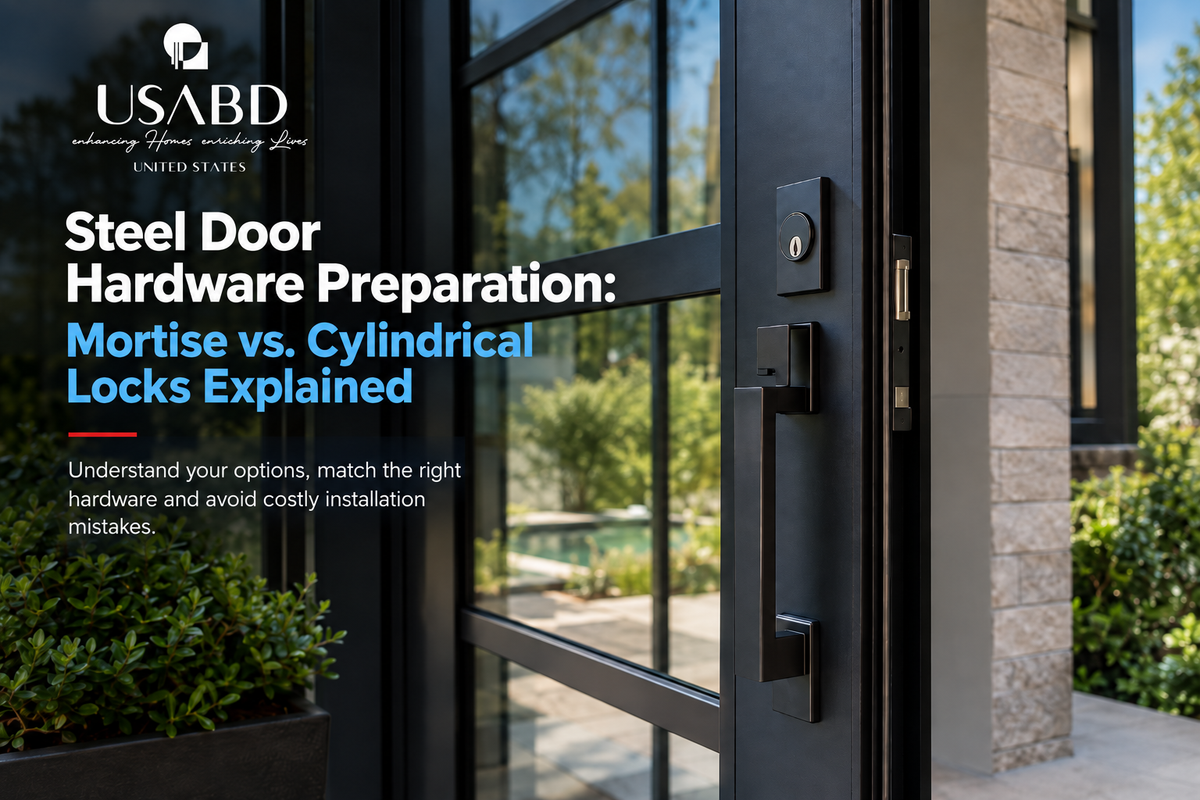
Steel Door Hardware Preparation: Mortise vs. Cylindrical Locks Explained

Choosing the door design is only part of ordering a steel entry door.
Before production or installation, one of the most important details to confirm is how the door will be prepared for the handle, latch, deadbolt, lockset, or smart lock.
A beautiful steel door can arrive in the correct size, finish and handing yet still create a major installation problem if the hardware preparation does not match the hardware you intend to use.
That is why terms such as mortise prep, cylindrical prep, tubular prep, bore holes, backset, lock center and deadbolt preparation should be understood before the order is finalized.
The most important rule is simple:
Choose the hardware first—or at minimum confirm its exact preparation requirements—before the steel door is fabricated or drilled.
What Does “Hardware Preparation” Mean?
Door hardware preparation describes the holes, pockets, reinforcement and mounting locations created in a door and frame so that a particular lockset, handle, deadbolt or other hardware component can be installed.
Different hardware systems require different preparations. A door prepared for one type of lock is not automatically compatible with another.
Hardware preparation can involve:
- holes through the face of the door
- openings through the edge of the door
- a rectangular mortise pocket
- latch preparation
- deadbolt preparation
- strike preparation in the frame
- mounting holes for handles or escutcheons
- reinforcement inside the door
- preparation for smart-lock components
- electrical preparation where applicable
For architectural steel doors, these details should be coordinated with the exact hardware rather than determined from appearance alone.
Mortise Lock Preparation
A mortise lock installs into a rectangular pocket machined into the edge of the door.
The lock body sits largely inside the door rather than simply passing through a round bore.
Depending on the lock design, the assembly can incorporate the latch, locking mechanism, deadbolt, cylinder and other functions within the mortise case.
Mortise locks are widely used in architectural, commercial, institutional and premium residential applications because manufacturers can offer a broad range of functions, trim styles and configurations.
However, the term “mortise lock” does not describe one universal cutout.
Different manufacturers and lock series can require different pocket dimensions, cylinder locations, spindle locations, trim holes and mounting details.
For that reason, the current hardware manufacturer's template should control the preparation.
Do not ask a fabricator simply to “prepare the door for a mortise lock” without identifying the actual hardware whenever possible.
Cylindrical Lock Preparation
A cylindrical lock, sometimes called a bored lock, normally uses a round opening through the face of the door with a separate latch preparation through the door edge.
This style is common in residential and commercial construction because installation and replacement can be relatively straightforward when the door and hardware use matching preparation.
Cylindrical locks are available in many grades and configurations.
The fact that a lock is cylindrical does not automatically mean it is residential duty or lower quality. Heavy-duty commercial cylindrical hardware is also available.
What matters is whether the exact lockset matches:
- the existing door preparation
- door thickness
- backset
- latch preparation
- trim dimensions
- strike
- intended application
- required performance or certification
Again, the hardware template is the controlling reference.
What About Tubular Locks?
The terms tubular and cylindrical are sometimes used interchangeably in everyday conversation, but the hardware industry distinguishes between different lock constructions.
Tubular locks are common in residential applications and also use bored preparation rather than the large rectangular pocket associated with a mortise lock.
If a hardware supplier calls a product tubular, cylindrical or bored, do not rely on terminology alone.
Request the installation template. That template will show what the door actually needs.
Mortise vs. Cylindrical: The Biggest Difference
From the door-preparation standpoint, the biggest difference is straightforward:
Mortise hardware requires a substantial pocket in the edge of the door. Cylindrical hardware primarily uses bored openings through the face and edge of the door.
Because the preparations are physically different, they generally should not be treated as interchangeable.
Trying to convert a finished architectural steel door from one preparation to another can involve significant modification.
Depending on the door construction, the change may interfere with reinforcement, finishes, glass locations, stile width or internal construction.
That is why hardware selection belongs near the beginning of the ordering process—not after the door arrives.
Should You Choose Mortise or Cylindrical Hardware?
Neither system is automatically right for every project.
Mortise hardware may be appropriate when:
The project calls for a particular architectural lockset, heavy-duty hardware, a specific commercial function, integrated latch and locking functions, specialty trim or hardware specifically designed around a mortise case.
Cylindrical hardware may be appropriate when:
The project calls for compatible bored hardware, easier replacement is desirable, the selected smart lock uses that preparation, or a particular residential or commercial lockset has been selected around cylindrical preparation.
The decision should ultimately come from the actual hardware specification and project requirements.
Do not choose preparation based only on which option appears more expensive, more secure or more commercial.
Security depends on the complete opening, including the door, frame, reinforcement, anchors, lock, cylinder, strike, glazing and installation.
What Is a Backset?
Backset is another measurement that must be coordinated before drilling or fabrication.
It describes the horizontal relationship between the edge of the door and the operating centerline of certain lock hardware.
Different hardware products can require different backsets.
A handle that looks correct on the face of the door may still be incompatible if its required backset does not match the door preparation.
On steel doors with narrow vertical stiles or large glass areas, hardware placement can be especially important because there may be less space available for lock components.
Always compare the exact hardware template with the actual door construction.
What Does “Pre-Drilled” Mean?
A steel door described as pre-drilled has already received at least some of its hardware preparation.
But pre-drilled does not mean compatible with every handle or smart lock.
Before purchasing replacement or third-party hardware, determine:
- What holes already exist?
- What is their diameter?
- What is the center-to-center spacing?
- What is the backset?
- Is there a separate deadbolt opening?
- What is the door thickness?
- What preparation exists on the door edge?
- How is the frame prepared for the strike?
- Does the hardware require through-bolts or additional mounting holes?
- Is adequate internal reinforcement present?
Never enlarge or modify a steel door simply because a new handle appears close to the existing dimensions.
Handle Sets and Pull Handles Need Coordination Too
Not every architectural steel door uses a conventional lever or knob.
Many contemporary doors use long pull handles, plate-mounted handles, knurled handles, copper handles or specialty hardware.
These components may require completely different mounting holes from the lock itself.
For example, a decorative pull may be mounted through the door while the locking function is handled separately by a deadbolt or mortise lock.
That means the fabricator may need specifications for both the decorative handle and the locking hardware.
For custom doors, supply the exact manufacturer, model number and hardware template whenever possible.
Smart Locks Require Extra Attention
Smart locks have created another common compatibility problem.
A product may be described as compatible with an exterior door but still require a specific:
- bore diameter
- backset
- door thickness
- deadbolt location
- spacing
- latch arrangement
- clearance around the trim
Large decorative handles or narrow steel stiles can also interfere with a smart lock's exterior or interior housing.
If you want a particular smart lock, choose it before finalizing the door hardware preparation.
Do not assume that every steel entry door can accept every smart lock after fabrication.
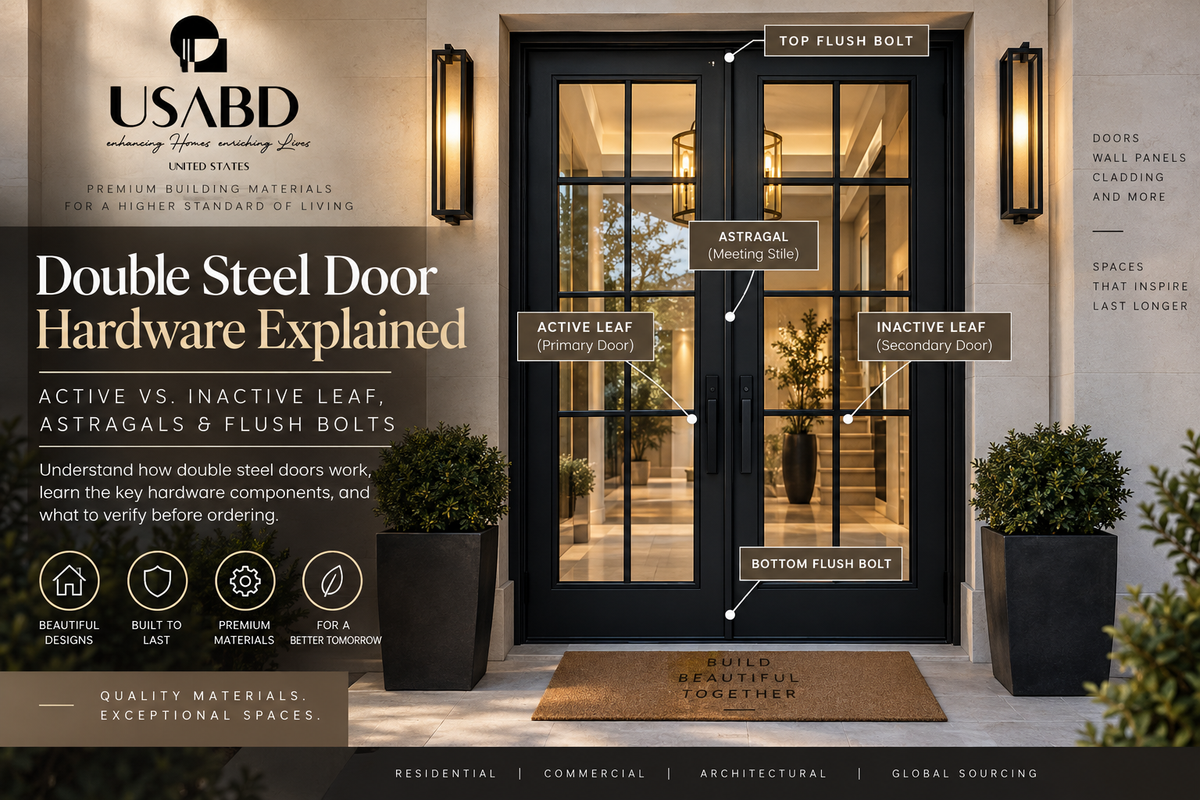
Double Steel Doors Require Additional Coordination
Double doors introduce more hardware decisions.
The project team may need to establish:
- which leaf is active
- which leaf is inactive
- where the primary lock will be located
- how the inactive leaf will be secured
- whether flush bolts or other hardware are used
- handle location
- deadbolt location
- strike location
- handing and swing
- whether both leaves receive matching decorative hardware
These choices should be shown on the approved door drawing before production.
Glass Location Can Affect Hardware
Modern steel entry doors frequently combine narrow steel profiles with large areas of glass.
That architecture looks clean, but it makes planning particularly important.
A lock body, deadbolt or handle cannot simply occupy the same physical space as the glazing system.
The available steel stile width, glass position, internal reinforcement and hardware dimensions must all work together.
This is one reason a hardware template should be supplied during the design stage for custom steel doors.
Can You Drill a Steel Door After It Arrives?
Sometimes field modification is possible, but it should never be assumed.
Before drilling, cutting or enlarging an opening, determine whether the modification could affect:
- structural reinforcement
- internal components
- glazing
- finish
- corrosion protection
- lock reinforcement
- weather sealing
- thermal construction
- warranty
- product rating or certification
If the hardware does not match the supplied door preparation, contact the door supplier or a qualified door-hardware professional before modifying the unit.
A field modification that looks simple can be difficult to reverse.
The Frame Matters Too
Correct door preparation alone is not enough.
The corresponding strike or locking component must align properly with the frame.
A quality lock installed into a poorly prepared or incorrectly aligned frame can still perform badly.
The frame should be installed plumb, level and square, and the latch or bolt should engage smoothly without requiring the user to pull, lift or force the door.
If the door must be pushed or pulled aggressively for the deadbolt to engage, investigate the alignment instead of immediately modifying the lock.
Hardware Preparation Checklist Before Ordering a Steel Door
Before releasing a steel-door order for production, confirm the following:
- exact door model
- single or double configuration
- door thickness
- handing and swing
- active leaf on double doors
- lock manufacturer
- lock model number
- mortise, cylindrical, tubular or other preparation
- backset
- handle or lever model
- deadbolt requirements
- center-to-center spacing
- smart-lock requirements
- decorative pull-handle drilling
- strike preparation
- required reinforcement
- hardware finish
- approved hardware template
- approved door drawing
For custom doors, the best practice is to have the hardware requirements reflected directly on the approved fabrication drawing.
Do Not Rely on a Generic Hole Pattern
A familiar-looking handle does not guarantee familiar preparation.
Hardware manufacturers can change mounting systems between product families, and two handles with nearly identical exterior dimensions may use different drilling patterns.
Whenever an exact handle or lock has already been selected, provide its current installation template.
The manufacturer’s template is more reliable than measuring a catalog photograph or assuming that another model uses the same preparation.
Planning a USA Builders Depot Steel Door
USA Builders Depot steel doors are available in modern single, double and French-door configurations, together with selected compatible hardware.
Exact hardware preparation, included components and compatibility vary by door model and configuration.
Before ordering, confirm the selected door, handing, frame, hardware preparation and any third-party lock or handle you plan to install.
For additional technical planning, review the Steel Door Technical Resources, the Steel Door Handing Guide, and the Steel Door Rough Opening Guide.
If you are still selecting your door, see How to Choose a Steel Entry Door. You can also review current steel door handles and locks.
Taking a few minutes to coordinate the hardware before the door is fabricated can prevent drilling errors, incompatible locks and expensive field modifications later.
Frequently Asked Questions
What is mortise preparation on a steel door?
Mortise preparation creates a pocket in the edge of the door for a compatible mortise lock body. The exact pocket, holes and mounting locations depend on the selected hardware.
What is cylindrical preparation?
Cylindrical preparation generally uses bored openings through the door face and edge for a compatible cylindrical lock and latch. Exact dimensions must match the hardware manufacturer’s template.
Is a mortise lock better than a cylindrical lock?
Not universally. Mortise and cylindrical locks are different hardware systems. The correct choice depends on the required function, hardware grade, project specifications, door preparation and intended use.
Can I put any handle on a steel door?
No. The handle must be compatible with the existing or specified preparation, door thickness, mounting arrangement and available space.
Can I install a smart lock on a steel door?
Many smart locks can be used with steel doors when the door preparation matches the lock requirements. Confirm bore size, backset, spacing, door thickness and clearance before ordering.
Should I buy the door or the hardware first?
Ideally, choose or specify the hardware before the door is fabricated so the preparation can be coordinated correctly.
Can I change from cylindrical to mortise hardware later?
Do not assume so. The preparations are substantially different and conversion can require major door modification. Confirm feasibility with the door and hardware manufacturer first.
What should I send USA Builders Depot for custom hardware preparation?
Send the exact hardware manufacturer, model number, installation template, required handing and any relevant project specifications so the preparation can be reviewed before production.