
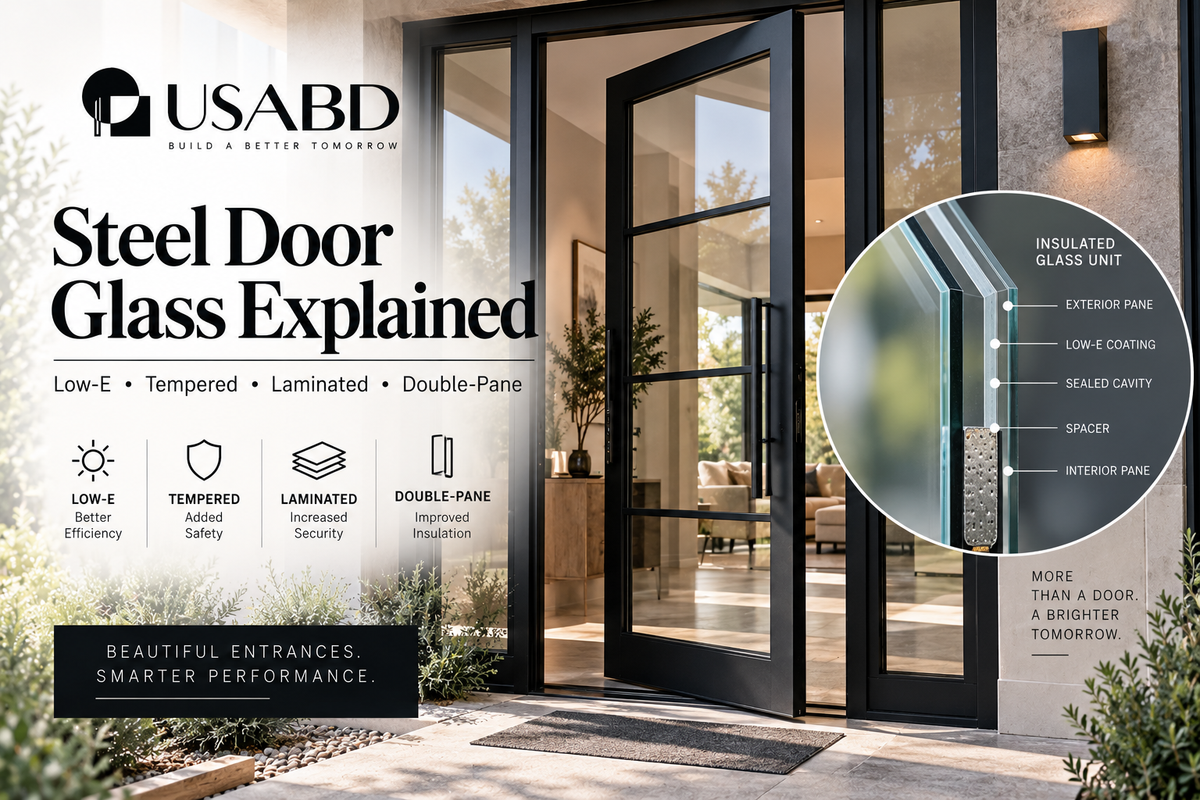
Steel Door Glass Explained: Low-E, Tempered, Laminated & Double-Pane
A steel entry door can contain a large amount of glass. On some modern designs, glass makes up most of the visible door.
That makes the glass package almost as important as the steel frame itself.
Yet steel-door specifications often use several glazing terms at the same time: Low-E, tempered, laminated, double-pane, insulated glass, clear glass, safety glass.
It is easy to read those words and assume they are competing choices. They are not.
A single glass unit can potentially be several of those things at once.
For example, a steel exterior door might use an insulated two-pane glass unit, incorporate a Low-E coating, and use safety-glazing panes appropriate for the intended application.
The important question is not simply, “What type of glass is this?”
The better questions are: How many panes are in the unit? Is there a Low-E coating? Is the glazing safety-rated for the intended location? Is the glass tempered, laminated, or another approved safety-glazing construction? What privacy level does it provide? What whole-door thermal documentation is available? Does the exact glass configuration match the door being ordered?
This guide explains the terminology so homeowners, builders, designers and architects can compare steel doors more intelligently.
The Short Answer
Low-E describes a coating intended to influence heat transfer through glazing.
Tempered describes glass that has been heat-treated so that its strength and breakage behavior differ from ordinary annealed glass.
Laminated describes glass made from layers bonded together with an interlayer.
Double-pane describes the construction of an insulated glass unit containing two panes separated by a sealed space.
Those terms are not interchangeable.
You can therefore encounter descriptions such as double-pane Low-E tempered glass because each word is describing a different part of the glazing system.
Start With the Complete Glass Assembly
Do not evaluate a steel door by one glazing buzzword.
Think of the glass as a system.
A modern exterior glazing assembly may involve exterior pane, interior pane, spacer, sealed cavity, Low-E coating, gas fill where applicable, sealants, setting materials, muntins or divided-lite construction, steel glazing frame, gaskets and safety-glazing treatment.
The performance of the door depends on how those parts interact with the steel frame, weather seals, threshold and installation.
That is why the phrase “Low-E glass” alone does not tell you the complete thermal performance of a steel door.
What Is Low-E Glass?
Low-E means low emissivity.
A Low-E coating is a thin coating applied to a glass surface to influence radiant heat transfer.
Depending on the glazing design, Low-E coatings can help reduce heat transfer through the glass while allowing useful daylight into the building.
Low-E Is a Coating — Not a Pane Count
A common mistake is assuming Low-E = double-pane.
It does not.
Low-E describes a coating. Double-pane describes the number of panes in the insulated glass unit.
A double-pane unit may contain a Low-E coating. A different glass construction could also incorporate Low-E technology.
Always read the complete glass specification.
What Does Low-E Do in a Steel Entry Door?
Large glazed steel doors allow significant daylight into an entrance. That is often one of the main reasons people choose them.
But glass is also part of the building envelope.
The glazing therefore influences interior surface temperature, solar heat gain, heat loss, visible daylight, glare, condensation risk and overall door performance.
Low-E coatings can contribute to the thermal strategy, but they should not be treated as a guarantee that a door is automatically “energy efficient.”
The frame matters too. So do thermal breaks, weatherstripping, glass spacers, threshold, sweep, air leakage, installation and glass area.
The complete door assembly needs to be evaluated.
What Is Tempered Glass?
Tempered glass is heat-treated glass designed to have different strength and breakage characteristics from ordinary annealed glass.
When properly manufactured as safety glazing, tempered glass generally breaks into many relatively small fragments rather than large sharp shards.
Door glazing is an important safety consideration because people routinely move toward and through door openings.
Does Tempered Glass Mean Energy Efficient?
No.
Tempering relates primarily to the physical treatment and breakage behavior of the glass.
It does not by itself tell you U-factor, solar heat gain, number of panes, Low-E coating, spacer construction, gas fill or whole-door energy rating.
A glass unit can therefore be both tempered + Low-E or tempered + double-pane + Low-E.
What Is Laminated Glass?
Laminated glass is generally made by bonding glass layers together with an interlayer.
When laminated glass breaks, the interlayer can help retain broken pieces rather than allowing the entire sheet to fall apart immediately.
This type of construction is used in many architectural applications where post-breakage behavior, security, sound performance or another project-specific requirement matters.
But the word laminated does not automatically establish impact certification, hurricane approval, forced-entry rating, ballistic rating, fire rating or whole-door code compliance.
Those are separate performance requirements.
If a project requires a specific tested performance, request documentation for the exact glass and complete door assembly.
Tempered vs. Laminated Glass
The simplest distinction is:
Tempered glass changes how the glass is strengthened and how it breaks.
Laminated glass uses an interlayer to help hold the glass together after breakage.
Neither term by itself tells you whether the glass has Low-E coating.
Neither tells you whether the unit contains one, two or three panes.
Neither establishes a whole-door U-factor.
And neither automatically makes a door hurricane-rated or impact-rated.
What Is Double-Pane Glass?
Double-pane glass means the glazing unit contains two panes separated by a sealed space.
This is commonly called an insulated glass unit, or IGU.
The sealed space can reduce heat transfer compared with a comparable single pane.
The cavity may contain air or a specified gas depending on the glass design.
The two panes are held apart by a spacer around the perimeter.
That spacer and edge seal are important parts of the system.
Double-Pane Does Not Automatically Mean Low-E
Another common assumption is double-pane = Low-E.
Not necessarily.
A double-pane unit can use clear glass without a Low-E coating.
It can also be designed with one or more Low-E surfaces.
That is why a specification might explicitly state double-pane Low-E glass rather than simply double-pane glass.
Can Double-Pane Glass Be Tempered?
Yes, depending on the designed glazing assembly.
Tempering describes the individual pane treatment. Double-pane describes the insulated assembly.
A two-pane insulated unit can therefore contain tempered panes.
Can Double-Pane Glass Be Laminated?
A multi-pane insulated unit can also incorporate laminated glass where the engineered product design calls for it.
The important point for the buyer is to request the actual glass build-up when the project has a specific requirement.
What Is Insulated Glass?
In door and window terminology, insulated glass usually refers to an insulated glass unit containing multiple panes separated by a sealed space.
It does not mean the glass itself contains foam insulation.
The insulation comes primarily from the multi-pane construction and the sealed cavity between the panes.
When comparing doors, confirm whether “insulated glass” means double-pane, triple-pane, a specific Low-E configuration, a specific spacer or a particular gas fill.
What Is Argon-Filled Glass?
Some insulated glass units use argon or another gas in the sealed cavity between panes.
Gas fill is one component of the glass system.
It should not be evaluated in isolation.
Whole-product performance is more useful than choosing a door because one glass component sounds advanced.
If an energy-performance requirement applies, request the current rating documentation for the exact configured door.
Glass Performance and the Steel Frame
This point is especially important with steel doors.
Steel is highly conductive.
A very good glass package does not eliminate heat transfer through an unbroken metal frame.
Likewise, a thermally improved frame does not make poor glazing disappear.
The frame and glass need to be considered together.
For cold or highly conditioned climates, the questions may include:
- Is the frame thermally broken?
- Is the door leaf thermally broken?
- What glazing is used?
- What spacer is used?
- How is the threshold designed?
- What weather seals are included?
- What is the whole-unit U-factor?
USA Builders Depot has a separate Thermal Break Steel Door Guide that explains the frame side of this equation.
What Is U-Factor?
U-factor measures heat transfer through a fenestration product.
In general, a lower U-factor indicates less heat transfer.
For doors and windows, the useful value is the rating for the applicable complete product—not merely a claim about one small glass sample.
What Is SHGC?
SHGC means Solar Heat Gain Coefficient.
It describes how much solar heat enters through the fenestration product.
A lower SHGC means less solar heat gain.
A higher SHGC permits more solar heat.
The preferred value can depend on climate, building orientation, shading and the energy strategy of the project.
Low-E Glass and SHGC Are Related — But Not the Same Thing
Low-E is a technology used within glazing.
SHGC is a measured performance value for the fenestration product.
Different Low-E coatings can be designed for different solar-control objectives.
Do not assume all Low-E glass produces the same SHGC.
What Is Visible Transmittance?
Visible Transmittance describes the amount of visible light passing through a fenestration product.
This matters when a project wants large glass areas for daylight.
More visible light is not always automatically better.
Designers may need to balance daylight, privacy, glare, solar heat gain, interior fading and visual comfort.
What About Clear Glass?
Clear glass is popular in modern steel doors because it allows the steel grid to remain visually light.
It works especially well when the architecture wants strong indoor-outdoor connection, maximum daylight, visible landscaping, minimalist elevations and glass-forward entrances.
But clear glass provides limited visual privacy.
Privacy Glass Options
Custom steel doors may support different glass finishes depending on the manufacturer and model.
Examples can include frosted, sandblasted, reeded, textured, tinted, reflective and patterned options.
Each option affects appearance differently.
Some provide privacy while maintaining daylight.
Others change color, glare or exterior reflectivity.
If privacy matters, review a physical sample rather than choosing only from a computer rendering whenever possible.
Reeded Glass
Reeded glass uses linear texture that distorts the view through the glass.
It can work especially well with steel doors because the vertical or horizontal pattern can complement narrow steel muntins.
But the amount of privacy depends on the exact reeded pattern.
Frosted or Sandblasted Glass
Frosted finishes diffuse the view and can create substantial privacy while still allowing light.
They can be useful for front entrances, bathrooms connected to exterior patios, urban houses, side doors and offices.
Tinted Glass
Tinted glass changes the color and amount of light passing through the door.
Common architectural tones can include gray, bronze and smoke.
Tint is primarily a visual and solar-control characteristic.
Do not assume a tint automatically provides a specific energy rating.
Reflective Glass
Reflective glazing can create a darker, more mirror-like exterior appearance.
Its privacy effect can change dramatically with lighting conditions.
For example, a surface that appears reflective during the day may behave differently at night when the interior is brighter than the exterior.
Safety Glass and Privacy Glass Are Separate Decisions
A privacy finish does not automatically make glass safety glazing.
A decorative pattern does not establish code compliance.
Safety, energy performance and appearance should be treated as separate specification questions.
True Divided Lite vs. Simulated Divided Lite
True Divided Lite
A true divided-lite configuration physically separates the glazed area into multiple individual openings.
Each opening contains its own glass section.
This creates strong architectural shadow lines and a traditional steel-window character.
Simulated Divided Lite
A simulated divided-lite design can use a larger continuous insulated glass unit with applied or integrated muntins creating the appearance of separate lites.
The exact construction varies by manufacturer.
Neither approach should automatically be considered better.
The choice affects appearance, glass construction, maintenance, sightlines, fabrication, performance and cost.
Does More Glass Make a Steel Door Less Secure?
Security cannot be determined solely from how much glass is visible.
The complete entry system matters.
That includes steel profiles, frame, anchors, glazing retention, glass construction, hinges, lock preparation, locking hardware, meeting stiles and installation.
Do not market or specify a door as “high security” merely because it is steel.
Does Tempered Glass Mean Impact-Rated?
No.
This distinction is particularly important in coastal and hurricane-prone areas.
Tempered safety glass is not the same thing as a tested impact-resistant door system.
Impact performance can depend on glass, interlayer, glass retention, steel frame, anchors, door leaf, locking system, sidelights, transoms and installation.
If a project requires Florida Product Approval, Miami-Dade documentation, hurricane impact, wind-load or another regulated performance standard, request the exact documentation for the selected assembly.
See our Steel Door Technical Resources for a documentation-first approach.
Does Low-E Mean NFRC-Certified?
No.
Low-E describes a glazing technology.
NFRC certification is a standardized rating and certification process for the complete applicable fenestration product.
A product can contain Low-E glass without automatically carrying a particular NFRC rating.
Does Low-E Glass Stop Condensation?
Not by itself.
Condensation forms when a surface temperature falls below the dew point of surrounding air.
A better-performing glazing system can help keep interior glass surfaces warmer under some conditions, but condensation also depends on indoor humidity, outdoor temperature, frame performance, spacer, air leakage, threshold and installation.
For a deeper explanation, review the USA Builders Depot Steel Door Condensation Guide.
Glass and Thermal Breaks Should Be Specified Together
Imagine two steel doors.
Door A has a good insulated glass unit but a highly conductive metal frame.
Door B has a thermally separated frame but a different glazing system.
You cannot confidently say which complete door performs better from those descriptions alone.
The more useful approach is:
frame + glass + seals + threshold + complete test documentation
Sidelights and Transoms Matter Too
A large entry may contain a single door, double door, one sidelight, two sidelights, transom, or sidelights plus transom.
Once those glazed areas are added, the glass package becomes an even larger part of the entrance.
Make sure the glass specification applies to the complete configured unit rather than only the main door leaf.
What Should You Ask Before Ordering a Steel Door With Glass?
- Exact door model.
- Door size.
- Single or double configuration.
- Lite pattern.
- Glass appearance.
- Number of panes.
- Low-E configuration where applicable.
- Safety-glazing documentation where required.
- Privacy finish.
- Thermal-break configuration.
- Whole-unit performance documentation where required.
- Sidelights or transom glazing.
- Impact, fire or other code documentation where required.
- Approved CAD or fabrication drawing for custom work.
What Current USA Builders Depot Listings Show
Selected current USA Builders Depot steel-door listings include glass-forward single and double steel-door configurations and identify clear double-pane Low-E glass on certain products.
That makes glazing terminology especially relevant for USABD customers.
However, glass configuration and technical documentation can vary by model.
Do not assume every USABD door uses the same glass package.
Check the current product page and request the applicable documentation for the exact door and order configuration.
Frequently Asked Questions
Is Low-E glass the same as tempered glass?
No. Low-E describes a coating affecting thermal behavior. Tempering is a heat-treatment process affecting the glass’s strength and breakage behavior.
Can glass be both Low-E and tempered?
Yes. The terms describe different properties, so a glazing unit can incorporate both.
Is double-pane glass automatically Low-E?
No. Double-pane describes the number of panes and sealed cavity. Low-E describes a coating.
Is tempered glass always double-pane?
No. Tempering and pane count are separate characteristics.
Is laminated glass better than tempered glass?
Not universally. They have different constructions and breakage behavior. The appropriate choice depends on the project and required performance.
Is laminated glass hurricane glass?
Not automatically. Hurricane or impact performance belongs to a tested assembly and configuration.
Does Low-E make a steel door energy efficient?
Low-E can contribute to better glazing performance, but the frame, thermal breaks, threshold, weather seals, air leakage, glass area and complete door assembly also matter.
What does IGU mean?
IGU stands for insulated glass unit, generally referring to multiple glass panes separated by a sealed cavity.
What glass gives the most privacy?
Frosted, reeded, patterned and certain tinted options can increase privacy. The result varies by exact glass type and lighting conditions.
Should I choose clear or privacy glass for my front door?
Clear glass maximizes views and daylight. Privacy glass limits direct visibility. Consider entry orientation, street exposure, interior layout and nighttime lighting.
What is the best glass for a steel front door?
There is no universal best glass. The correct specification depends on climate, safety requirements, privacy, design, energy performance, code requirements and available documentation for the selected door.
Does the glass need to be safety glazing?
Door glazing may be subject to safety-glazing requirements. Confirm the current applicable product certification, building requirements and exact glazing supplied with the door.
The Bottom Line
When choosing a steel door with glass, do not ask only: “Does it have Low-E glass?”
Ask what the complete glazing system is.
Low-E explains the coating.
Tempered explains one form of glass treatment.
Laminated explains a layered glass construction.
Double-pane explains the insulated unit configuration.
U-factor and SHGC describe measured fenestration performance.
Safety, impact and code approvals require their own documentation.
The best specification treats the door as one coordinated assembly:
steel frame + glazing + thermal design + weather seals + threshold + installation
That gives builders, architects and homeowners a much clearer basis for comparing one steel door with another.
Explore our residential steel doors and frames, browse steel French doors, and review Steel Door Technical Resources before relying on project-specific thermal, safety, impact or code claims.
Related guides: Thermal Break Steel Door Guide, Steel Door Condensation Guide, Steel Door Rough Opening Guide, Steel Door Jamb Depth Guide, and exterior steel doors with glass.
Written by USA BUILDERS DEPOT