
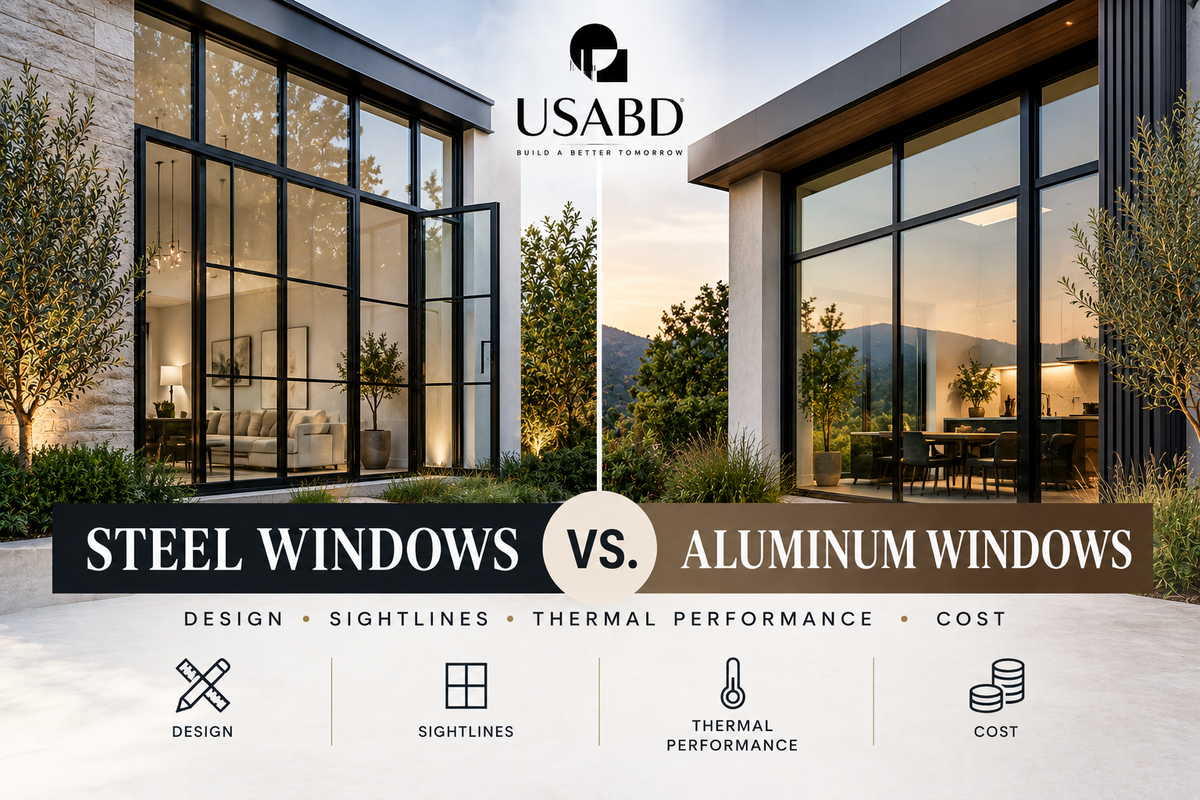
Steel Windows vs. Aluminum Windows: Which Should You Choose?

Black-framed windows can look surprisingly similar from across the street.
Up close, however, two nearly identical-looking windows may be built from completely different systems.
One may be steel.
The other may be aluminum.
Both can create contemporary black-framed architecture. Both can support large areas of glass. Both can be fabricated as fixed or operable windows. And both can be engineered with insulated glazing and thermal improvements.
So what is the real difference?
The answer is more complicated than:
Steel is stronger.
or:
Aluminum is cheaper.
A good comparison needs to consider the complete window system:
Frame construction + sightline + glazing + thermal design + operation + finish + maintenance + installation + documentation
This guide explains how steel and aluminum windows differ—and what homeowners, builders, designers and architects should actually compare before specifying either material.
Quick Answer: Steel vs. Aluminum Windows
Steel windows are often chosen when the project prioritizes:
- refined architectural character
- narrow-looking frame profiles
- substantial metal construction
- traditional steel-window detailing
- custom grids and lite patterns
- compatibility with luxury, transitional, industrial or historic-inspired architecture
Aluminum windows are often chosen when the project prioritizes:
- lower weight
- broad system availability
- contemporary appearance
- easier handling
- a wide range of standardized systems
- potentially lower initial cost depending on specification
But neither material automatically wins every category.
A premium thermally broken aluminum system may outperform a basic non-thermally-broken steel window in one area.
A carefully fabricated steel system may provide architectural proportions that a particular aluminum system cannot duplicate.
Compare the actual products, not generic material stereotypes.
What Is a Steel Window?
A steel window uses steel as the primary structural frame material.
Architectural steel windows can be fabricated as fixed windows, single casements, double casements, awnings, push-out windows, combination units, round windows, oval windows and custom shapes.
USA Builders Depot's current Steel Windows collection includes fixed, casement, awning, push-out, round, oval and combination configurations.
Steel's material strength allows designers to create highly refined frame proportions, but the visible sightline ultimately depends on the specific profile, glazing arrangement, reinforcement, hardware and structural requirements.
Do not assume every steel window has the same frame width.
What Is an Aluminum Window?
An aluminum window uses extruded aluminum profiles to form the frame and sash.
Aluminum is widely used in residential and commercial fenestration because it is lightweight, formable, corrosion resistant and adaptable to many standardized window systems.
It can be fabricated into fixed windows, casements, awnings, sliders, multi-panel combinations, window walls and large glazed openings.
Modern aluminum windows can also use thermal barriers to reduce heat transfer through the frame.
As with steel, there is no single universal aluminum-window construction.
A basic aluminum window and a premium thermally broken architectural aluminum system can perform very differently.
Steel vs. Aluminum at a Glance
| Consideration | Steel Windows | Aluminum Windows |
|---|---|---|
| Architectural character | Distinctive, substantial | Clean, contemporary |
| Typical visual profile | Often very refined | Can also be slim depending on system |
| Structural material | Steel | Aluminum |
| Weight | Heavier | Lighter |
| Custom fabrication | Strong potential | Strong potential |
| Corrosion strategy | Protective coating system is important | Aluminum naturally forms a protective oxide; finish still matters |
| Thermal performance | Depends on thermal design and glazing | Depends on thermal design and glazing |
| Fixed configurations | Yes | Yes |
| Operable configurations | Yes | Yes |
| Large glass | Possible with proper engineering | Possible with proper engineering |
| Cost | Often premium | Often lower, but premium systems overlap |
| Installation | Heavier handling | Generally easier handling |
| Best comparison method | Exact system documentation | Exact system documentation |
This table describes common market tendencies. It is not a substitute for the specification of the actual window.
The Biggest Visual Difference: Frame Character
For many buyers, this is where the decision begins.
Steel has a particular architectural presence.
Even when painted black, the visual character of a welded or fabricated steel window can differ from an extruded aluminum system.
Steel windows often work particularly well in architecture that emphasizes strong grids, tall openings, French-style proportions, industrial references, transitional detailing, European-inspired architecture and historic-modern combinations.
Aluminum can achieve a clean contemporary appearance as well, particularly in modern systems designed around large glass areas.
The question is not simply: Which material looks modern?
Both can.
The better question is: Which frame system creates the proportions the architecture needs?
Sightlines Matter More Than the Word “Slim”
“Slim frame” is used so often in window marketing that it has become almost meaningless without dimensions.
Sightline generally describes the visible frame width you see around or between panes of glass.
A narrow sightline can create more visible glass, lighter-looking frames, greater daylight, cleaner grid proportions and less visual interruption.
Steel is frequently associated with narrow architectural profiles because its structural properties can support refined frame sections.
But do not buy a steel window solely because a website says “slim.”
Ask for the actual profile or drawing.
Likewise, do not reject aluminum assuming it must have a bulky frame.
Premium aluminum systems can also be designed with restrained profiles.
Compare drawings.
Steel Strength Is Useful—but It Is Not the Whole Window
Steel's structural properties are one of the reasons architects have used it for fenestration for generations.
But raw material strength does not tell you whether one finished window is better than another.
A window also depends on frame geometry, sash geometry, corner construction, mullions, glass thickness, reinforcement, hinges, locks, anchors, opening size and wind requirements.
A thin-looking window that is poorly engineered is not automatically superior to a slightly wider frame that is correctly designed for the opening.
Aluminum's Biggest Practical Advantage: Weight
Aluminum is much lighter than steel.
That can make a meaningful difference during manufacturing, shipping, jobsite handling, lifting and installation.
Large steel window assemblies can require more manpower or lifting equipment.
This does not make steel impractical. It simply means logistics should be considered early.
Which Material Is Better for Large Windows?
Both materials can be used for large openings when the system is engineered appropriately.
Large glazing introduces questions about glass thickness, wind pressure, frame deflection, mullion spacing, anchors, head condition, sill support and installation tolerances.
Steel's structural characteristics can make it attractive for architecturally ambitious openings.
Aluminum systems are also extensively used for large-format residential and commercial glazing.
There is no universal maximum window size for either material.
Fixed Windows vs. Operable Windows
The material decision should be separate from the operation decision.
A window can be steel + fixed, steel + casement, aluminum + fixed or aluminum + casement.
The opening style determines how the window functions.
The material determines part of how the frame is constructed.
If you are still deciding which windows actually need to open, review our Fixed vs. Operable Steel Windows guide before selecting the lite pattern.
Which Is More Energy Efficient?
This is where many comparisons become misleading.
Neither steel nor aluminum should be assigned one universal energy rating.
Both are metals. Both conduct heat.
For exterior windows, the key question is how the frame system manages that conductivity.
That means a useful comparison is not:
steel vs. aluminum
It is:
this complete steel window vs. this complete aluminum window
What Is a Thermal Break?
A thermal break is a lower-conductivity material that separates conductive sections of a metal frame.
Its purpose is to interrupt the direct path that heat would otherwise follow through the metal.
Thermal design can affect frame surface temperature, heat transfer, condensation risk, comfort near the window and whole-window U-factor.
But the phrase thermally broken is not itself a performance rating.
Compare the Whole-Window U-Factor
If energy performance matters, compare the certified whole-window U-factor.
U-factor indicates the rate of heat transfer through a fenestration product.
Lower values indicate less heat transfer.
The glass is not the entire window.
The frame, spacer, sash and glass work together.
Ask for the rating that applies to the complete configuration.
SHGC Matters Too
U-factor is not the only energy metric.
Solar Heat Gain Coefficient, or SHGC, describes how much solar heat passes through the fenestration system.
Lower SHGC generally means less solar heat gain.
That can be particularly important on heavily glazed façades in warmer climates.
The ideal glass strategy may also depend on orientation, shading, climate, overhangs, window area and interior comfort goals.
Glass Can Matter as Much as the Frame
Two windows with identical frames can behave differently if the glazing changes.
Glass options may include clear glass, Low-E glass, double-pane insulated glass, laminated glass, tempered glass, tinted glass and specialty coatings.
The exact glass package can affect thermal performance, solar heat, safety, acoustics, appearance and cost.
This is why material comparisons that ignore glazing are incomplete.
Tempered Glass Is Not an Energy Rating
Tempered describes a safety-glass treatment.
It does not tell you U-factor, SHGC, Low-E coating, impact rating or acoustic performance.
Likewise, double-pane glass does not automatically guarantee a specific energy result.
Always review the complete specification.
Which Is Better for Condensation?
Again, the material name alone cannot answer this.
Condensation occurs when a surface reaches a temperature below the dew point of the surrounding air.
Window condensation can be influenced by outdoor temperature, indoor humidity, frame thermal design, edge spacer, glass, air leakage, installation and interior airflow.
A thermally improved metal frame may reduce condensation risk compared with an unbroken frame, but the complete window and indoor environment matter.
Steel vs. Aluminum for Coastal Projects
Coastal environments deserve special attention.
Salt-laden air can be aggressive toward building components.
Aluminum has natural corrosion resistance because its surface forms a protective oxide layer, but finishes, hardware, fasteners and dissimilar-metal conditions still need consideration.
Steel depends heavily on its protective finish system.
A steel window intended for exterior exposure should have the coating, preparation and maintenance appropriate for its environment.
Ask about finish system, salt exposure, hardware, fasteners, warranty limitations and maintenance requirements.
Steel Window Finishes
Exterior steel requires protection.
USA Builders Depot's current selected steel-window listings describe multi-stage finish systems and provide product-specific construction information.
The exact finish should always be confirmed for the exact window being ordered.
A coating system matters because scratches, damaged edges and long-term exposure can affect corrosion protection.
Aluminum Window Finishes
Aluminum windows are commonly finished through systems such as powder coating, anodizing and architectural coatings.
The exact system varies by manufacturer.
Color alone does not tell you how durable the finish is.
If exterior exposure is severe, request the relevant finish specification rather than relying on phrases such as “premium black finish” or “weather-resistant coating.”
Which Requires More Maintenance?
Aluminum generally requires less corrosion-related attention than exposed carbon steel.
But a finished architectural steel window should not be compared to bare steel.
The relevant comparison is:
finished steel window system vs. finished aluminum window system
For either material, inspect frame finish, joints, glazing seals, weatherstripping, hardware, drainage and sealant.
Scratches Matter
A scratch on an aluminum finish and a scratch on a coated steel finish should not automatically be treated the same way.
With steel, a coating breach can expose the base metal.
If damage occurs, follow the manufacturer's repair method.
Avoid improvising with random spray paint simply because the window is black.
Which Costs More?
Steel windows are generally positioned as a premium architectural product.
Aluminum systems often begin at a lower price point.
But this comparison becomes less predictable when you move into thermally broken systems, oversized openings, specialty glazing, premium finishes, custom shapes and bespoke architectural fabrication.
A highly engineered aluminum window can cost more than a straightforward steel unit.
Get actual quotes.
Do Not Compare Price Per Window Without Comparing Size
A $900 window and a $2,000 window do not necessarily represent different value.
The $2,000 unit may be twice as large, operable, custom, thermally improved, using different glass or using specialty hardware.
Before comparing prices, normalize the specification.
Compare the Complete Quote
| Item | Verify |
|---|---|
| Window size | Yes |
| Frame material | Yes |
| Fixed or operable | Yes |
| Lite pattern | Yes |
| Glass specification | Yes |
| Thermal configuration | Yes |
| Finish | Yes |
| Hardware | Yes |
| Screens if applicable | Yes |
| Jamb/frame depth | Yes |
| Freight | Yes |
| Installation | Yes |
| Technical documentation | Yes |
| Lead time | Yes |
What About Steel-Look Aluminum Windows?
Some aluminum systems are specifically designed to create a steel-inspired appearance.
That can be useful when the project wants black framing, divided lites, industrial styling, lighter weight or a different budget point.
But “steel-look” is a visual description.
It does not mean the window is constructed like an architectural steel window.
Compare the actual profiles.
Pay particular attention to sightline, frame depth, muntin width, corner construction, meeting rails and hardware.
Real Divided Lites vs. Applied Grids
A multi-lite appearance may be created using true separate glazing divisions, structural muntins, applied interior/exterior grids or simulated divided-lite systems.
These approaches can produce different depth, shadow and proportion.
Do not assume that two six-lite windows are constructed the same way because the elevation looks similar.
Which Works Better With Modern Architecture?
Both can work extremely well.
Steel tends to suit projects where the window is intentionally part of the architecture.
Aluminum can be particularly effective in minimalist contemporary homes, window walls, large modern openings, commercial architecture and projects requiring extensive standardized glazing systems.
The building should drive the decision.
Which Works Better With WPC Cladding?
Either material can work visually with exterior WPC.
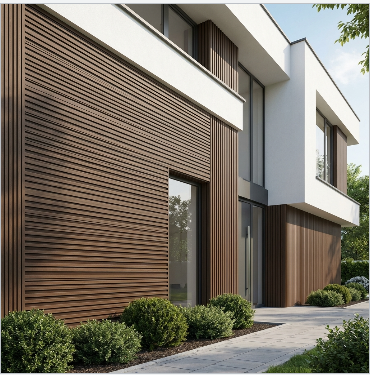
Black steel windows paired with warm wood-look fluted cladding can create a strong contrast.
Black aluminum can create a similar color relationship.
The more important technical issue is how the cladding terminates around the opening.
Coordinate flashing, WRB, drainage, sill, jamb returns, head detail, cladding trim, expansion and frame position.
Window Frame Depth Matters
Width and height are only two dimensions.
Frame or jamb depth also needs to coordinate with the wall.
A wall may contain interior drywall, wood framing, sheathing, exterior insulation, furring, rainscreen cavity, WPC, stucco, stone or brick.
The window does not automatically extend through every visible layer.
Rough Opening Is Separate From Window Size
Do not choose either steel or aluminum and then frame the opening from the catalog name alone.
There are several different dimensions:
Nominal size — the product or planning designation.
Actual frame size — the outside dimension of the manufactured unit.
Rough opening — the structural opening prepared for installation.
Daylight opening — the visible glass area.
These dimensions are related. They are not interchangeable.
For steel windows, review our How to Measure for Steel Windows guide.
Installation Quality Can Erase Product Quality
A premium window installed poorly can perform poorly.
Regardless of frame material, installation should address level, plumb, square, anchorage, flashing, sill pan where applicable, sealant, drainage, insulation, interior air sealing and exterior water management.
Which Is Easier to Install?
Aluminum's lower weight can make handling easier.
Steel units may require more labor because of their weight.
But installation difficulty also depends on opening size, story height, access, masonry, glass weight, equipment, anchoring and frame geometry.
Which Is Better for Renovations?
Both can work.
The key issue is the existing opening.
Renovation projects can contain hidden conditions such as masonry returns, damaged framing, uneven openings, old flashing, plaster, embedded steel and nonstandard jamb depths.
Measure the structural opening—not only the old sash.
Historic and Transitional Architecture
Steel has a particularly strong connection to historic industrial, Art Deco, European, early-modern and institutional architecture.
That makes it useful when a project wants an authentic metal-window character rather than merely a black frame.
Aluminum may still be appropriate where cost, weight, availability or the exact system make it the better fit.
Which Material Lasts Longer?
Do not assign a universal lifespan to either category.
Service life depends on environment, finish, maintenance, drainage, hardware, glazing seals, installation and usage.
A poorly maintained steel window can deteriorate.
A poorly installed aluminum window can also fail.
The Seven Questions That Matter Most
- What sightline does the architecture require?
- Is the window fixed or operable?
- What is the complete glazing specification?
- What thermal performance is required?
- What exposure will the window face?
- What total installed price applies?
- What documentation supports the exact product?
If you can answer those seven questions, the material choice usually becomes much easier.
When Steel Makes the Most Sense
Steel deserves serious consideration when architectural proportion is a primary design objective, the project wants authentic steel-window character, narrow-looking grids are important, the design uses custom lite patterns, unusual shapes are required, long-term material character matters or the window is a visual focal point.
When Aluminum May Make More Sense
Aluminum may be the better fit when weight is a major consideration, a standardized commercial system is preferred, the budget does not support custom steel, the desired aluminum profile already produces the required appearance, large quantities favor a specific aluminum system or the project team already has compatible storefront or curtain-wall assemblies.
Frequently Asked Questions
Are steel windows better than aluminum windows?
Not universally. Steel can provide distinctive architectural proportions and substantial construction, while aluminum offers lower weight and broad system availability. Compare the exact window systems.
Are steel window frames thinner than aluminum?
Steel is often used to create refined architectural profiles, but visible sightline varies by window system. Always compare profile drawings or actual samples.
Are aluminum windows cheaper than steel?
They often are at the entry and mid-market levels. Premium thermally broken aluminum and highly engineered systems can narrow the price difference. Use actual project quotes.
Are steel windows energy efficient?
They can be. For exterior conditioned spaces, evaluate the complete frame, thermal design and glazing package. Use whole-window performance documentation.
Are aluminum windows energy efficient?
They can also be. Metal frames benefit from thermal breaks, and whole-window U-factor and SHGC should be reviewed for the exact configuration.
Which is better in hot climates?
Do not choose solely by material. SHGC, U-factor, Low-E coating, orientation, shading and installation all affect performance.
Which is better in cold climates?
Again, compare the whole window. Pay particular attention to U-factor, thermal breaks, edge-of-glass conditions, air leakage and condensation performance.
Which is more resistant to corrosion?
Aluminum naturally forms a protective oxide layer. Steel requires a suitable protective finish system. But exposure, coating quality, scratches, fasteners and maintenance matter for both.
Are steel windows harder to install?
They can require more handling because they are heavier. The actual difficulty depends on unit size, glass, opening and installation conditions.
Can steel windows be customized?
Yes. Custom fabrication is one of the major reasons architects and homeowners choose steel.
Can steel windows be used with exterior WPC cladding?
Yes, when the wall assembly and opening details are properly coordinated. Plan flashing, drainage, frame position, WPC returns and trims together.
Which should I choose for a luxury home?
Choose based on the architecture. If the design depends on authentic steel character and refined grids, steel may be the better fit. If a premium aluminum system achieves the required proportions, performance and budget, aluminum may be entirely appropriate.
The Bottom Line
The steel-vs.-aluminum question should not be reduced to one material being “better.”
Both can produce excellent architectural windows.
Steel's appeal comes from its structural character, refined proportions and unmistakable material presence.
Aluminum's strengths include lower weight, broad availability and a large range of modern systems.
The best buying process is:
Choose the architectural look → define the operation → confirm the dimensions → specify the glass → compare thermal performance → review finish → compare complete pricing → verify documentation
Do that, and the material decision becomes much clearer.
For projects where steel provides the right architectural language, explore the current USA Builders Depot Steel Windows collection and compare fixed, casement, awning, push-out, round, oval and combination configurations.
For additional planning, see our Steel Window Cost Guide, Residential Metal Windows Guide, custom steel window manufacturer guide, and Architect & Specifier Center.
Written by USA BUILDERS DEPOT