
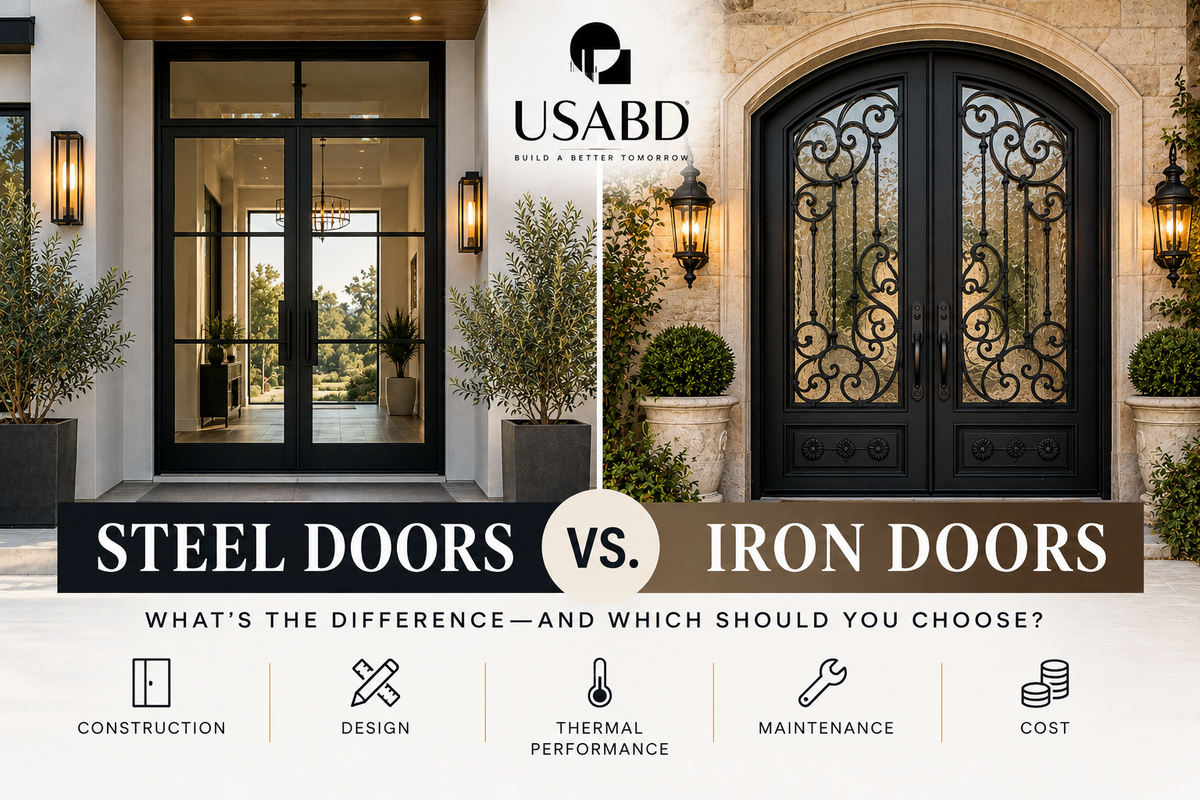
Steel Doors vs. Iron Doors: What’s the Difference—and Which Should You Choose?

Search for a black metal front door and you will quickly run into several different names.
Steel door. Iron door. Wrought iron door. Steel French door. Modern iron door. Architectural steel door.
At first, it sounds as though each name identifies a completely different material.
In the modern door market, it is not always that simple.
Many products sold as “iron doors” are actually fabricated primarily from steel. Other products called “steel doors” may refer to very different constructions—from thin steel skins over an insulated core to heavy welded steel-and-glass architectural doors.
That makes the buying decision less about the label on the category page and more about the actual construction of the door.
If you are comparing steel and iron entry doors, the better questions are:
- What metal is actually used?
- How thick is it?
- How is the frame constructed?
- What glass system is included?
- Is there a thermal break?
- How is the door finished?
- What hardware preparation is provided?
- What technical documentation applies to the exact configuration?
This guide explains the terminology so homeowners, builders, designers and architects can compare metal entry doors more intelligently.
The Short Answer
In today's residential door market, the terms steel door and iron door can overlap.
A modern “iron door” may actually be fabricated from steel but designed in the visual tradition of ornamental ironwork.
A modern architectural steel door is usually associated with cleaner geometry, large areas of glass, narrow metal profiles and contemporary or transitional architecture.
The important distinction is therefore often:
ornamental metal-door design vs. architectural steel-and-glass design
rather than simply:
iron vs. steel
Always verify the exact product specification before assuming the material from the marketing name alone.
What Is Steel?
Steel is an alloy based primarily on iron with controlled carbon and other alloying elements.
Its combination of strength, consistency, weldability and manufacturability makes it one of the most widely used construction materials in the world.
For door fabrication, steel can be formed into frames, door leaves, muntins, reinforcement, glazing surrounds and structural profiles.
But the term steel door covers several very different products.
- a conventional insulated residential entry door with steel face sheets
- a commercial hollow-metal door
- a welded architectural steel-and-glass door
- a heavy fabricated metal entrance with divided glass lites
- a thermally improved steel door system
Those products should not be compared as though they are identical simply because all contain steel.
What Is Wrought Iron?
Historically, wrought iron was a distinct iron material that was heated and mechanically worked into shape.
It was commonly used for gates, fences, railings, balconies and decorative architectural metalwork.
True wrought iron is now a specialty material rather than the standard metal used for most newly manufactured decorative doors.
That means the phrase “wrought iron door” in today's market often describes a design tradition rather than the literal historical material.
A modern door marketed as wrought iron may actually use mild steel or another steel construction shaped and finished to create the appearance associated with traditional ironwork.
That is not automatically a problem.
It simply means buyers should ask: What is the actual base metal?
Why Are Some Steel Doors Called Iron Doors?
Part of the reason is history.
Decorative metal entrances have been called iron doors for generations.
Architectural styles such as Mediterranean, Spanish Colonial, French Country and Tuscan often used elaborate metalwork associated with blacksmithing and ornamental iron.
As modern fabrication shifted toward steel, the architectural vocabulary remained.
Today, iron door can describe the style customers recognize even when the product is fabricated from steel.
For purchasing and specification, the product documentation matters more than the category label.
Steel Door vs. Iron Door at a Glance
| Consideration | Modern Architectural Steel Door | Traditional Iron-Style Door |
|---|---|---|
| Typical design language | Clean, linear, minimal | Decorative, ornamental |
| Common architecture | Modern, transitional, industrial | Mediterranean, Spanish, traditional |
| Glass area | Often large | Varies |
| Grid design | Straight, geometric | Can include scrolls and decorative work |
| Actual metal | Steel | Frequently steel-based; verify exact product |
| Custom fabrication | Common | Common |
| Thermal performance | Depends on exact construction | Depends on exact construction |
| Maintenance | Depends on coating and exposure | Depends on coating and exposure |
| Weight | Often substantial | Often substantial |
| Installation | Requires correct opening and anchorage | Requires correct opening and anchorage |
The Biggest Difference Is Often Design
Modern Steel Doors
Modern steel doors tend to emphasize straight lines, large glass areas, narrow metal divisions, restrained geometry, clean black finishes, tall proportions and minimal ornament.
Instead of making the metal itself decorative, the architecture often comes from the relationship between the glass and the frame.
Iron-Style Doors
Traditional iron-style doors may emphasize scrollwork, decorative overlays, hammered textures, curved forms, ornamental panels, arched tops, decorative glass cages and old-world detailing.
These doors can work beautifully with architecture that calls for that vocabulary.
Neither approach is automatically more luxurious. The better choice is the one that fits the building.
Modern Architecture Usually Favors Restraint
On a contemporary house, every line matters.
The façade may already contain large windows, stone, stucco, wood-look cladding, metal roofing and clean reveals.
Adding highly ornamental metalwork can compete with that composition.
That is why modern and transitional projects frequently use steel-and-glass doors with simple geometric divisions.
Traditional Architecture May Benefit From Ornament
A highly minimal steel door is not the right answer for every house.
Mediterranean, Spanish Revival, French Country and other traditional styles may benefit from arches, scrolls, textured metal, decorative pulls, divided glass and ornamental details.
Choose the door for the building—not the trend.
Do Iron Doors Use Thicker Metal Than Steel Doors?
You cannot determine thickness from the category name.
One manufacturer may call a heavy fabricated door an iron door. Another may call a similarly constructed product a steel door.
Another “steel door” may be a completely different lightweight skin-over-core product.
That is why gauge, wall thickness, profile construction and door-leaf design should be reviewed on the exact product.
Does Heavier Mean Better?
Not automatically.
Weight can indicate substantial metal construction, but it also creates engineering and installation considerations.
A heavy door places greater demands on hinges, frame, anchors, header, rough opening, wall construction and threshold support.
A properly engineered lighter assembly can perform better than a poorly detailed heavier one.
Which Is Stronger: Steel or Iron?
This question sounds simple but becomes misleading in a finished door.
Material strength is only one factor.
Door performance also depends on profile geometry, metal thickness, weld quality, frame construction, hinges, lock preparation, glazing retention, anchors and installation.
A marketing claim that one door is “stronger” because of the word steel or iron does not tell you enough.
Which Is More Secure?
Again, the material name alone cannot answer the question.
Security depends on how the complete entry system is designed.
Important components include door leaf, frame, glass, glazing retention, lock, hinges, strike area and installation.
A steel door with weak hardware can be less secure than a properly engineered metal door with better hardware and anchorage.
Steel Door Glass Changes the Comparison
Many architectural metal doors contain substantial glass.
On some modern designs, the glass occupies most of the visible door area.
That means the glazing system becomes a major part of the performance discussion.
Ask about pane count, Low-E coating, tempered glass, laminated glass where applicable, privacy options, insulated glass, spacer construction and impact documentation where required.
Read our Steel Door Glass Explained guide for more detail.
Tempered Glass Does Not Mean Impact-Rated
This distinction matters for both steel and iron-style doors.
Tempered glass is a type of safety glazing.
Impact certification is a performance requirement for a tested assembly.
The two should not be treated as interchangeable.
A door requiring hurricane, wind-load, Florida Product Approval or another regulated performance standard should be supported by documentation for the exact product and configuration.
Which Is More Energy Efficient?
Neither category automatically wins.
Metal conducts heat.
The energy performance of a metal door depends on how the complete assembly manages that conductivity.
Important features may include thermal breaks, insulated cavities, foam-filled profiles, insulated glass, Low-E coatings, weatherstripping, threshold design, sweeps and air sealing.
A well-designed thermally improved steel door can perform very differently from a non-thermally-broken ornamental metal door.
For climate-sensitive projects, request documentation for the exact configured product.
What Is a Thermal Break?
A thermal break separates conductive metal surfaces with a lower-conductivity material.
Without that separation, metal can create a continuous thermal path between exterior and interior surfaces.
That can affect heat transfer, interior surface temperature, condensation risk and comfort.
Read our Thermal Break Steel Doors Guide for more detail.
Can Steel or Iron Doors Condensate?
Any exterior door can experience condensation if surface temperature falls below the dew point of the surrounding air.
Metal doors deserve particular attention because conductive frames can become cold under winter conditions.
Condensation can be influenced by outdoor temperature, indoor humidity, thermal break, glass, spacer system, threshold, air leakage and installation.
Which Requires More Maintenance?
If both products are steel-based, their maintenance requirements may be more similar than the marketing names suggest.
The key issue is usually the protective finish.
Exterior metal doors rely on coatings to isolate the base metal from the environment.
The important question is: What finish is actually on this exact door?
Exterior exposure can include rain, humidity, salt, pollutants, UV, scratches and landscaping chemicals.
Review our Steel Door Rust Prevention & Maintenance Guide.
Does Iron Rust?
Iron-based materials can corrode. So can steel.
The practical corrosion resistance of a finished door depends greatly on surface preparation, primer, galvanizing where applicable, e-coating where applicable, powder coating or finish system, cut-edge protection, maintenance and environmental exposure.
What About Coastal Homes?
Coastal projects require more careful specification.
Salt exposure can be aggressive toward base metals, coatings, hinges, screws, fasteners, thresholds and lock hardware.
Before using any metal exterior door near the coast, confirm the manufacturer's applicable exposure requirements, finish limitations and maintenance recommendations.
Which Costs More?
There is no reliable universal answer.
The price of an architectural metal door can be influenced by size, single vs. double configuration, steel thickness, glass, thermal-break construction, hardware, finish, decorative work, arches, sidelights, transoms, custom dimensions, freight and installation.
Compare actual project quotes.
Compare the Complete Cost
Do not compare Door A: $3,500 with Door B: $5,500 until you know what each price includes.
One quote may include frame, glass, threshold, hinges, weatherstripping, lock preparation and crating while the other may not.
You may also need to account for freight, tax, installation, hardware, opening modification and masonry work.
Which Is Better for Double Doors?
Both modern steel and ornamental metal systems can work well as double doors.
The important issues are mechanical.
Confirm active leaf, inactive leaf, flush bolts, astragal, meeting stile, threshold, weather seals, lock preparation, handing and swing direction.
See our Double Steel Door Hardware Guide.
What About Sidelights and Transoms?
Metal doors are often used as part of larger entrance assemblies.
A single door may be combined with one sidelight, two sidelights, transom or sidelights plus transom.
These features can significantly change the weight, glass area, rough opening and appearance of the entrance.
Custom Fabrication
Custom fabrication is one of the main reasons homeowners and designers choose architectural metal doors.
Custom options may include nonstandard widths, taller heights, double doors, sidelights, transoms, glass patterns, grid layouts, hardware preparation, custom finishes and arched configurations.
The more custom the product becomes, the more important approved drawings become.
Shop Drawings Matter
For custom metal doors, a shop or fabrication drawing can help confirm overall frame size, door-leaf size, glass pattern, handing, swing, hardware location, jamb depth, threshold, sidelights, transom and finish.
Review those details before production.
Rough Opening Is Not Door Size
This distinction causes many installation problems.
The dimensions of the finished door assembly are not necessarily identical to the framed rough opening.
Installers need allowance for setting, shimming, anchorage, flashing, sealant and leveling.
Use the manufacturer's current installation documentation rather than a universal rule.
See our Steel Door Rough Opening Guide.
Installation Matters More With Heavy Doors
Large metal doors can be heavy.
A tall double-door assembly may require multiple installers or lifting equipment.
The installer should verify opening dimensions, wall construction, header, sill, drainage, floor height, exterior finish, interior finish and anchor locations.
Which Door Is Better for Modern Homes?
For many contemporary and transitional projects, modern steel-and-glass doors offer a natural fit.
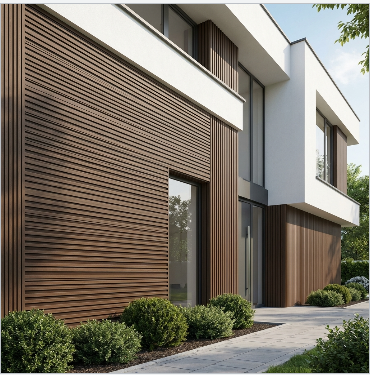
They work particularly well when the architecture uses black windows, large glazing, stone, stucco, WPC cladding, wood accents and clean geometry.
Which Door Is Better for Traditional Homes?
Traditional iron-style doors can be very effective when the architecture uses arches, heavy stone, decorative columns, Mediterranean details, wrought-metal balconies, ornate lighting and traditional landscaping.
The ornament can become part of the architecture.
What Should You Ask Before Ordering?
Before purchasing a door marketed as steel, iron or wrought iron, confirm the actual construction.
- Exact base metal
- Metal thickness or applicable construction details
- Door-leaf construction
- Frame construction
- Glass specification
- Thermal-break configuration
- Weatherstripping
- Threshold construction
- Hardware preparation
- Finish system
- Rough-opening requirement
- Handing and swing
- Sidelight or transom details
- Current applicable technical documentation
- Lead time and freight requirements
If the supplier cannot clearly explain what the product actually is, the category name is not enough.
Frequently Asked Questions
Are iron doors actually made of iron?
Some may contain iron components, but many modern products sold as iron or wrought-iron doors are fabricated largely from steel. Verify the exact manufacturer's material specification.
Is wrought iron the same as steel?
No. Historically, wrought iron and steel are different ferrous materials. However, the term wrought iron is now frequently used as an architectural style description for modern steel-fabricated ornamental products.
Are steel doors stronger than iron doors?
You cannot determine finished door strength from those labels alone. Metal type, thickness, frame geometry, welds, reinforcement, hardware and installation all matter.
Are iron doors more secure?
Not automatically. Security depends on the complete door assembly, including frame, anchors, glass, hinges, locks, glazing retention and installation.
Are steel doors more modern-looking?
Architectural steel doors are frequently associated with minimalist and contemporary design because they often use straight grids and large glass areas.
Are steel doors energy efficient?
They can be. Thermal performance depends on the exact frame design, thermal separation, glass, insulation, weather seals, threshold and complete tested assembly.
Are iron doors energy efficient?
Some modern metal doors sold as iron doors incorporate insulation and thermal improvements. Others do not. Verify the exact configuration rather than relying on the category name.
Which costs more: steel or iron doors?
The ranges overlap. Door size, glass, thermal construction, decorative fabrication, hardware, finish, freight and installation can have more influence on price than the label steel or iron.
Do steel doors rust?
Bare steel can corrode when exposed to moisture and oxygen. Quality exterior doors rely on protective finish systems, and damaged coatings should be maintained according to the manufacturer's instructions.
Do iron doors rust?
Iron-based products can also corrode. The finish system and environmental exposure are critical.
Which is better for coastal areas?
Do not choose by material name alone. Coastal suitability depends on the exact metal, coating, hardware, fasteners, exposure rating and maintenance requirements.
Are steel French doors the same as iron French doors?
The terms may refer to similar fabricated metal-and-glass products depending on the manufacturer. Compare the actual construction rather than assuming the names identify different products.
The Bottom Line
The biggest mistake when comparing steel and iron doors is assuming the category name tells you exactly how the door is built.
It often does not.
A door marketed as iron may be fabricated primarily from steel.
A door marketed as steel may be anything from a conventional insulated entry slab to a heavy architectural steel-and-glass assembly.
The better buying method is:
Material + Construction + Glass + Thermal Design + Finish + Hardware + Installation + Documentation
For modern architecture, clean steel-and-glass designs can provide the narrow grids, large glass areas and restrained geometry many projects are looking for.
For traditional architecture, ornamental iron-style designs can provide the decorative character that better suits the building.
Choose the architecture first.
Then verify the construction.
Then confirm the exact product documentation before ordering.
Explore the current Residential Steel Doors & Frames collection and review the Steel Door Technical Resources before finalizing a project-specific specification.
For additional planning, see our Steel Door Hardware Preparation Guide and Architect & Specifier Center.
Written by USA BUILDERS DEPOT