
Article: WPC Cladding Cost in 2026: Price Per Square Foot & Project Budget Guide
WPC Cladding Cost in 2026: Price Per Square Foot & Project Budget Guide
A customer sees a WPC exterior panel listed for $45 or $83 and asks a reasonable question:
How much will my wall actually cost?
The answer is not simply panel price × wall square footage.
Exterior cladding has several cost layers. The visible boards are only one of them.
A complete project can also involve trims, clips, fasteners, furring or subframing, flashing, water-resistive barriers, access equipment, freight, labor, wall repairs, waste, openings, corners and project-specific installation requirements.
That is why two homeowners can buy the same exterior WPC panel and end up with very different installed costs.
This guide explains how to build a realistic WPC cladding budget—and how to compare quotes without being misled by a low headline price.
Quick Answer: How Much Does WPC Cladding Cost?
As of October 5, 2026, current USA Builders Depot exterior WPC listings provide a useful real-product example.
A Brown Walnut exterior fluted WPC panel is currently listed at $83 per panel, with published coverage of 6.24 square feet per panel.
That works out to approximately:
$13.30 per covered square foot for the panel itself
before trims, fasteners, clips, freight, tax, labor, subframing or wall preparation.
A current exterior shiplap WPC panel is listed at $45 per board and publishes approximately 4.95 square feet of coverage.
That equals approximately:
$9.09 per covered square foot for the panel itself
before the remaining project costs.
These are product-specific examples—not universal WPC prices.
Different profiles, manufacturers, finishes, dimensions, quantities and installation systems can change the number substantially.
Why WPC Cost Numbers Online Are So Different
Search online for WPC or composite siding cost and you may see dramatically different numbers.
One guide may say $8 per square foot. Another may say $25. Another may quote a price per linear foot, board, square meter or carton.
The numbers can all appear legitimate while describing completely different things.
That is because “composite siding” is not one standardized product.
The category can include thin siding boards, capped composite boards, fluted architectural panels, shiplap profiles, lap siding, hollow profiles, solid profiles, different fastening systems, different lengths and widths and different trim systems.
A deep fluted architectural façade panel should not be assumed to cost the same as a basic lap-siding board.
Start With the Exact Product
The most reliable way to estimate a WPC project is to start with the actual panel being purchased.
You need four numbers:
- Price per panel
- Effective coverage per panel
- Packaging quantity
- Minimum order
Do not calculate from nominal dimensions alone.
Some panel systems overlap. Others interlock.
The visible or effective coverage may therefore be smaller than the total physical width of the board.
Use the published coverage for the exact product whenever available.
Current USA Builders Depot WPC Cost Examples
| Current example | Fluted WPC | Shiplap WPC |
|---|---|---|
| Example panel price | $83 | $45 |
| Published coverage | 6.24 sq. ft. | 4.95 sq. ft. |
| Approx. panel-only cost | $13.30/sq. ft. | $9.09/sq. ft. |
| Pieces per box | 4 | 4 |
| Current minimum | 8 pieces | 12 pieces |
Prices and availability can change. Always use the current product page when placing the order.
Panel Price Is Not Installed Cost
This distinction is the most important part of WPC budgeting.
A panel-only price tells you what the visible material costs. An installed wall may require considerably more.
A complete exterior-cladding budget can contain:
- Panels — the main visible cladding.
- Corner trims — needed where walls turn or where a finished corner detail is required.
- Edge trims — used at exposed panel edges and selected terminations.
- Clips and fasteners — the exact attachment method depends on the selected panel system.
- Furring or substructure — many installations need a support system behind the panels.
- Water-resistive barrier — the cladding should not automatically be treated as the building's sole water-control layer.
- Flashing — particularly important around windows, doors, roof intersections and horizontal transitions.
- Labor — cutting, layout, fastening, openings, corners and access affect labor significantly.
- Freight — long exterior panels can require freight rather than ordinary parcel shipping.
- Tax — depends on the order and destination.
- Wall preparation — existing siding removal, repairs, flattening or substrate correction can change the project dramatically.
- Access — a single-story accent wall and a three-story façade are not equivalent installations.
Fluted WPC vs. Shiplap WPC Cost
Profile selection can have a major effect on material cost.
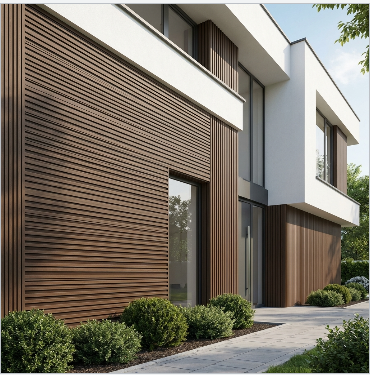
Fluted WPC
Fluted panels create pronounced vertical or horizontal shadow lines.
The deeper architectural profile tends to produce more visual texture.
That makes fluted WPC especially popular for entrance volumes, feature façades, garage returns, commercial entrances, courtyard walls and modern residential accents.
Explore our exterior fluted WPC cladding.
Shiplap WPC
Shiplap profiles create a flatter, more continuous cladding appearance.
They can work well on long horizontal elevations, modern residential siding, soffit-adjacent walls, garden structures, commercial feature walls and mixed-material façades.
Explore our exterior shiplap WPC cladding.
A 100-Square-Foot Material Example
Suppose your project contains approximately 100 square feet of net wall area.
Using a fluted panel with approximately 6.24 square feet of coverage:
100 ÷ 6.24 = approximately 16.03
Since partial panels cannot be ordered, the mathematical requirement becomes at least 17 panels.
But if the product is sold in full boxes of four, the order needs to be rounded to the next complete box.
That results in:
20 panels
At $83 each:
$1,660 panel cost
Those 20 panels provide approximately 124.8 square feet of published panel coverage.
That is not the final project cost. It is only an illustration of how packaging can affect material purchasing.
The same 100-square-foot wall using shiplap
At approximately 4.95 square feet per panel:
100 ÷ 4.95 = approximately 20.2
The project therefore requires at least 21 boards mathematically.
Rounded to complete four-piece boxes:
24 boards
At $45 each:
$1,080 panel cost
Those boards provide approximately 118.8 square feet of published panel coverage.
Again, this excludes accessories, freight, labor and other project requirements.
Why You Should Not Automatically Add “10% Waste”
Builders often hear rules such as “Always add 10%.”
That can be useful as a rough early assumption, but it is not a substitute for a layout.
WPC waste depends on panel length, wall height, installation orientation, windows, doors, corners, returns, panel pattern, whether offcuts can be reused, box quantity and damaged-piece contingency.
The better method is:
draw the elevation → lay out the boards → identify cuts → calculate packaging → add a deliberate contingency
That produces a defensible quantity.
Do Not Use House Floor Area to Price Cladding
A 3,000-square-foot house does not automatically have 3,000 square feet of exterior cladding.
Floor area and wall area are different measurements.
To estimate façade material, use exterior elevations.
For each wall:
Width × Height = gross wall area
Then account for large openings according to your takeoff method.
After that, calculate the actual cladding zones.
Openings Can Increase Cost Even When They Reduce Square Footage
A window removes wall area, but every opening creates detailing.
Around a window, installers may need to coordinate head flashing, sill condition, jamb returns, trim, edge pieces, drainage, water-resistive barrier, cut panels, expansion allowance and sealant joints.
The result can be fewer square feet of panel but more labor per square foot.
That is why a 300-square-foot blank wall can sometimes be easier to clad than a 200-square-foot façade containing several windows and doors.
See our guide to WPC cladding around windows and doors.
Corners Affect Cost
Exterior corners require a decision.
A project may use matching WPC corner trim, metal corner trim, manufacturer-specific accessories or another approved architectural termination.
The correct detail depends on the system.
Do not calculate only the flat wall and discover the corner detail after the material arrives.
The Subframe Can Change the Budget
Exterior cladding is often installed over some form of support or furring system.
The exact requirement depends on substrate, wall assembly, panel, installation orientation, drainage strategy, insulation and fastener requirements.
A WPC retrofit over an existing masonry wall can therefore have a very different cost structure from installation over prepared new-construction sheathing.
See our guide to installing WPC over stucco, brick or concrete.
Do Not Remove the Water-Control Budget
Exterior WPC cladding is the visible finish.
That does not automatically make it the entire water-control system.
An exterior wall may need WRB, drainage space, flashing, sill detailing, head flashing, properly terminated openings, ventilation and compatible sealants.
Those items may not appear in a panel quote, but they can be essential to the wall assembly.
Expansion and Movement Matter
WPC is a composite material.
Exterior temperature changes can cause movement.
The required installation allowance depends on the exact profile, board length, fastening method, temperature and manufacturer's instructions.
There is no universal expansion gap that should be copied across every WPC product.
Review our WPC Cladding Expansion Gaps Guide.
Labor Cost Depends on Geometry
Contractors do not price every square foot equally.
Labor typically increases when the project contains multiple stories, scaffolding, lifts, many corners, narrow returns, curved surfaces, penetrations, windows, doors, diagonal layouts, difficult access, demolition, damaged substrate or unusual transitions.
This is why an online national labor figure should be treated as planning context—not a quote for your project.
Freight Can Matter More Than Expected
Exterior cladding boards are long.
Long products are different from ordering a box of small hardware.
Depending on panel length, order quantity and destination, material may require freight shipping, palletization, residential delivery, commercial delivery, liftgate service or jobsite coordination.
Do not compare two suppliers until you know whether freight is included.
The Five Prices You Should Separate
1. Panel Cost
What are the actual cladding boards?
2. Accessory Cost
What trims, clips, screws and finishing pieces are required?
3. Wall-System Cost
What furring, WRB, flashing, drainage and related building-envelope components are required?
4. Installation Cost
What will the contractor charge to install the complete scope?
5. Landed Project Cost
What is the actual amount after freight, tax, access equipment, removal, disposal and other project-specific costs?
This prevents a very common mistake: comparing one supplier's panel-only price against another contractor's complete installed price.
What Should Be Included in a WPC Quote?
| Cost item | Included? |
|---|---|
| Main panels | Confirm |
| Exact profile and finish | Confirm |
| Panel dimensions | Confirm |
| Effective coverage | Confirm |
| Corner trims | Confirm |
| Edge trims | Confirm |
| Clips | Confirm |
| Screws / fasteners | Confirm |
| Subframing / furring | Confirm |
| WRB | Confirm |
| Flashing | Confirm |
| Sealants | Confirm |
| Freight | Confirm |
| Tax | Confirm |
| Labor | Confirm |
| Access equipment | Confirm |
| Old siding removal | Confirm |
| Wall repair | Confirm |
| Waste allowance | Confirm |
| Spare material | Confirm |
If the quote simply says “WPC siding — $X per square foot”, ask what that number actually contains.
Does Dark WPC Cost More?
Color alone does not universally determine price.
Some product families use the same price across multiple finishes.
Others charge more for premium surfaces, specialty textures, custom colors or different cap layers.
Check the exact current product page before assuming one color carries the same price as another.
Does Vertical Installation Cost More Than Horizontal?
Not automatically.
Orientation affects layout.
That can change subframe direction, cut quantities, board lengths, joints, openings, waste and visual alignment.
The correct orientation should be planned around both architecture and the installation requirements of the exact profile.
WPC Cost vs. Fiber Cement
WPC and fiber cement should not be compared only by board price.
They create different architecture.
WPC is particularly strong when the design calls for fluted texture, wood-inspired appearance, deep shadow lines, warm contemporary façades and dimensional feature areas.
Fiber cement is commonly used for lap siding, flat panels, painted façades and broader cementitious wall surfaces.
Read our WPC vs. Fiber Cement Siding guide for the full comparison.
Can WPC Be Used Only as an Accent to Reduce Cost?
Yes—from a design standpoint, WPC does not have to cover the entire building.
Many modern elevations use WPC strategically.
For example:
Main walls: stucco or fiber cement
Entry volume: WPC fluted cladding
Garage projection: WPC accent
Stone: base or chimney
Steel door: entry focal point
This can concentrate the more dimensional material where it has the greatest visual impact.
Where WPC Often Creates the Most Visual Value
If the budget is limited, consider placing architectural cladding where people actually experience the building.
High-impact locations often include main entrance, front façade feature volume, garage projection, courtyard, outdoor kitchen wall, covered patio, commercial entry, signage wall and garden structures.
Should You Buy Extra Material?
Usually, some contingency is sensible.
But the amount should come from the layout.
You may want extra material because future production runs can vary slightly, one board could be damaged during installation, a future repair may need a matching piece or unusual cuts may produce unusable remnants.
Should WPC Cost Be Compared on Price Per Panel?
No.
Price per panel is useful only when every panel has identical coverage.
The correct comparison is:
price ÷ effective coverage
Then compare the complete wall system.
Should WPC Cost Be Compared Per Linear Foot?
Usually not when estimating wall coverage.
Linear-foot pricing can help compare boards with identical widths.
For a façade budget, square-foot coverage is generally more useful because wall area is measured in square feet.
Use linear feet for items such as trims, corners, starter pieces and selected rails.
Use effective square-foot coverage for the main field panels.
Frequently Asked Questions
How much does WPC cladding cost per square foot?
There is no single universal WPC price. Current USA Builders Depot product examples work out to roughly $9.09 per covered square foot for a selected exterior shiplap board and around $13.30 per covered square foot for a selected exterior fluted panel before accessories, freight, tax and installation. Verify the current listing before ordering because prices can change.
Is that the installed WPC price?
No. Those examples represent panel material only.
Installation may also require trims, clips, fasteners, wall preparation, furring, flashing, WRB, freight and labor.
Why do I see cheaper WPC prices online?
Products can differ dramatically in profile, thickness, finish, size, effective coverage, composition, cap construction, accessories and sales channel.
Is fluted WPC more expensive than shiplap?
It can be. Current USABD examples show a higher panel-only square-foot cost for a selected fluted profile than a selected shiplap profile, but the final comparison should always use the exact current products.
How do I calculate how many WPC panels I need?
Measure the actual cladding area.
Then divide the wall area by the published effective coverage of the selected panel.
Round upward to whole panels and then to the required package quantity.
Next, review cuts, openings and contingency.
Should I subtract windows and doors?
For a material takeoff, large openings are commonly accounted for.
But do not assume every removed square foot produces an equal cost reduction.
Windows and doors introduce trim, flashing, cuts and labor.
Does WPC need a rainscreen?
The answer depends on the exact wall assembly and product requirements.
Confirm current substrate, drainage, ventilation and support requirements rather than applying one generic detail to every profile.
Is WPC cheaper than natural wood?
That depends on the exact wood species, WPC system, finish, installation method, labor and maintenance expectations.
Compare the complete project rather than generic material families.
Is WPC cheaper than fiber cement?
Not always.
The material categories overlap in some price ranges, but architectural fluted WPC can be more expensive than standard fiber-cement siding.
Use the exact specified products.
Can I install WPC myself?
Some projects may be relatively straightforward for experienced installers or skilled DIY users.
Complex façades involving multiple stories, windows, flashing, wall-envelope detailing, unusual substrates or difficult transitions are better evaluated by a qualified contractor.
The Bottom Line
The real question is not:
“How much does one WPC panel cost?”
It is:
“How much will the complete finished wall cost?”
Start with:
Panel price ÷ effective coverage
Then add:
Panels + Trims + Fasteners + Subframe + Water Management + Freight + Labor + Project Conditions
That produces a realistic budget.
For current USA Builders Depot pricing, dimensions and availability, begin with the Exterior WPC Wall Panels & Cladding collection and confirm the exact product before building a final project estimate.
For technical planning, also review our WPC exterior cladding installation guide and Architect & Specifier Center.
Written by USA BUILDERS DEPOT